What is Authenticity in Popular Music?

I have had an interesting debate this week about the nature of authenticity in popular music – prompted by the recent revelations that Seasick Steve, the bastion of authenticity for many, turned out to be a session musician who lied about his age. It prompted the question – ‘what is authenticity’ in popular music?  Is it a universal truth or more individual? Or is it the tension between these two extremes? As mentioned in the Facebook posts below, for me, authenticity in popular music is a problematic term, as all popular music is fake to some degree. The question for me is not ‘is the music authentic’, but to what degree is it ‘inauthentic‘? Artists such as Elvis, Bowie and Lady Gaga have all overtly appropriated influences into their public personas and outputs – yet are still generally regarded as ‘authentic’. However, in the case of Seasick Steve, his persona was more disingenuously constructed – his background and age were tweaked in order to make him appear more ‘authentic’ in the lineage of the blues tradition. So, the next time SSS performs at a music festival near you – still enjoy his music, but be more aware of the authenticity mask that pervades all popular music.

Posted in Musicology | Tagged , , , | Leave a comment

Who says in academic writing: ‘I’, ‘the researcher’, ‘this study’, ‘this thesis’…?

Interesting read for post grad students.

doctoralwriting's avatarDoctoralWriting

By Susan Carter

Choosing terms for the agent in academic writing can be tricky for novices, and in my experience, not all supervisors give wise advice on the terms to use for the speaking author. This post considers choice from the perspective of textual clarity. ‘I argue that…’ could also be ‘this thesis argues that…’ or ‘the researcher argues that…’ Doctoral students must decide what nomenclature is best for their research projects.

Some writing shies away from admitting there is an author. Historically, empirical science disciplines sought objectivity; to do so, they chose to hide human agency with passive constructions, e.g., ‘It was found that’. With humans eliminated, arguments were muted, not acknowledged in text: ‘results may suggest that….’ Textual masking of agency signaled a positivist epistemology.

By disappearing the people from the text, the matter of the research itself is emphasised, since, in theory, anyone could duplicate the study…

View original post 625 more words

Posted in Musicology | Leave a comment

Starting Questions for Thinking About Music and Production.

Here are a series of questions aimed at my students, but anyone is free to comment. The exercise is chose a couple of songs and ask yourself the following.

1.Can the recorded songs communicate anything beyond the notes, sounds and textures on the record? How do they communicate ? Why do they communicate? Why do they not communicate? What do they communicate?

2.Is the meaning the songs impart  universal or personal? Again – explain your answer.

3.What ‘causes’ the music to occur? Is it the songwriter, society, the rehearsal process, a piece of technology, a producer etc? Are there any ergonomic clues in the music – what are they? What proof can you give for your answer?

Looking forward to seeing some responses.  Use this as an opportunity to try and understand what you currently think about how music communicates meaning and most importantly – is your opinion correct?

Good luck


Posted in Musicology | Tagged , | 9 Comments

Popular Music in Merthyr Tydfil Update

Just a quick update on my Merthyr Music project.

Well, over the last couple of months, with the help of community members, I have put together the beginnings of a community archive of popular music memorabilia, in addition to a Facebook site. I have also started the process of capturing a few memories, some of which have been captured in the project’s Sound Cloud site – I have placed a few examples below for reference.

As I go about interviewing some key members of the Merthyr Music scene of the 1955 – 1965 period, The next stage of the project will hopefully involve one of my student groups from The ATriuM engaging with the project to focus on things such as

  1. Carry out some research in order to recreate concerts from the past (such as the 1967 Pink Floyd and Love Affair gigs in Merthyr) in an attempt to understand the broader context that this music making took place in. What equipment did the band use, what did the stage set up look like, what do audience members who attended the original concerts remember?
  2. Recreate exact and reworked versions of songs by artists such as The Man and The Bystanders.
  3. Consider technologies such as ibeacons to disseminate the archive, concert materials and recorded footage to the general pubic
  4. Provide a training programme that encourages the community to record their memories remotely – using appropriate technologies.
  5. Devise school/college workshops that help students engage with their local history
  6. Compose GPS based compositions of the town using apps such as sonic maps. For an example of this, click here.

So watch this space. In the meantime, watch the trailer of the project above.


Posted in Merthyr, Merthyr Music Project, Musicology | Tagged , , | 1 Comment

Benjamin Halligan: Mind Usurps Program: Virtuality and the ‘New Machine Aesthetic’ of Electronic Dance Music

Here is an audio recording of a talk given by Dr Ben Halligan at the recent IASPM Uk & Ireland conference in Brighton on September 8th. The talk was related to the chapter that Ben documented f…

Source: Benjamin Halligan: Mind Usurps Program: Virtuality and the ‘New Machine Aesthetic’ of Electronic Dance Music

Posted in Musicology | Tagged | Leave a comment

An Analysis of Virtuality in the Creation and Reception of the Music of Frank Zappa

Here is a transcript of the paper Paul Carr gave at the IASPM conference in Brighton, in September 2016 Introduction My chapter in the book discusses the creation and reception of the music of Fran…

Source: An Analysis of Virtuality in the Creation and Reception of the Music of Frank Zappa

Posted in Musicology | Leave a comment

Frank Zappa and Virtuality

Screen Shot 2016-02-20 at 22.55.47

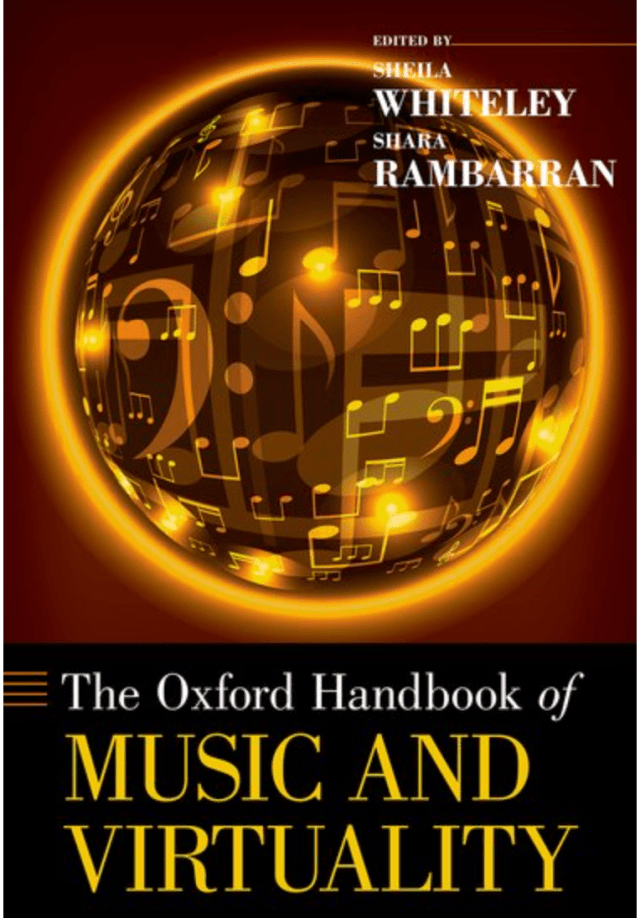
Well, I am really looking forward to talking about Frank Zappa for the first time in a couple of years this week. I am presenting at a panel as part of the book launch for The Oxford Handbook of Music and Virtuality, which contains a chapter from me on the ways in which Zappa’s music has a significant virtual dimension to it. The book has been edited by Shara Rambarran and the late Sheila Whiteley, so I feel really honoured to be part of the book launch, particular as the event is taking place in Sheila’s home town of Brighton. Although I have not worked my way through all of the chapters yet, the book is a fitting contribution to Sheila’s memory, being by far the most comprehensive contribution on this subject matter to date. In conjunction with Shara, we have set up a book blog, which we intend to use to encourage guest posts, in addition to opening up discussions based on the book . Although it is  still in the early stages, please feel free to have a look and sign up so you can access future posts. The blog can be accessed here.

My chapter in the book discusses the creation and reception of the music of Frank Zappa, who overtly and purposively positioned his creative output in a virtual, often teleological dimension. Through the analysis of Zappa’s music, use of the recording studio and personal philosophies such as Xenochrony, Project/Object and Big Note, the chapter draws on the work of a range of scholars from Hanslick, Hagel, Nietzsche, Heidegger and Schopenhauer, to Bernard Russell, Jennifer Robertson and Leo Treitler, ultimately examining the broader question regarding the extent to which music has the capacity to be representational and/or ‘virtual’.

So, if you are around the Brighton area this week, look forward to seeing you there. Info on the IASPM conference can be found here.

Posted in Academic, Frank Zappa, Musicology | Tagged , , , , , | Leave a comment

Music, Memory and Nostalgia: Film Makers Required

25-11-2006 10-58-20_0137

As some of you may know, I am currently working on a ‘history of popular music’ project in the town of Merthyr Tydfil – eventually moving to other regions of South Wales. The 2nd dimension to the project is related to the various ways in which music can evoke memories and nostalgia. In preparation for a conference in Prague in November,I  am working on a series of pieces of music (not all composed by me) that deal with this theme – and I am looking for those interested in filmmaking/photography to provide accompanying images to the music. The idea is to come up with a combined music/image combination that evoke memory and nostalgia in the people listening/watching. If anyone is interested please get in touch. Here are a couple of pieces to get you started – please share with anyone you think may be interested. These pieces will be considered for a month long exhibition taking place in Merthyr in January 2018.I am open to how  the images are put together, but obviously anything used needs to be cleared for copyright. I do however have a number of images that have been given permission, that can be accessed via the projects Facebook Page and History Pin page


Posted in Musicology | Tagged , , , , , | Leave a comment

Pink Floyd in Merthyr Part 2

Castle%20Cinema

Off the back of my last post on Pink Floyd playing at The Castle Cinema in Merthyr Tydfil on December 9th 1967, it appears that this would have been one of the last gigs that Syd Barrett played with the band. Interesting, of the few people who remember the gig, one person remembers Sid playing, while someone else thought the gig featured Dave Gilmour! I am not Pink Floyd expert, but I do know that Sid and Dave played together for a while in the early years of 68. So – to me it looks like this was one of Sid Barrett’s last gigs for Pink Floyd? For those who are interested, here is a collection of some of the memories that  people have.

  • ‘I saw Pink Floyd at the Castle Cinema BUT they were supporting The Herd when Peter Frampton was lead vocalist
  • Peter frampton with the Herd did’nt play a note his guitar was over his shoulder all night
  • I was there. Sat next to and chatted with Roger Waters during the interval.
  • Good friend of mine,the late Barrie Jones played support to Pink Floyd , The Herd
  • Pink Floyd played the Kee Club in Bridgend

Although there is some contention who supported who, I believe Pink Floyd actually supported The Herd that evening. If anyone has any other memories or details – please let me know. Also,  check out the Historypin link – that has loads of interesting photos of music making in South Wales.

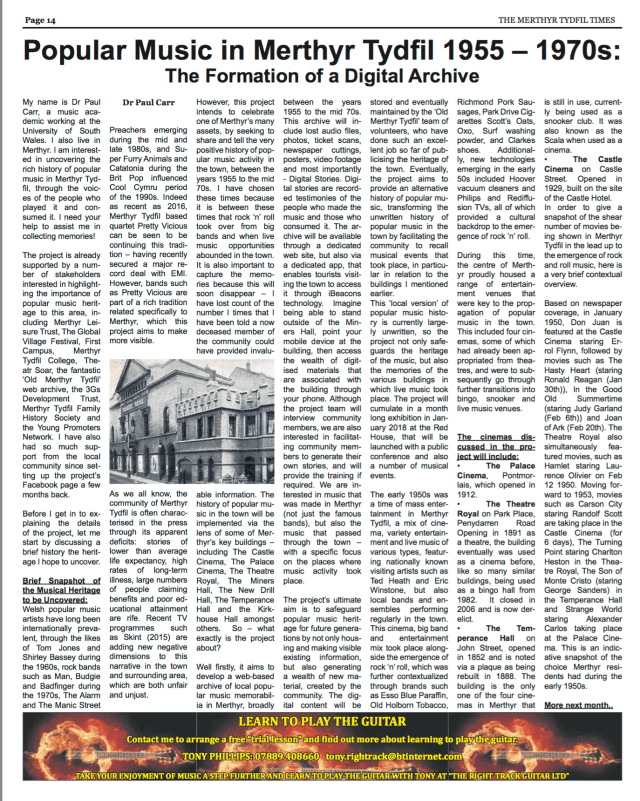
I wil finish with the first of a two part article that is printed in a local newspaper about the project.

Screen Shot 2016-08-02 at 22.14.20


Posted in Musicology | Tagged , , | 1 Comment

Pink Floyd in Merthyr: It Actually Happened!

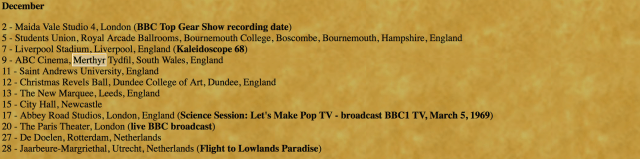
My Oral History of Popular Music in Merthyr Tydfil project is now well underway, so it now seems about the right time to do some detective work regarding the mythical performance Pink Floyd performed in the town in the 1960s at the Castle Cinema. S0, after a few mins searching on Google, I found the following evidence that they did indeed play in Merthyr, on December 9th 1968

Screen Shot 2016-07-30 at 22.40.29

What is interesting is the gigs they  played in and around then: Maida Vale Studio 4, Abbey Road Studios and Newcastle City Hall been a few of them. So what I now need is some oral testimonies of people who were either at the gig in Merthyr, or any of the other concerts in and around then. Here are a few videos which may jog your memory

Firstly, a couple of recordings made for Top Gear, on December 2nd 1968 – a week to the day prior to the Merthyr gig


And second, a recording of the full session they done in Paris on December 20th 1968 – broadcast in the early months of 1969


So, if you have any memories to share, please get in touch. If you are interested in looking at any of the images I have collected so far, access my Histrypin page here. You can also access the projects Facebook page here.

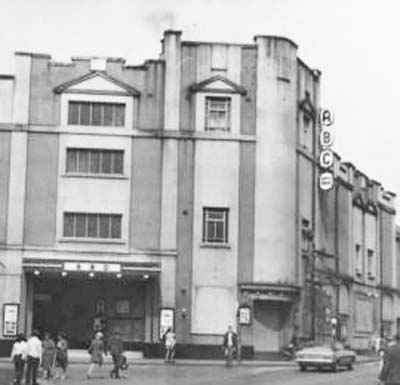
Here is a picture what the site of the concert may have looked like on the day – although the Castle Cinema is long gone!

Castle%20Cinema

Posted in Music, Musicology, Popular Music | Tagged , , | 1 Comment