How Can We Think About Popular Music?

Another very very short segment – this time concerning the ways in which we can think about popular music analysis – more detail late!

Posted in podcast | Tagged , , , , , | 2 Comments

Why Was Popular Music so Slow to Emerge as an Academic Disciplin

Here are a few thoughts about why popular music was so slow to emerge as an academic discipline. It is a two minute lecture – see if you agree

Posted in podcast | Tagged , , , , | Leave a comment

“Music was better back then”: When do we stop keeping up with popular music?

Interesting piece of research – the average age where we stop listening to new music is apparently around 33! However, is the music I listened to 20 years ago technicaly still not ‘popular’? This is a term that I have always struggled with in higher education – there being a clear difference between ‘pop’ music and ‘popular music (I try and make this clear to my students from day 1). On a different note, I am particularly interested if anyone has used the ‘Echo Nest’ service (http://developer.echonest.com). It looks complex – but would love to learn it at some point. Interesting post!

ajaymkalia's avatarSkynet & Ebert

After sixty years of research, it’s conventional wisdom: as people get older, they stop keeping up with popular music. Whether the demands of parenthood and careers mean devoting less time to pop culture, or just because they’ve succumbed to good old-fashioned taste freeze, music fans beyond a certain age seem to reach a point where their tastes have “matured”.

That’s why the organizers of the Super Bowl — with a median viewer age of 44 —  were smart to balance their Katy Perry-headlined halftime show with a showing by Missy Elliott.

Missy don't brag, she mostly boast Missy don’t brag, she mostly boast

Spotify listener data offers a sliced & diced view of each user’s streams. This lets us measure when this effect begins, how quickly the effect develops, and how it’s impacted by demographic factors.

For this study, I started with individual listening data from U.S. Spotify users and combined that…

View original post 1,228 more words

Posted in Musicology | Leave a comment

Last Exit Demo

Posted in Musicology | Tagged , | Leave a comment

Magnetic North: Sting, Place and Identity

Although I am currently in the midst of loads of marking – when the dust settles I will be spending some time during the summer finishing off the initial draft of my Sting book – currently called ‘Magnetic North: Sting, Place and Identity. Although I am disclosing no specific details at this point, what I can say is that the book will be the first to deal in detail with Sting’s background in Newcastle – and will include a number of exclusive interviews. The book will also, for the first time feature a detailed analysis of many Last Exit songs – including many that went on to success with The Police and his solo career. The section that I am most proud of are the chapters that deal with his personae and Geordie Identity. What was interesting about the latter in particular is that I found that it was therapeutic for myself – when dealing with my own identity. There are also chapters on his time in London and his protest song – which was essentially trans-national. If anyone is interested in updates – please like this Facebook Page. 

Posted in Musicology, Sting | Tagged , , , , , , , | 1 Comment

NE folk song

An area that is becoming very close to my heart – North East Folk song.

Simon McKerrell's avatarnorth east folk

Sandra Kerr discusses and introduces some North East folk songs:

Sandra Kerr discusses her views on the special characteristics of folk songs from the North East:

Pete Wood lists the top 20 NE folk songs in his opinion here with a brief discussion of the special character of these songs.

There’s also a link to Tynefolk club available here.

North East Song Tradition

The North East of England has a strong singing tradition. Its songs are varied with wide-ranging subject matter, but all with a common theme: the people, industries and landscape of the North East. The songs tell of the region’s tangled history and place in the world, of the sailors, the shipyards, the pitmen, the Border raiders, the legendary figures and the normal people.

There is a strong link between the region’s native instrument, the Northumbrian pipes, and its songs. Many Northumbrian song tunes are played on the pipes and…

View original post 852 more words

Posted in Musicology | Leave a comment

Frank Zappa, Popular Music and Politics

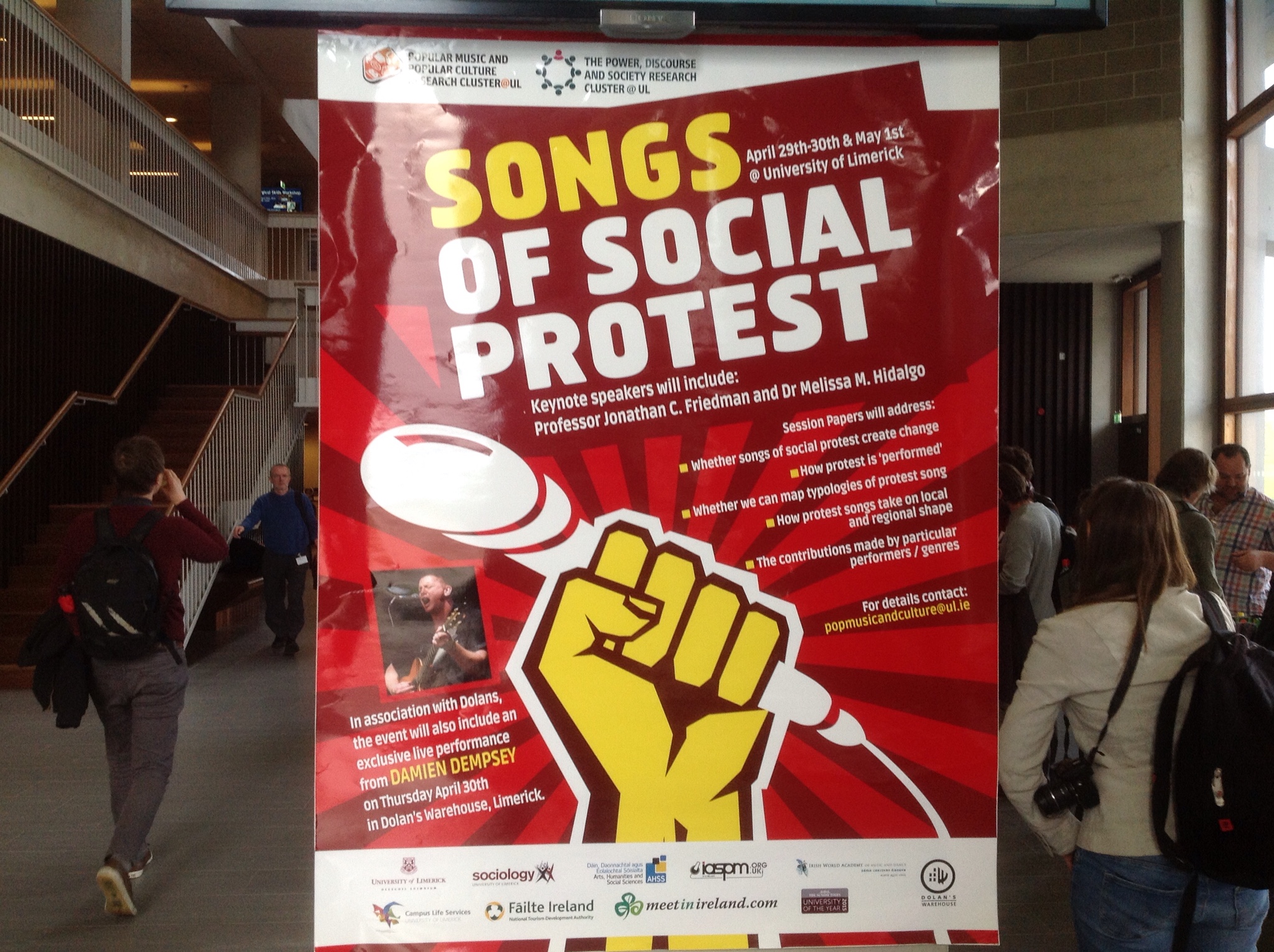
Having recently returned from a fantastic conference on ‘music and protest’ at the University of Limerick’, it got me thinking about an unpublished Zappa paper that I wrote around 7 years ago. I have copied and pasted the unedited version here – alongside the powerpoint slide that can be downloaded and flicked through while reading the document. When I interviewed Sting recently he said that the world needs more protest singers like Zappa – and this paper alludes to this. I certainly did not agree with a lot of Zappa said – but he certainly spoke his mind. Anyway – paper below.

In addition to being one of the most prolific and versatile composers of the rock idiom, Frank Zappa was also an astute and outspoken political commentator. Described as ‘the most politically potent musical force since the collaborations of Bertolt Brecht and Kurt Weill’, Zappa’s music deals directly with a range of subject areas, ranging from trade unions, American presidents, immigration, freedom of speech and the importance of using the vote. In his autobiography Zappa stated that ‘the only thing that binds nations together is the incompetence of their governments,’ and his distrust of these authority figures manifested itself in numerous non musical ways, two of which included his much publicised confrontation with Tipper Gore’s Parents Music Recourse Centre (PMRC), and his encouragement and facilitating of young Americans’ voting rights. Zappa believed that ‘unless you have people registered so they can participate in the political process, you don’t really have democracy’, and that party officials in some States actually prohibited this process. As Zappa financed the administration of his voter registration campaign himself, it can be seen to represent an altruistic aspect of his character. However, his more pervasive ‘anti – authority’ stance was demonstrated in numerous ways, including a number of debates concerning music censorship on American television throughout the late 1980’s, where he described certain sections of the American government as a ‘fascist theocracy’. Although becoming noted for his stance against the ‘Christian values’ of the PMRC during the 1980s, his position against Christian fundamentalism had been apparent for a number of years, stating in a 1968 interview for Life Magazine that ‘a lot of things wrong with society today are directly attributable to the fact that people who make the law’s are sexually maladjusted’. These positions were also cuttingly portrayed musically in his 1967 song ‘Brown Shoes Don’t Make It’, and 1979’s Joe’s Garage, an eerie prophesy of a fascist government that had banned music. This paper examines the various means through which Frank Zappa’s political convictions are manifested musically by critically exploring two pieces related to American Presidents – ‘Dickie’s Such An Asshole’ and ‘Reagan At Bitzburg’.

According to David Walley, Frank Zappa’s music ‘inspired Czechoslovakian students in Prague to battle Soviet Tanks with rocks in the late 60’s’, with Soviet secret police muttering the words ‘I’m going to ‘beat the Zappa out of them’ during protest rallies. In an acknowledgment of his ‘debt’ to Zappa, president Václav Havel somewhat naively decided to employ him as Cultural Liaison officer for Czechoslovakia, a gesture which perhaps best encapsulates the impact that Zappa’s political views had on eastern bloc countries in particular during the 1970’s – 1980’s. Not surprisingly this appointment was not well received in Washington, with Secretary of State James Baker informing Havel that ‘if the appointment was not rescinded, there would be consequences’. Zappa was obviously considered an irritant by the Bush administration, with not only a track record of heated confrontations with Baker’s wife during music censorship debates when opposing the PMRC, but also an outspoken critic of Bush’s predecessors – Presidents Reagan and Nixon. Walley considered the PMRC debates a unique example of ‘the politics of entertainment and the politics of international diplomacy [being as] close as they’d ever been before or since’, and this is congruent to Zappa’s comment when describing politics as ‘the entertainment branch of industry’ in his autobiography.

Although Zappa’s early subject matter was to quote Barry Miles ‘a cartoon collage of American life’, his works became specifically focused during the 1970’s – 1980’s on political targets such as TV evangelists, Christian Fundamentalist Groups, and the focus of this paper, presidents Nixon and Reagan.

Zappa’s fascination and distrust of American presidents was a pervasive topic throughout the majority of his career, with Nixon and Reagan receiving particular attention in interviews, the written word, and of course his music. According to Miles, Zappa’s distrust of the American establishment commenced after his 10 day prison sentence in 1964 for recording an illegal sex tape, an entrapment that prompted him to ‘shove his pornographic tape down America’s mouth, time and time again’. Zappa’s negative view of American presidents is possibly best encapsulated in an 1989 Austrian documentary, he stated

The way I look at it, take a look at the people who have been president of the United States so far. Could I do any worse?

In 1991 Zappa eventually decided that the answer to this question was ‘no’, and according to an article in The Boston Globe dated July 10th 1991, employed two political consultants to conduct a feasibility study into the viability of running for office in 1992. Although he never officially offered his candidature, his intentions were clear when informing Charles Amirkirkhanian – ‘if I do it, I would do it to win, not just to go there and be symbolic’. Zappa discussed this topic in numerous interviews, but a combination of ill health and realism prompted him to spend his remaining time focusing on music as opposed to his political ambitions.

Perhaps Zappa’s  most controversial presidential artwork was the satirical ‘You Are What You Is’ (1980), his only music video, and banned from American TV due to the portrayal of  a smiling Ronald Reagan being executed in the electric chair.  SLIDE 2 When this footage is analysed psycho-analytically, Zappa is not only satirizing one of the most popular American presidents of recent times, but also portraying him as receiving what he obviously considered a just punishment for war crimes. On a 1986 edition of Crossfire, Zappa’s contempt for Reagan continued on American TV, describing him as being responsible for steering America in the direction of a ‘Fascist Theocracy’. Of particular interest is Zappa’s musical depiction of Reagan’s visit to the Bitburg-Prüm district of Germany in 1985 to observe the 40th anniversary of V-E Day. Unlike other pieces that were composed to oppose the event such as The Ramones ‘My Brain Is Hanging Upside Down (Bonzo Goes To Bitburg)’ (1985), Zappa’s ‘Reagan at Bitburg’ provides a programmatic instrumental account of Reagan’s ill-advised excursion. Recorded exclusively on the synclavier and conceptualised as an orchestral work, the piece commences with a ‘clumsy sounding’ opening motif played in melodic and rhythmic unison. The piece gradually gains contrapuntal momentum, with the faster tempo and disjointed nature of the middle section’s angular themes symbiotically depicting the criticisms and problems the presidential office faced once they had agreed to sanction a visit that not only was home to American and German soldiers, but also 49 graves of the Waffen SS! SLIDE 3 Play EXERPT This piece is clearly influenced melodically by Stravinsky, textually by Milton Babbitt’s electronic work, and harmonically by Edgard Varèse, but above all, in typical Zappa fashion, is a humorous and satirical account of the occasion.

This work is a direct continuation of Zappa’s earlier tribute (sic) to Richard Nixon, which is less complex musically, but equally as innovative in the means it conveys information.  It was common practice during the Roxy Tour in 1974 for Zappa to begin the song by initially encouraging the audience to sing the work’s principle motif and title – ‘Dickies Such An Asshole’.  PLAY EXERPT AND SLIDE 4 The colloquial use of the word ‘Dickie’ combined with the collective nature of audience participation somehow accentuates how Zappa believed everyone should feel about Nixons’s misdemeanours, which are progressively revealed as the piece progresses. It is noteworthy to elucidate how much of the work is superimposed over an altered blues, which somehow accentuates Zappa’s position regarding the state of American Politics at the time. Lyrically, the piece commences with a sarcastic plea to the audience that Nixon’s office was more sinister than what was portrayed on the surface. PLAY EXERPT AND SLIDE 5

One ‘n one is eleven!
Two ‘n two is twenty-two!
Won’t somebody kindly tell me,
What the government’s tryin’ t’ do . . .
Dickie’s just too tricky
For a chump like me to use
Well, you’d take that sub-committee serious, boy
You might get a seizure from the evenin’ news

This piece was only recorded live, which indicates that Zappa was initially more interested in spreading his message via a live audience as a gesture of political theatre. The work continues to depict direct reference to Watergate in particular, with allusions to the FBI being out to ‘get your number’, the  consequences of the misuse of microphones, and principally the impact this practice could have on the American peoples’ capacity to have ‘private conversations’ if left uncovered. All of the lyrical content up to this point is principally in first person narrative, but this intensifies when Zappa begins to quote directly from both Nixon’s Resignation Speech of August 8th 1974, and his 1952 Checkers speech, when as the Republican Vice Presidential candidate he defended himself on national television against financial improprieties, twenty years before Watergate. After Zappa’s blues based guitar solo, the work proceeds to alternate direct quotations or allusions from Nixon’s history with Zappa’s own rhetoric as follows. PLAY EXERPT SLIDE 6

Let me tell you one thing right now
Let me tell you one thing right here
Let me make this perfectly clear
Let me tell you ’bout this right here
You know you put me in office
So you must have wanted me in office
I’ve did you no harm
You know I’m not a crook
You know I’m innocent

Zappa then continues, this time portraying a humorous version of the missing Watergate tapes, from Nixon’s perspective PLAY EXERPT SLIDE 7

I had twenty-five tapes
I only have ten
I don’t know what happened to the rest
Musta gave ’em to a friend
Bebe
Somebody
Ronald
Somebody
Who
Was it?
Who?

The piece finishes with a short phrase that includes the opening motif taught to the audience PLAY EXCERPT SLIDE 8

Here It Comes Ladies And Gentleman, Sing Right Along

Dickie’s Such An Asshole

Sincerely Dick We Mean it

Much of the final section of this piece is conducted over a ‘Stop-Time’ backing, a practice that was pervasive in blues and R & B during the 1940’s – 1950’s, with examples ranging from the secular, (James Brown’ ‘That’s Life’) to the religious (Mahalia Jackson ‘Search Me Lord’). When analysing these lyrics, of particular interest is the phrase ‘Let me make this perfectly clear’, a quintessential example of  Nixon’s use of a ‘pointer phrase’ –  ‘a term for verbal signs that underscore essential points of speech’.  As verified in a 1971 edition of Life Magazine, the author notes how Nixon ‘stopped using this pervasive wording, just as John Kennedy stopped utilising the words vigour when it became the target of impressionists’ parody. This of course would have been precisely the reason Zappa used it, and it is apparent that there were also a number of other sources using the expression in the early 1970’s. Examples include early 1970’s editions of Marvel Comics,  SHOW SLIDES 9 and 10 The Hartford Times SLIDE 11  and Advertising (Kosher Wine), SLIDE 12, all of which use the phrase in a similar fashion to Zappa. Just as Nixon appropriated the use of a catchphrase from John F Kennedy’s inaugural speech –  ‘My Fellow Americans’,  it is fascinating to note that Barak Obarma also adapted ‘let me make this perfectly clear’, SLIDE 13 and Zappa would consider this a perfect example of his self titled ‘conceptual continuity’, where extracts from his previous portfolio were used in later recordings. Indeed in this work, Zappa’s juxtapositioning of Nixon’s 1952 and 1974 speeches is a microcosmic example of the way he experimented with time and space. In addition to the blues based progression of this work, it is important to outline that Zappa carefully crafted a range of subliminal musical fragments into the piece that indoctrinates the lyrics with additional meaning. Entitling these fragments ‘Archetypical American Musical Icons’, he commented

I can put sounds together that tell more than the story in the lyrics, especially to American listeners, [who are] raised on these subliminal clichés, shaping their audio reality from the cradle to the elevator (Zappa 1989: 171).

Two bootleg recordings dated October 26th 1973  and November 11th 1973 indicates that Zappa experimented with a range of semiotic devices to indoctrinate the music with specific meanings. For example both of these shows include a short do-wop style I – vi – ii – V progression that accompanies words related heavily to the words ‘cheatin’’ and ‘lyin’’. According to Phillip Tagg, this ‘turnaround’ progression has inherent associations with ‘lost unrequited love’ for ‘certain people of a certain generation’, a factor that gives the meaning of the entire section an ironic, but deeply ambiguous duplicitous nature. This may be influenced by the common practice of blues musicians incorporating double entendre into their lyrics, but is more likely focused on the deliberate confluence of the harsh realities of Nixon’s administration, against the media’s utopian view of reality Slide 14

It is difficult to precisely ascertain where Zappa’s political convictions came from. A child of the 1940’s and adolescent of the 1950’, with Italian and French ancestry, his family was an obvious target during the McCarthy era of the 1950’s when Zappa was growing up. He commented

‘Every time I would get in trouble at school [my father] would flip out because he worried that it would effect in some roundabout way, his security clearance.

His father’s position in chemical weaponry research also resulted in the Zappa family constantly moving house, a factor that possibly impacted his ability to conform and develop close friendships. Whatever the reason, it is apparent that Zappa preferred to be in a position of control throughout his career. This manifested itself in various ways, including what could described as amateur anthropology, where he would often record, document and release his band’s off stage activities, to his authoritarian live performances, to control over his intellectual property, to his manipulation of recording studio technology – where time and space itself would succumb to his authority. As outlined by Steve Jones (1992), the recording studio itself can facilitate political power in terms of decision making and in Zappa’s case, his autocratic approach to these other factors accentuate this ‘political position’. Indeed Zappa’s work on the synclavier in the last several years of his life takes this controlling power a stage further, the equivalent of an automated society where all ‘citizens’ are  under Zappa’s jurisdiction. Zappa often complained about the inadequacies of orchestral musicians, and this machine enabled him to automate his workforce. He stated

With the synclarier, any group of imaginary instruments can be invited to play the most difficult passages, and the little guys inside the machine play them with one millisecond accuracy – every time

Although this statement very much concurs with Edgard Varèse’s ‘Liberation of Sound’ lecture in 1939, this totalitarian approach conflicts with his view of American politics, where he very much emphasised the importance of freedom of speech, but this itself is another dimension of the conflictory nature of his music. Ultimately, the freedom in Zappa’s music reflects the way in which he viewed the First Amendment, and this is apparent in both his controversial subject matter and the uncompromising way he juxterpositioned musical styles and genres, and the freedom that his art give him. According to Kevin Courrier, Zappa’s capacity to draw ‘moustaches on the faces of America’s sacred cows’ made his work ‘formidably political, even if the subject matter was often sociological in nature’. Courrier continues to compare Zappa to other musicians/political commentators such as Bob Dylan, Woody Guthrie, U2 and Rage Against The Machine, but differentiated Zappa because he did not make his work explicitly partisan, but in a manner that ‘transcended the lyrics’. As outlined in this paper, Zappa’s music certainly transcended lyrical content and was also explicitly political, as indicated by his carefully crafted lyrics, his facilitation of voting rights, his political gestures in performance and recording studios and his pervasive outspoken media comments. Weinburg considers ‘all theatre, by virtue of it being a cultural construct as ideologically inscribed’ as political’, and considering the theatrical nature of Zappa’s portfolio it is not unreasonable to position him within the continuum of political theatre, alongside Erwin Piscator and Bertolt Brecht, even if critics in Zappa’s opinion described his work as ‘perverse’. As noted by Courrier, Zappa’s work was not explicitly partisan, but this is due to his personal affiliation to a political party being vague. Claiming to be neither Democrat or Republican on his 1984 video Does Humour Belong in Music, he described his position toward the end of his autobiography as a ‘practical conservative’. As noted by Delvile and Norris, ‘as long as people keep confusing avant-garde art with revolutionary politics, Zappa’s music will continue to be misunderstood by leftists and conservatives alike’. As discussed in this paper, what is apparent in Zappa’s work is the pervasiveness of his ideological tendencies. Even though they may not always manifest themselves in his lyrics, his politics are inextricably embedded into his art in numerous ways, and hopefully this paper has elucidated some of the means through which these tendencies were channelled to audiences.

powerpoint for conference

Posted in Frank Zappa, Musicology | Tagged , , , | 2 Comments

Music and Protest Conference Day 2: University of Limerick


Due to simple lack of time today, I will not be posting any real detail about the conference today – but I have had time to include some brief notes below

Firstly, the conference opened with a reading by Joseph O' Connor


After the reading, Panel 1 included 'protest in the music industry in Brazil', 'protest in British newspapers' and 'struggle and protest in Folkways Records'. Regarding paper 1, I was reminded of the beautiful music that has often accompanied a protest narrative in Brazil. I have copied a few of the artists discussed below – and it is interesting how the musical backing is so different to a style like Punk – although the message can be broadly similar.


Paper 2 initially focused on how the pervasiveness of rock music can Potentially make it problematic as a form of protest. How can it be protest when it is used to sell goods in supermarkets? Although I don't necessarily agree with this, the paper proceeded to discuss newspaper coverage of the sex pistols during the mid 70s. It also included the famous Bill Grundy interview – which typifies the clash of cultures that was so important to the band


After the paper, one of the audience members outlined how the Sex Pistols were in fact a constructed group – put together by Malcolm Maclarin. He also noted how by becoming part of the Establishment, they defeated their original purpose – an interesting point. Another audience member also noted how memes of the band have transferred, across to places such as China – and he wondered if this had transferred across to Eastern Europe. I would be interested in seeing any images and learning more about this.The final paper focused on protest song in Folkways Records – a label so associated with political comment in the 60s – including the spoken word of Martin Luther King. What was particularly interesting, was the linking of the visual images of the recordings – with the music – in other words the agency of the record covers. The album discussed was Pete Seeger's 'songs of struggle and protest 1930-50' (1964).


What was deemed interesting about the album, is that Seeger is deemed to be challenging the dominant historic narratives of the period 1930-50 via both the music and visuals of the album – this was a great paper to finish panel 1!

Panel 2 included papers on 'Empathy – the quality of the protest singer', 'Otherness in Scottish traditional song' and 'Structures of feeling in industrial song poems in Nova Scotia, Canada'. The first paper presented an analysis of Sinead O' Connor's song 'Famine' (1994)

Unusually for O' Connor, the song is a rap – quoting the Beatles' 'Eleanor Rigby' in the chorus. The song deals with the Irish Famine (1845-52)- the devastating historical event which claimed up to 30 percent of the population. The presenter discussed how the song challenges the status quo, dealing with how the Irish have lost their memory, consequently losing their history as a result of what was described as post traumatic stress disorder. The song is read as providing a 'treatment plan' for the nation – including advocating forgiveness in the song's refrain. My question is, are narratives such as this the new form of history? Music certainly has the capacity to bring these histories forward into the public eye. Paper 2, by Simon McKerrell dealt with Scotland's position as 'other' in the UK. After discussing how the UK is arguably in a state of 'disunion', he presented the following elements of analysis


  • Rhythm as a category for textual understanding
  • Composition – how the different modes are articulated in space
  • Inter textually – relationships between texts and images
  • Dialogues – the narrative exchange of communicatio

He then presented an indicative example of what he described as a border ballad


The song discussed in the analysis was 'Proddy Dogs and Papes' by Mick West


The central narrative of the song was reported as being related to how Scotland is to busy arguing with itself – to notice being dominated by English policy. Simon then proceeded to present an interesting account of how the 'Scottish self' is engrained with a strong 'tonal gravity' of chords 1 – 4 – 5, while the 'English oppressor' consists of the weaker harmonies. Really fascinating stuff – which seems to mix content analysis with musicology. I asked the following question at the end of the presentation: Has he considered the vertical dimension of the melody's relation to the chord? – So chord tones would be strong and colour tones weak? This produces inherent tension and release. Simon's response indicated that we are thinking along similar lines – so this is a conversation I will aim to pick up. Paper 3 outlined an overview of the dying coal and steel industry on Cape Breton Island – Canada – where does that remind you of! It is an island with a profound class consciousness – which led to his question – how can we understand the 'structures of feelings' of the people of the 1930s-60s? As part of a recording project, where he has recorded over 120 folk songs, his project has used music as a means of understanding these questions. What were the songs used for? What are their principal narratives? How can they be re arranged? I asked the question regarding the extent these songs can be regarded as part of a universal meta narrative – with William Blake's ‘And Did Those Feet in Ancient Time’ (1804) coming to mind (those dark satanic [flour mills) – which became the hymn Jerusalem. This is also apparent in popular music songs such as '16 Tons' and 'Dark as a Dungeon' by Merle Travis, and also ‘New South Wales’ by Mike Peters and the Alarm.

You can access Richard's web site here – well worth the visit

The final panel also consisted of three papers – African American Protest Song, protest songs and the African-American experience, and the history of the song 'kumbaya'. I ran out of time to discuss these sessions in detail – but I have posted some videos below that were used.


If you want to access the conference programme – you can access it here.

I am off to see this guy now!


Posted in Uncategorized | Tagged , , , , , , , , , , | 1 Comment

Songs of Social Protest Conference: University of Limerick, Ireland.

Day 1 – April 29th 2015

After the long trip from South Wales to Limerick, the first thing that struck me with the University of Limerick is its size and beauty. I was at the university to give a paper around 5 years back – but somehow missed out on this. So here are some pics to prove the point!


After the formal introductions were out of the way, the first panel was entitled 'Punks Not Dead', featuring papers ranging from Pussy Riot, to counter hegemonic Yiddish music in Israel, to the invisibility of punk music in Portugal.

Using the band Oy Division as a case study, paper 1 proposed how singing in Yiddish can have a punk rock aesthetic in Israel – the language itself essentially being considered a form of protest. This was an interesting paper, but as I don't understand a great deal about the political backdrop – it was difficult to see some of the connections the presenter outlined. I will have to explore this at some point in the future. The Pussy Riot phenomena was described initially as 'performing punkness' – which includes not only the music, but also factors such as the performances, videos and publicity – all of which inform the world of the realities of 'Russia'. This formulates an interesting question regarding how UK bands actually perform this music? The protest performance Pussy Riot put on at the cathedral in Russia represents the power of the subversion of place in protest – a phenomena I would like to engage with more in my own work.


It is also interesting how the Pussy Riot 'brand' has become a symbol of protest – a mass media product that in many ways continues the universal struggle against state sanctioned violence. It is also interesting how the band have been adopted in America to portray its own 'anti Putin' ideology. Regarding the 'punk in Portugal' paper, the paradox of punk often having a paradoxical relationship with the media – simultaneously disagreeing with the dominant ideology, while also relying on it to a certain extent. As with the early days in the UK in particular, the paper continued to give examples of the negative press the genre receives in the Portugese press, in addition to outlining some of the dominant subjects matters. It is also interesting to note the importance of protest artists linking in with the past. With my own recent work regarding the Amnesty International 'Participation of Hope' tour for example – the artists performing Bob Dylan's 'I Will be Released' was important in terms of resonating with Dylan's protest stance. In a similar manner, current Amnesty International events tend to link current artists with the likes of Sting, Peter Gabriel and Bono. I was surprised to hear that the Portuguese media have seemingly 'banned' punk – begging the question if this takes place in the UK under the radar?


The First paper of Panel 2 (which included my paper on Sting and the Protest Song) focused on singing protest in post war Italy – the history of the Canzone d'autore. The presenter discussed how this a problematic term, but from the mid 60s became considered as a songwriter who used 'refined' lyrics – sort of an intellectual poet. By the 70s the genre was expected to Include political and social content – hence its inclusion in this conference. The presenter then proceeded to analyse 'La Demenica dele Salme' – a song which was seen as overtly political regarding its lyrical denotation. Interestingly, the presenter argues that the intellectual complex codes presented in the lyrics – actually Has the potential to weaken the song's political impact – as some people may simply not understand its complex narrative. This reminded me initially of Frank Zappa – whose protest stance I am only just beginning to understand, although I think the multi-lauded political codes make it more political – not less. He then proceeded to suggest that more connative symbolism is more important than denotive lyrics – which is a fascinating area I agree with – but don't have time to elaborate on here.

An analysis of Juice Aleem's 'Straight Outta B.C' was also included in panel 3 – taking place after the lunch break. After (re)introducing the concepts of essentialism/anti essentialism – the paper proceeded to present an analysis of the song – picking up on factors such as double entendres, use of metaphor and quotes from the bible (listen to the track 'The Fallen').


Paper 2 commenced with a brief discussion of how humour can in fact act as a form of protest – once again resonating with Frank Zappa. The presenter examined two You Tube videos ( on of which was 'The kabab Shop') that basically (on the surface) stereotyped the operation of a kabab shop – with the presenter outlining how to some, the dish may be considered presentable, but not the people behind it are not. In situations like this, humour was considered a way of expressing these racist realities.


Paper 3 give an Interesting overview of the stage musical by David Byrne and Fatboy Slim on the life of Imelda Markos – 'Here Lies Love'. Apparently, Markos was a great lover of disco – the stylistic reason why Byrne wanted to work with Fatboy Slim. The text of the production was noted to include actual archival footage from the time – giving the text a sense of authenticity – essentially attempting to re write the history books regarding this period in phillapheno history. Although I have never seen (or heard of) the show, I thought the audience participation element was interesting – with the audience having to cheer some of Markos' decision making!

The day finished with a keynote by Melissa Hidalgo – who presented a fascinating on the ways in which Morrissey Fandom can be regarded as a form of resistance. This is an area I have written about when discussing the German based Zappa festival Zappanale a few years ago. Hodalgo's paper focused on the Los Angeles based alternative band Ozamata, and the song 'Gay Vetas in Love' (which references Morrissey via the following phrase: 'The more I hear Morrissey, the more I feel alright') – which was wrote in protest to Proposition A'.


Hidalgo outlined how the sounds of the song are influenced by Chicano Soul, a style of mixed Mexican decent that has an inherent protest narrative, and acts as a perfect underlying feel to the numerous references in the lyrics which act as a narrative map to 'queer LA'. The paper then discussed Mexican icon Juan Gabriel, who was critically compared to Morrissey. She discussed how Morrissey often writes songs from the position of disenfranchised social groups – who consequently hear something special in his music – becoming fans. She then suggested that his music is an instance of audiotopia – where music engrains a sense of belonging, transforming space and often bringing together otherwise desperate factors – in this instance the gay community and Morrissey. What I was not aware of was that Morrissey seems to have a significant relationship with Los Angeles – with the term 'Mos Angeles' being coined to describe it!

That's it for now – time to sample a piece of Ireland…….


Posted in Academic, protest | Tagged , , , , , , , , , , , , , | Leave a comment

STING: GEORDIE IDENTITY AND SOME THOUGHTS ON THE LAST SHIP


I was back in Newcastle for one of Sting’s three The Last Ship shows, at The Sage in Gateshead last weekend. As I am in the closing stages of my book on Sting, it provided the perfect setting – where he was essentially bringing the stage play home. Although this was not the full Broadway production of the show, it offered Sting the opportunity to talk through the story, introduce the characters, and of course play through many of the songs. In addition to its location, the show had an additional layer of authenticity due to the appearances of The Unthanks, The Wilson Family and of course Jimmy Nail – who performed in the show on Broadway.

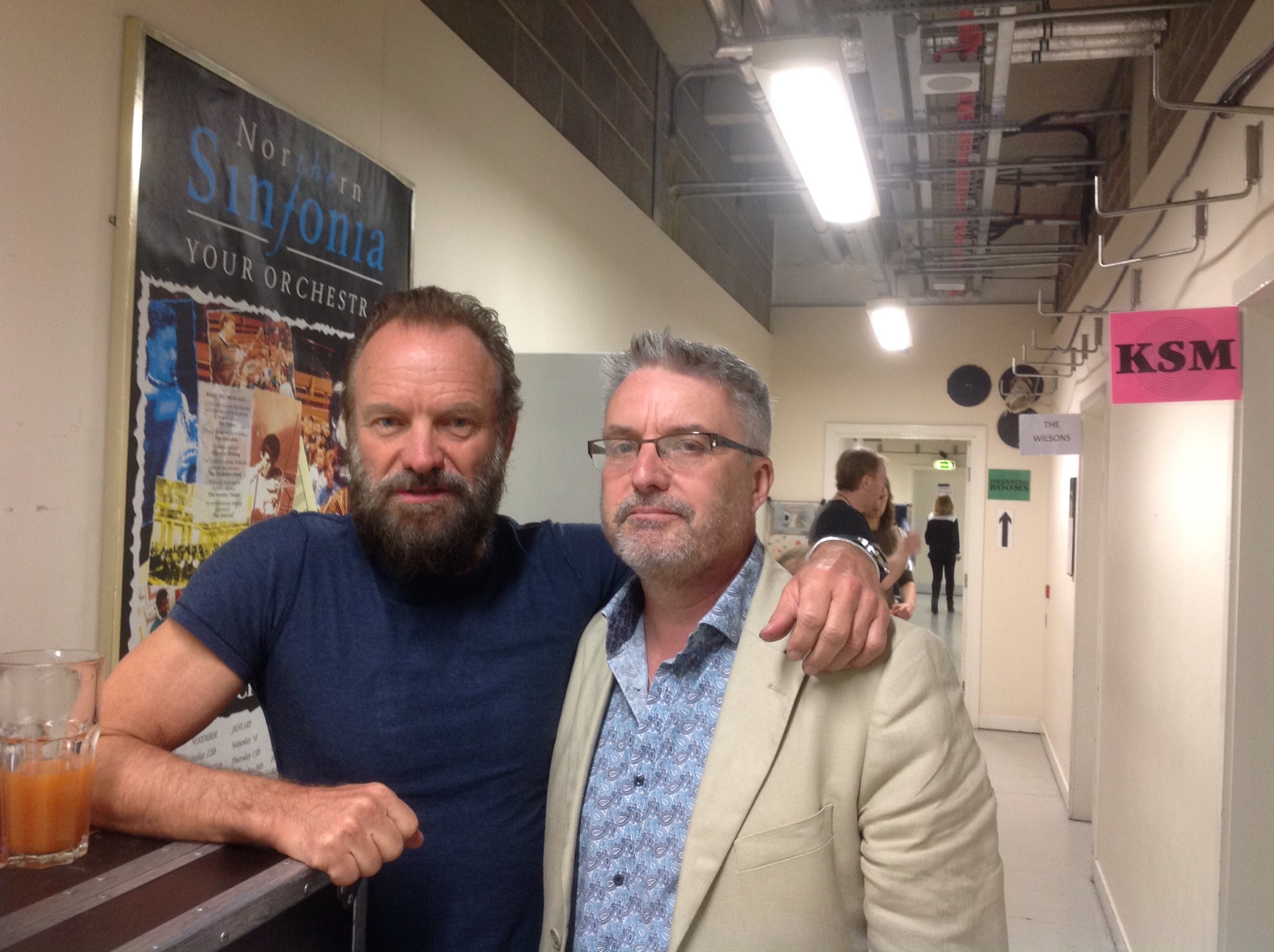
This is not intended to be a review of the show, as there has been a number of them already, But more an opportunity for me to consider the impact of the songs – when played in Newcastle, and their reflection of Geordie Identity. I got the opportunity to meet with Sting, just before his first show on Saturday 25th, and managed to discuss the impact of living away from Newcastle, yet being inextricably tied to it causes. This is an akenside syndrome ‘condition’, so beautifully written about by Joe Sharkey.

Firstly, Sting quite correctly believed that a vocabulary is yet to be invented that describes the feelings that those of us experiencing the condition go through. However, I think music has the capacity to portray these emotions more accurately than pure words. Unlike words – it enables us to experience multiple complex feelings simultaneously – as opposed to the more linear trajectory of words. The first time I heard Sting’s ‘Dead Mans Boots’, it portrayed not only his own relationship toward the expectations of his upbringing – but also my own. Indeed it was this song that inspired me to write the book on Sting – maybe I could try and understand my own complex feelings via the lens of my far more famous compatriot? I have lived away from Newcastle myself for 30 years now since leaving music college – yet still consider myself a Geordie, although I am constantly renegotiating my identity in much the same way that Sting has – sometimes feeling very distant – and other times incredibly proud and close.

As a result of my brief conversation with Sting, I set off tomorrow to deliver a paper on Sting and the Protest song at a conference at the University of Limerick, with a fresh perspective of my chosen subject matter. Not only is Sting a thoroughly nice guy – but he is in the process of thinking through his Geordie identity – like many of us. In many ways – despite some of the essentialisms in The Last Ship, he is in fact breaking down the stereotype of what it means to be a Geordie – no incomprehensible accents, flat caps, pigeons or lack of intellect to be seen here. Regarding protest song, I gave him a copy of my book on Frank Zappa as a thank you for meeting me. He informed me that the music world needs more people like Zappa – who speak their mind, not afraid of the consequences in terms of record sales. Sting, who seems to regularly use his background as a creative spark, is also making a brave move here – in particular with his American audience – who may not quite understand or relate to the plot or cultural backdrop in a play such as The Last Ship. I wish him good luck – as the stage play moves forward – apparently to Scandinavia next year – them maybe London after that – although I would like to see the Broadway production taking place in Newcastle!


Posted in Academic, Sting | Tagged , , , , , , , , , , , , , | 7 Comments