This is the 3rd blog I have written intending to take stock of the various impacts Covid 19 has had on the music sector. Related news this week included discussions around the initial guidelines proposed concerning musicians returning to work, with the most alarming suggestion being the notion that brass players in orchestras have to social distance by three metres, with singers being capped to six per room (For a short piece advocating the return of public singing in churches for example, see here). Although the proposals have not gone through parliament as of yet, UK music are pressuring government to reconsider its plans, but it is fairly obvious that decisions such as these must be made taking into account the perspectives of representatives from the music industries – otherwise criticism is bound to follows. Aside from brass players not being able to hear each other properly, the resultant sound produced not to mention the capacity to fit players into a recording studio space are highly problematic.
Related to this, at the time of writing, music venues throughout the UK were waiting to see if any updates were forthcoming regarding the 2-metre social distancing rule. As it stands, government have announced that some restaurants and pubs will be open on July 4th – but two questions remain unanswered 1) will it be financially viable to open if a 2 metre rule is applied and 2) if it is reduced – is it safe and will the general public have the confidence to return to social spaces such as this? I absolutely have no answer to this, but considering grass root venues were already struggling – this is only going to make their financial viability even more precarious, hence the reason why UK Music are urging the UK Government for an agent cash injection of £50 million.
All of this was taking place during a week when Cameron Mackintosh announced that West End shows such as Les Misérables, Mary Poppins, Hamilton and The Phantom of the Opera will not open until 2021 – with resultant job losses on the table. In terms of more positive narratives, it was announced this week that artists such as The Lightning Seeds and Gary Numan, have signed up to play at the ‘Live From The Drive-In’ events, taking place in outdoor spaces in Birmingham, Liverpool, London, Edinburgh, Bristol and beyond. Although by no means a ‘solution’ to the crisis hitting live music around the world, this initiative at least provides a means by which the general public can experience music outside again, albeit in relatively small numbers (300 capacity). Although Live Nation support this initiative, the biggest concert promoter in North America, announced plans to make some radical changes to its proposed 2021 concert series, most of which shift the financial burden of concerts from promoters to artists. It seems that if touring artists want to work next year, they will have to accept a greater part of the risk and responsibility of promoting the concert. The changes are wide ranging and are summarised below (courtesy of Rolling Stone).
Artist Guarantees: Artist guarantees will be adjusted downward 20% from 2020 levels.
Ticket Prices: Ticket prices are set by the promoter, at the promoter’s sole discretion, and are subject to change.
Payment Terms: Artists will receive a deposit of 10% one month before the festival, contingent on an executed agreement and fulfillment of marketing responsibilities. The balance, minus standard deductions for taxes and production costs, will be paid after the performance.
Minimum Marketing Requirements: All artists will be required to assist in marketing of the festival through minimum social media posting requirements outlined in artist offer.
Streaming requirements: All artists will be required to allow their performance to be filmed by the festival for use in a live television broadcast, a live webcast, on-demand streaming, and/or live satellite radio broadcast.
Billing: All decisions regarding “festival billing” are at the sole discretion of the promoter.
Merchandise: Purchaser will retain 30 % of Artist merchandise sales and send 70% to the artist within two weeks following the Festival.
Airfare and Accommodations: These expenses will be the responsibility of the artist.
Sponsorship: The promoter controls all sponsorship at the festival without any restrictions, and artists may not promote brands onstage or in its productions.
Radius Clause. Violation of a radius clause without the festival’s prior authorization in writing will, at the festival’s sole discretion, result in either a reduction of the artist fee or the removal of the artist from the event, with any pre-event deposits returned to the festival immediately.
Also see this
Other News
For a nice story about a UK based record shop reopening – click here
If you live in or around Hamburg and are interested in playing your part in developing new business models to kick start the city’s music industry – click here.
For an honest outline of how Covid19 has impacted my colleague Martin Cloonan’s research in terms of importance and relevance, click here.
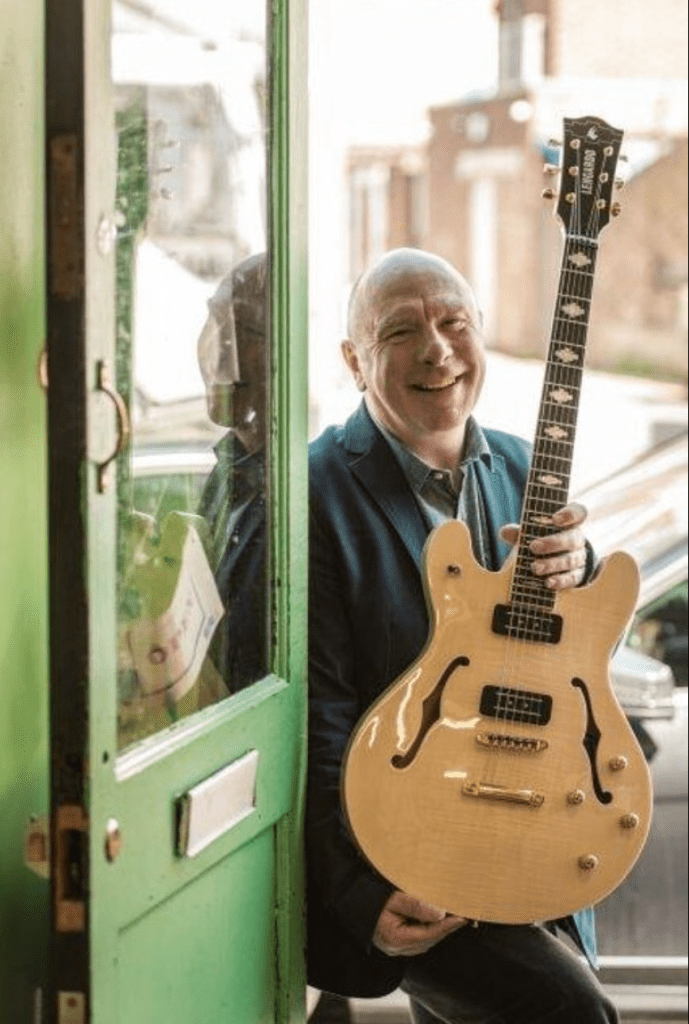
Guitarist, composer and Sting sideman Carl Orr was kind enough to write a five-star review of my Sting book this week. It was great to see the book get a ‘thumbs up’ from Carl, who I respect. greatly as a musician and have seen perform a couple of times when performing Sting’s The Last Ship during its initial tour, including the inaugural performance at Northern Stage on March 12 2018. Carl played some magnificent guitar that evening, so I was interested to find out more about him.
When looking at his backstory, it is obvious Carl has a fantastic pedigree. Born in Newcastle, growing up Australia, then moving to London in the early ‘90s, by which time his CV was already very impressive, having studied at Berklee College of Music and worked with many name jazz musicians – including Billy Cobham.
Since moving to London, he has released six solo albums, which are incredibly eclectic stylistically. Although broadly falling into the ‘jazz’ category, his music can be placed within the genre’s tradition by engaging with influences ranging from that of The Brecker Bros (‘Swamp Thing’), later Miles Davies (‘Still Life’), to more traditional jazz (Deep Down), to his most recent album and the main subject of this post –Somewhere Else (2019)
After spending time listening to it this week, I would say his Something Else album takes the listener on a journey of escapism, both in terms of the imaginary landscapes of tracks such as ‘Katie‘ (written for his daughter) and ‘Somewhere Else‘ (which reminds me of Tim Garland’s recent work, depicting the North East of England – listen to ‘Lady of the North‘), to the more ‘place centred’ textures of tracks such as ‘Analyse‘ (a Radiohead cover), ‘Fayah‘, and ‘Ride the Camel‘, which have more specific semiological relationships with India, Africa and ‘the Middle East’ respectively, due to the purposeful use of musical textures related to those regions (‘Ride the Camel’ features my old guitar teacher Stuart Hall).
Compositions aside, it is also noticeably that Orr is a ‘special guitarist’, who if I was to describe his work in one word— it would be TASTE. This is something that no amount of musical training can manifest. As with all of his work, Carl performs equally as proficiently on acoustic as he does on electric and although he can ‘shred’ (listen to the Cobham track above), he is also capable of ‘playing the spaces’ by manifesting a ‘less is more’ idiolect. One of the first things one notices when listening to his music, is that he appears to place a lot of emphasis on melody—both in terms of his compositions and his guitar playing and by doing this, he engages with the listener on many levels—be it from simply ‘singing the tune’, to marvelling at the technical proficiency and competency of his artistry, to being ‘lost’ in textures, melodies, rhythms and timbres of tracks such as the title track – ‘Somewhere Else’. Indeed I challenge anyone reading this post to listen to this track and while doing so – just consider the places it takes you – open fields, across oceans, through wooded landscapes, looking at ones home from a distance – they are all possible. Once the Covid19 pandemic is out of the way and public gatherings are possible again, I would love to see this guy perform his own material live, which I am sure will bring some of these imaginary landscapes even closer – fantastic!
This week’s news has featured a number of headlines related to Covid19, ranging from AEGs announcements of its intention to make some staff redundant, Travis McCready performing America’s first post lockdown gig, Eventbrite being sued as a result of its refund policies, to the ominous news by the Musicians Union, who predict that the majority of the UKs theaters and music venues face shut down as a direct result of the pandemic. Out of these headlines, the Eventbrite one is interesting, in as much that it relates to the terms and conditions of ticket purchase and if a gig has been ‘cancelled’ or postponed’. The latter of course, despite being effectively cancelled, can be an ugly loophole if you can’t make the replacement gig. In Wales, I am pleased to say that St David’s Hall in Cardiff acted very honorably to me recently, when a recent George Benson gig was postponed 12 months – but I still was offered a refund due to not being able to make the rescheduled performance.
The Travis McCready gig was also interesting, despite being a bit of a publicity stunt, gave an eerie indication of what post lock down gigs could look like – with concert arenas half empty and most importantly – with no atmosphere. This mixture of how to ensure live music remains financially sustainable and an enjoyable cultural experience is going to be something that is an ongoing debate. Indeed this was a topic of conversation at a session I attended yesterday on ‘the future of live music, which can we watched here
The event featured Peter Hook from New Order, record producer Graham Massey and Teresa Moore from A Greener Festival, and I have to say – it was very informative. The conversations started with dialogue surrounding the environmental impact of festivals and music touring that was starting to take place pre lockdown. The presenters noted how the massive amount of CO2 being produced by the live music industry relied on organisers having a ‘social responsibility’, which was most notably brought to the public’s awareness by Coldplay’s announcement to stop touring last year. Put simply, as the live music industry has grown over the last decade or so – so has its negative environmental impact, so the question asked was – how do we get a balance between growing live music infrastructures and considering environmental responsibilities – it is a difficult mix which A Greener Festival were/are attempting to navigate (Teresa Moore noted the importance of ensuring one does not grow at the expense of the other). Covid19 has of course blown all of this debate open – so maybe this is an opportune time to consider these issues from the ground up?
One piece of good news announced this week by the Music Managers Forum is a new fund (managed by Help Musicians UK and aided by donations from PPL and a number of leading artist managers), targeted toward supporting music managers suffering from the impacts of Covid19. Many artist managers are noted as being in the unusual position of not being eligible for existing support packages – as they can’t self-furlough due to their responsibilities to their clients, despite being significantly impacted by the lack of live work their artists are now undertaking. The scheme is entitled ReBuild and more details can be found here.
That’s it, my hour is up. I will finish by copying below a couple of interesting links – the first concerning the prospects for gigging musicians as lockdown begins to ease and the 2nd more relevant to the academic world, a call from the Post Parliamentary Academic Fellowship Scheme, announced this week, can be found here
Now into my third month of lockdown, I thought I would start up a regular blog which highlights some of the developments concerning covid 19 on the music industry. The impacts of the pandemic seem to be changing every week, with the prospect of returning to ‘normal’ being as distant as when we started. Although some government support is there at the moment for our self-employed workforce, what actually is going to happen when it runs out in October? Having attended a number of ‘online’ gigs over the last few weeks, I am personally not convinced how readily grassroots level music will be monetized – which may result in many online gigs being an extension of an issue we currently have in society – expecting grass roots live music for free.
In terms of how music can engage with our local and national ‘recuperation’, Sound Diplomacy (the company that recently analysed Cardiff’s music ecosystem), recently launched a report that highlights the importance of music in the recovery of cities, with a nine point plan outlined as follows
1. Put artists to work: Incentivize creation from crisis. 2. Convert creativity into community investment vehicles. 3. Create a city music registry. 4. Start a cultural infrastructure plan. 5. Create emergency preparedness plans (venue, event, city-wide). 6. Ensure music, arts and culture language is included in policy frameworks. 7. Commit to genre agnosticism. 8. Plan and develop a night time economy policy. 9. Set-up city-wide artist compensation policies, music liaison services and fair play schemes.
With governments understandably working on priorities such as ensuring their populations are safe and that medical teams have the correct PPE, I would agree that it is essential that music (and the arts more generally) are included in government/city/town recovery policies as we move forward. The report rightly points out the importance of music as not only an artifact of aesthetic pleasure, but as a unifying force that brings communities together (be it by attending live music events, instrumental lessons, playing in bands, etc). Unification is something that so important in the current pandemic – where SEPARATION has been the dominant narrative. Both the aesthetic pleasure music brings and its associated community engagement both have an important part to play in our general well being – which is easily overlooked in times such as these. However, if we are are maximize the impact of music, governing bodies do of course need to be intentional in terms of how we use it – for by using IT we engage OURSELVES. My question is this: there does seem to be a strategy for the return of sport – so why not music?
Taking a step back, as opposed to how music can potentially be used, the issue of clarity of how the music industry moves out of lockdown, so it can be used, was highlighted this week by UK Music, whose Chair, stated
“The government is right to try to move towards kickstarting our economy, provided it can ensure protecting public health is paramount at all times. However, these latest proposals on the easing of the coronavirus lockdown are missing the clarity that the UK music industry so desperately needs”.
He continues
“There is a risk the British music industry will be left behind as other countries come out of lockdown”, […] “We cannot afford that to happen to the UK’s world-leading music industry which is really suffering”.
These concerns appear to be in sharp contrast to the activities taking place in New Zealand, who this week highlighted a plan to kick start their music industries, by announcing a ‘music recovery fund’ aimed specifically toward the popular music industry. The $16.5m fund includes $7.1m to boost the country’s on Air’s New Music programmes, $5m to assist Live Music Touring, and $3m to support ‘safe’ music venues. Maybe this is an approach that the UK could consider – or is it impossible to compare a small nation such as NZ to the UK? Maybe we can compare it to Wales though?
Finally, for those living in and around Cardiff – ‘We Are Cardiff’ have opened a repository of memories and experiences of lockdown. Although not music specific, it would be really useful to have some music based documents on there – so you can contribute by clicking here
Earlier on in the week, I was asked to write a blog for my university’s Centre for the Study of Media and Culture in Small Nations. The subject was on the impact of Covid-19 on the music industry and yes – I had to turn it around quickly. I have copied the article below as it was submitted a couple of days back, but the question I am interested in asking is – has the government’s decision to now include self employed workers in the compensation package helped creative practitioners like musicians, sound enginners and the like? You can find a few transcripts from musicians in the original article (which is copied below and you can find here), but I would really appreciate it if you could do something I rarely get with this blog – COMMENTS! It would be so useful to have some sort of collective expression of how, as things stand, self employed people in the music industry are supported. Please share if possible.
COVID-19 FREELANCERS AND THE LIVE MUSIC INDUSTRY: THE PERFECT STORM?
Starting to write a blog post on the impacts of COVID-19 on the music industry, on the day Prime Minister Boris Johnson announced a firm ‘UK lockdown’ on public gatherings (on March 23rd), was a sharp reminder that stakeholders in the live music sector were going to be impacted for a significant amount of time, with the implications for the music industries being potentially very serious. Indeed it is terrifying to consider that as recently as November last year, the live music industry was regarded by The Guardian as hitting a “record high”, with its value to the UK economy estimated to be circa £5.2 billion (with music tourism alone regarded as generating 45,530 jobs), which contrasts sharply with recent well publicised narratives concerning the cancellation of tours and landmark events such as Glastonbury, South by Southwest and The Great Escape, not to mention the general decimation of the live music sector. However, returning to the music industry of only a few weeks ago, despite some individuals making a great deal of money, The Guardian article is quick to point out that the £5 billion generated does “not reflect the financial struggles of many music creators”, whose average earnings are reported to be £23,059 per year (although the recent research conducted by Sound Diplomacy into the music ecosystem in Cardiff, estimated the average to be £18,000). Earlier this week, we explored the impact of the pandemic on freelance screen sector workers, and as with screen, the majority of music practitioners work on a freelance basis, with the Musicians Union reporting that a staggering 94% of musicians earn at least part of their income via this means. It is therefore no surprise that it is this sub-sector that is particularly vulnerable during the current pandemic crisis.
Although the UK government’s £350 billion pound financial package for British business, announced on March 17, will no doubt assist some music companies staying afloat, concern for the freelance sector is understandably real, with industry bodies such as UK Music, the Musicians Union and the Music Managers Forum all announcing that they have “significant concerns that the benefits will not reach [this category of] music makers, their representatives, [or] their teams”. So, although the government’s financial pledge is welcome, it needs to be highlighted at the highest level that music freelancers are ‘slipping through the gap’, as they simply don’t qualify for many of the rights other workers take for granted, including access to sick pay or indeed the promised 80% of wages the government pledges to cover. Indeed currently, although freelancers can access the ‘Universal Credit’ system, this is also restricted if their partners work!
This may be the bleakest moment in living memory when it comes to making a living as a freelance music practitioner. However, a glimmer of positivity can be seen when one examines some of the ways the sector has responded, ranging from grassroot to world famous musicians and venues. For example, Ronnie Scott’s is now streaming selected live concerts as part of its ‘Lockdown Sessions’, with the musicians performing in an empty venue to a ‘virtual audience’, spread around the world. In order to monetise these activities, viewers are encouraged to donate direct to the musicians via a live Facebook feed, a practice also made possible via web sites such as Stageit, Facebook Live and Crowdcast. Indeed band members from Snarky Puppy, who usually tour extensively every year, are currently offering musicianship lessons, once again asking attendees to offer a financial contribution so they can sustain their livelihoods. As outlined by Graeme Virtue, artists such as Chris Martin (from Coldplay), John Legend and Ben Gibbart have also joined in a now pervasive practice of musicians performing live from their homes in ‘virtual house concerts’, where finance is not the objective, but simple ‘good will’, to entertain their fans for free during these difficult times, a gesture not too dissimilar to the escapism Dame Vera Lynn provided the nation of Britain during World War 2. However, and as pointed out by the BBC, although shows by the likes of Chris Martin “provide a much-needed creative outlet and sense of community for artists and fans alike […], they [don’t] make up for the loss of income as the touring circuit effectively shuts down”. Former Ocean Colour Scene and Paul Weller bass player Damon Minchella, describes the current situation well.
“The professional touring and studio community has been devastated due to across the board cancellations. All the summer festivals I was playing with Richard Ashcroft have been cancelled, as has all previously arranged session work. A friend of mine who has been doing (and still is doing) onstage sound for Madonna for over 10 years has just applied to Tesco to become a shelf stacker. The idea of online gigs is partially relevant, but this cuts out trucking crews, venues, security, tour managers, and so on. It’s devastating for everyone […]”.
When one reflects on the current situation, it is not sensationalist to suggest that some creative music practitioners may never recover, as they attempt to maintain their professional status and remain solvent during the financial storm they are currently experiencing.
What Can We Do To Help?
The ideas below are intended as a starting point
We can stream more music than usual by artists who would benefit, although this will have negligible impact in the short term.
We can watch out for streamed concerts and donate generously.
We can purchase products such as CDs and merchandise direct from channels such as Paypal, where artists obtain all of the profit.
We can look out for altruistic gestures by mainstream music hosting sites such as Bandcamp, who have waved all of their fees during the current pandemic, and purchase accordingly.
As indicated by Ellie Mae O’Hagan in The Guardian on March 24th, the UK government must ensure all freelancers who work within the creative industries are supported in the same way as the employed workforce. (The artists themselves can of course investigate UK based national support funds, specifically targeted for freelance musicians, such as that organised by Help Musicians UK. Examples currently in the US include funds established by Music Cares and Sweet Relief).
We can lobby service providers such as iTunes and Spotify to temporarily increase the royalty rate for artists who earn under an agreed threshold.
The media coverage of the The Covid-19 outbreak has in some respects become the distorted mirror through which we see ourselves, as supermarket shelves are emptied, government safeguards are ignored, and wealthy business leaders don’t pay staff. However, this is an opportunity for both the general public and most importantly the UK government, to contribute towards a more positive narrative, by showing their appreciation of this fragile sub-sector of the creative economy by providing important financial support. It has been well reported over the last decade or so how the live music industry has been a lucrative sector, on which the music industry as an entity depends. So, this is also an opportunity to assist its recalibration, by ensuring that many of its lower paid freelancers can remain within it, once this pandemic has run its course.
In terms of the situation in Wales, the impacts of Covid-19 are obviously impacting here too, ranging from the grassroots venues on Womanby Street, to larger venues like Tramshed and the Motorpoint Arena, not to mention the impact on countless working musicians throughout the country who make their living from music. One such musician stated the following when asked how Covid-19 was impacting her day to day work.
“[…] my main source of income is gigging [and] all my gigs for the next two months have been stopped. I had a residency at a hotel in Cwmbran – all cancelled. Residency in Tenby – stopped, Mother’s Day gigs – cancelled. I also play at least once a week in Care homes for a company called MusiCare – all stopped. Huge impact.”
A similar situation was reported by the owner of One Louder Studios in Newport, who verified that they were now “completely closed” with “no band rehearsals or recording sessions taking place. Income is now £0”. At the time of writing, the studio was remaining closed until at least April 5th. Another freelance musician based in Crickhowell reported the cancellation or postponement of over 40 shows, which has resulted in a loss “just shy of £5k”.
These stories are of course the tip of the iceberg, with many local stories still to be told. Indeed as this blog was going to press, stories of Owen Money having to cancel his 20 date mainly sold out tour of Wales was just emerging. With major events such as the Greenman Festival and Focus Wales, taking place later in the year, they will surely be watching with trepidation to see if the pandemic settles.
In this new reality that many of us find ourselves in, I have been experimenting with Panopto as a means of recording content for my students. So, please find below a synopsis of an essay I have written for the Bloomsbury Handbook of Rock Music Research. Is Rock and Popular Music delivered and assessed appropriately in our mainstream music curricula?
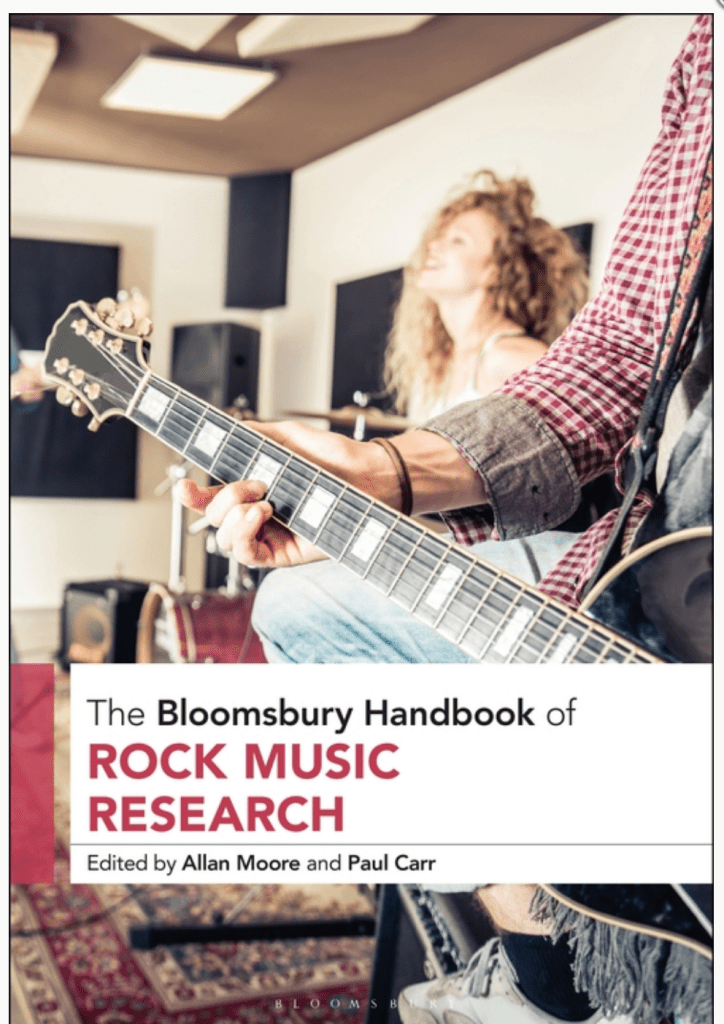
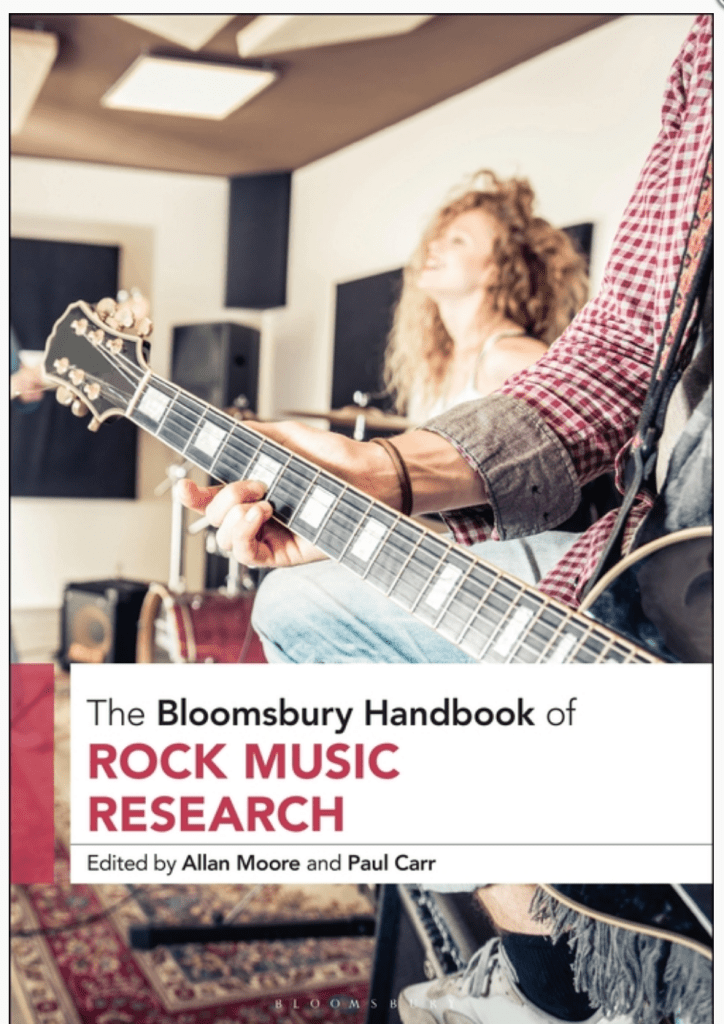
Well, we have spent the last few weeks going through all of the proof edits for the Bloomsbury Handbook of Rock Music Research, including an enormous bibliography and an even larger index of close to 9000 words. Despite the various issues associated with corona virus, the book is on schedule to still be released in July. So – it has been a few weeks since I blogged about a chapter, but here we are at Chapter 6 – entitled The Rock Instrumentarium. Abstract copied below…
Considering all rock instruments as a type of technology, Steve Waksman surveys the fundamental components of rock music instrumentation—namely guitar, bass, drums, keyboards and wind instruments. In addition to providing an historical evolution of the individual instruments, his essay concentrates on the variety of playing styles, as well as accompanying styles of physical stage performance where applicable. Waksman frames the essay throughout by also considering the small but growing literature on musical instruments as cultural artifacts, in connection with rock and popular music. The chapter provides not only a useful overview of the scholarship and contributions of practitioners and instrument designers, but also how these combined innovations shaped the history of the genre.
Chapter four of the Bloomsbury Handbook on Rock Music……
In a chapter focusing on rock vocalities, Katherine Meizel points out how the ways in which rock vocalists sing vary not only between subgenres, but from performer to performer. Meizel highlights how singers and listeners use particular sonic cues in the voice to identify music as rock: because those sounds index specific ideas and ideologies of authenticity that matter to them. The chapter, in addressing the production of the rock voice and the scholarship in which it features, investigates how the sounds associated with rock voices correspond not merely to superficial aesthetic values, but rather to concepts grounded in a culturally authenticated, genred, gendered, racialized, classed, and dis/abled framework of singing. They are rock values that celebrate imperfection and flawed individuality, and that at once resist and reinforce white cultural power through the appropriation of vocal sounds associated with black American singing.
The third essay of the Bloomsbury Handbook of rock music Research is provided by Taylor Myers and Brad Osborn, who initially examine the music theory, musicological and cultural studies literature that has emerged relating to rock scholarship over the last thirty plus years. Myers and Osborn then assert that a rhizomatic as opposed to arborescent approach is a more appropriate way of philosophically considering the genre formation of rock, which is regarded not as a ‘family tree’ with development branches, but a non-hierarchical construction, with multiple entry and exit points. The essay subsequently provides a chronology of the literature that has helped define rock’s stylistic parameters, ranging from the work of Fabbri and Tagg in the early to mid 1980s, through to more contemporary scholarship.
The Bloomsbury Handbook of Rock Music Research is now in the ‘post proof’ stage, with the publishers getting back with their various tweaks and suggestions. So I have just spent the day responding to 33 authors, who will soon be finalizing their chapters. As we move toward publication, I will be sharing the abstracts of the chapters, so here is the chapter by Sarah Hill
The second essay of the prefatory is by Sarah Hill, who surveys some of the key themes in academic writing about popular music in general and rock music in particular, considering the commonalities and ruptures that have emerged in the past forty years, and the variety of disciplinary approaches that constitute popular music studies. After outlining how the Beatles garnered positive critical attention in the late 1960s, Hill verifies how rock music entered the realm of academic discourse fairly late in its history—with the genre not fully solidifying until the early 1970s, after the first dedicated peer-reviewed journal, Popular Music and Society, was established in 1971. After the formation, ten years later, of both the International Association for the Study of Popular Music and the peer-reviewed journal, Popular Music, popular music studies is regarded as gradually becoming established into a recognizable field of ideas and approaches. Hill discusses how much of the early scholarly writing about popular music concerned not only ‘perimeters’ (what is popular music?), but the very groundwork of the field, with definitions of genres, audiences, styles, histories and cultural interactions emerging. These early publications of the field’s discursive fabric, alongside their inter-disciplinary dialogues and critical reassessments, are regarded as underpinning the academic study of popular music today.










 Professor Paul Carr Music Consultancy