200 Motels: The Programme Notes that Never Happened!

Editor ‘Frank Zappa and the And’

20131031-215617.jpg

For those that are interested, here are the programme notes that never happened!

Guitarist, satirist, political activist, music technologist film maker and composer, Frank Zappa (1940-1993) has to be objectively considered one of the most creative and prolific musicians of his, or any other generation. During the years that he was in the public eye between 1966 and 1993, he was to release over 60 albums, between the inaugural Mothers of Invention’s Freak Out (1966) and his pioneering synclavier based masterpiece –  Civilization Phaze III (1993). Born in Baltimore, Maryland on December 21, 1940, Zappa can be considered part of the 60s generation that celebrated sexual liberation to the soundtrack of the emerging Rock genre. However, it is important to emphasise that Zappa’s musical interests reached far beyond the Rhythm & Blues bands of his youth, almost developing an alter ego compulsion for twentieth-century avant-garde music, especially the work of Edgard Varèse – who was described as ‘the idol of his youth’. Particularly interested in Varèse’s concept of music as ‘organised noise’, the influence remained consistent throughout his entire career, and appears to provide the foundation toward his approach to live and studio work, as well as the numerous styles he was to merge and juxtaposition. When examining his catalog, it is immediately apparent that his influences are not only eclectic and numerous, but also often contradictory – questioning the listener to ask: is his music Rock, Jazz or Classical? High or low art? Controlled or open? Improvisatory or notated? Serious or frivolous? Complex or simple? Elitist or vernacular? A true postmodernist, Zappa’s compositions would often include many of these factors –  both simultaneously and/or consecutively, reflecting his long standing and often quoted creative maxim – “Anything, Anytime, Anywhere – for no reason at all”.

Although primarily known as a ‘Rock musician’, Zappa very much considered himself, and needs to be considered today as, a ‘serious’ composer, whose engagement with Rock music was essentially used to finance his more orchestral art music ambitions. In a 1966 interview for the New York Times at the start of his professional career, he stated

“Stravinsky in rock is like a get-acquainted offer, a loss-leader. It’s a gradual progression to bring in my own ‘serious’ music”

When examining Zappa’s recorded output, it is apparent that he explicitly, subtly and progressively integrated classical avant-garde gestures into his early portfolio, gradually increasing the propensity of the statements in individual compositions, and eventually albums as time progressed. Examples of his early practice prior to 200 Motels include puns that allude to ‘high art’ titles (such as “Prelude to the Afternoon of a Sexually Aroused Gas Mask” from Weasels Ripped My Flesh, 1970), direct borrowings/quotations of avant-garde composers he admired (For example “Status Back Baby” (Absolutely Free, 1967) quotes segments of Stravinsky’s  Petrushka); musical allusions (Zappa considered his doo-wop influenced Crusing with Ruben and the Jets (1967) to be heavily influenced by Stravinsky’s neo-classical period); written acknowledgement of relevant influences (Freak Out includes a substantial list of his major influences, including Boulez, Kagel, Schoenberg, Varèse, and Stravinsky amongst many others ) and compositional intent (Absolutely Free was considered by Zappa to be two oratorios, and included a ‘mini Rock opera’: “Brown Shoes Don’t Make It”). As we move toward the release of both the film and double album of 200 Motels in 1971 (which is cited as his thirteenth release), the inclusion of avant-garde influences and techniques can also be witnessed via recordings such as the Musique Concrète influenced We’re Only in it for the Money (1968), his first solo album Lumpy Gravy (1967), which made extensive use of an orchestra, and Uncle Meat (1969), which was also influenced by avant-garde composers such as Stravinsky in places, and was actually the sound track to a movie which was not released until 1987.

Described at the time as both a ‘Fantasy Opera’ and ‘Surrealistic Documentary’, 200 Motels can be considered a postmodern mix of 20th Century avant-garde, Rock music and Country music, combined with humour, subversion, sex and horror – to name but a few descriptors. It was to be the first of eight full length movies Zappa produced between the years 1971 to 1988 and the first movie ever to be shot using video tape technology. A partially autobiographical piece, the film is essentially a depiction of life on the road, including its banality, inter-band relationships, dope smoking (which Zappa never partook in) and sexual liberation – humorously encapsulating the zeitgeist ‘groupie phenomena’ of its time. Directed by Zappa and Tony Palmer, the movie was originally released by United Artists and features Ringo Starr as Larry the Dwarf (an alter ego of Zappa), Theodore Bikel as Rance Muhammitz, in addition to numerous members of his 1971 touring band and ex Mothers of Invention members. Zappa claimed to write much of the orchestral music for the film in motel rooms over a five year period while touring – with the ‘200’ label representing an estimate of the actual number of motels the work was conceived in.

In terms of the resonance of The Southbank as a venue of this UK premier of 200 Motels, it is fascinating that early sketches of pieces such as “This Town is a Sealed Tuna Sandwich”,  “Dance of the Just Plain Folk” and “Redneck Eats” were actually premiered at a performance at the Royal Festival Hall on October 25th 1968 by members of  the BBC Orchestra – later released on the 1993 album Ahead of Their Time. To hear this, simply compare the opening motif of “This Town is a Sealed Tuna Sandwich with the Clarinet theme of “Prologue” or “Like it Or Not” (from Ahead of Their Time), or the Stravinsky influenced opening bars of “Dance of the Just Plain Folk” with the earlier “The Rejected Mexican Pope Leaves the Stage”. It is important to note that the orchestral pieces of 200 Motels can also be perceived as clear signifiers which point toward Zappa’s avant-garde influences. For example, after the ‘safe sounding’ opening few bars of “Semi-Fraudulent/Direct-From-Hollywood Overture”, as Rance Muhammitz (Theodore Bikel) states “200 Motels – life on the road” , it is underpinned by a short segment which has clear textual, rhythmic and percussive elements not dissimilar to Varèse’s Intégrales (1925). One can also hear connotations such as Berg’s Wozzeck (1925) in “A Nun Suit Painted on Some Old Boxes”, the haunting dissonant strings of Penderecki’s Emanacje (1959) in “Touring Can Make You Crazy”, and Stravinsky in pieces such as “Dance of the Just Plain Folks”, “I’m Stealing the Towels” and the instrumental  section of “Centerville”.

Due to a quirk in the Musicians Union rule book of the time, in 1970, there was surprisingly no official rate which facilitated Zappa to rehearse the complex material of 200 Motels for a movie recording session. To quote Zappa from his autobiography “this means that a person hiring an orchestra, for example, either is prohibited from rehearsing all together, or has to pay full recording scale while the orchestra makes all the mistakes you’d never want to release on record”. To circumnavigate this problem, a concert at the Royal Albert Hall was organised – with initial rehearsals for 200 Motels labelled as ‘rehearsals for a live concert’ – all totally legal. However, days prior to the sold out concert, the venue decided to cancel the event, citing obscene song lyrics as the reason. This resulted in Zappa not only having to refund ticket prices, but also reclassified the union rate for ‘rehearsals’ for the concert to additional ‘recording costs’, causing what Zappa described as “substantial and demonstrable financial  damages”. In his autobiography, Zappa provides a partial transcription of the court case which followed a few years later, as he attempted to gain compensation for lost earnings. Although the final verdict found his music not to be ‘obscene’, Zappa lost his claim for damages, with a recent article in The Independent reporting he vowed not to return to Britain unless he received an apology from The Queen.

So, over 42 years since that fateful event, and 46 years after Zappa premiered some of these compositions at this very venue, tonight’s performance, as part of the ‘Rest is Noise’ Festival has great significance. The fact that this historical event is taking place at The Southbank complies with Zappa’s notion of ‘conceptual continuity’ – where creative elements such as lyrics, album artwork, compositional references, live performances etc were considered as part of a philosophical whole – integrated through time and space – so I imagine Zappa would have appreciated the fact that this work was back in London, where it all started. This evening’s performance will now become a part of what Zappa may have described as the 200 Motels ‘Object’. Clearly differentiating between the individual instance of a work of art (which he described as the ‘Project’) and the ongoing process of redefining it (the ‘Object’) – tonight’s concert adds an additional chapter to this important work.

In conclusion, it is important to emphasise that Zappa regarded the division between commercial Rock and Art Music to be a social construction – something which he was determined to challenge. It is proposed that 200 Motels achieves this objective. Unlike other classical/rock fusions at the time such as The Who’s Tommy (1969) or Deep Purple’s Concerto for Group and Orchestra (1969), Zappa’s interface with ‘classical music’ was not a isolated occurrence, but a lifelong process – that commenced well before he formed the Mothers of Invention through to his death. As I stated at the start of this short programme note, is 200 Motels Rock or Classical? High or low art? Controlled or open? Improvisatory or notated? Serious or frivolous? Complex or simple? Elitist or vernacular? A composer who merged not only musical styles but entire traditions, Zappa would have left it for you to decide. Enjoy!

Dr Paul Carr

20131031-215901.jpg

Posted in Frank Zappa | Tagged , , , , , | 3 Comments

Elements of Music and Impact on Musical Form

My last musicology session discussed the various ways in which the elements of music impacted our appreciation of music. Factors such as dynamics, texture, timbre, harmony, melody etc are interesting – as they can be discussed with all age groups – from first school to PhD. In fact I remember them being introduced into the National Curriculum (in the UK) well over 20 years ago – and used them as a way of encouraging school kids to appreciate music. For this blog – I am interested on the ways in which the elements of music are used to impact musical form specifically. How do factors such as time signatures, rhythm, texture, melody, harmony etc impact our understanding and interest of form in music? This session will act as a grounding for more advanced study in the weeks to come. See the powerpoint for more information and indicative musical examples.


<div style=”margin-bottom:5px”> <strong> <a href=”https://www.slideshare.net/carrp/session-4the-elements-of-music-and-form&#8221; title=”Session 4‘the elements of music and form’” target=”_blank”>Session 4‘the elements of music and form’</a> </strong> from <strong><a href=”http://www.slideshare.net/carrp&#8221; target=”_blank”>Paul Carr</a></strong> </div>

Posted in Education, Musicology | Tagged , , , , | 3 Comments

Zappa Zappa Zappa Zappa………

Well, after my recent promises to stop talking about Zappa – it appears I still have a few things to say. Firstly – I was bitterly disappointed this week to hear that the essay that I had commissioned for the premier to 200 Motels at the end of the month is not going to be used. It appears that Gail Z has asked to have some sort of control over the programme notes – and has asked for someone else to document them. Maybe it was my earlier essay on the Zappa Family Trust – I don’t know.  I put a great deal of work into this essay, and to be fair to the Southbank – they are paying me for my services – so no  hard feelings. I will post the full programme notes in a couple of weeks for those of you who are interested.

On the ‘good news’ side of things – I finished a short essay for the 25th anniversary of the Zappanale Festival this week. There is a book being published in time for the next festival – so i am really honored to be involved in this – thanks to Andrew Greenaway For putting me in touch.

As stated in the last blog – I have a couple of book launches coming up – the first which is this weekend in Cardiff.  It  is being launched alongside three other books written by colleagues of mine – see details here

I also had the chance this week to talk about Zappa and the book for Loosegoose. The chat involves not only my ramblings – but also lots of Zappa music

it is always interesting to talk about the book and Zappa of course. I would however like to apologize to one of the contributors – James Gardiner. I was so proud of myself after finishing the interview having recited the chapters and authors – and realised soon after I ommited making reference to James’ amazing chapter on Zappa’s grouting techniques.  So James – APOLOGIES – put it down to old age!

Finally – if anyone is interested in getting a discounted copy of the book – Ashgate have

1) given me 20 copies of the book that I can sell for half price – happy to sign of course

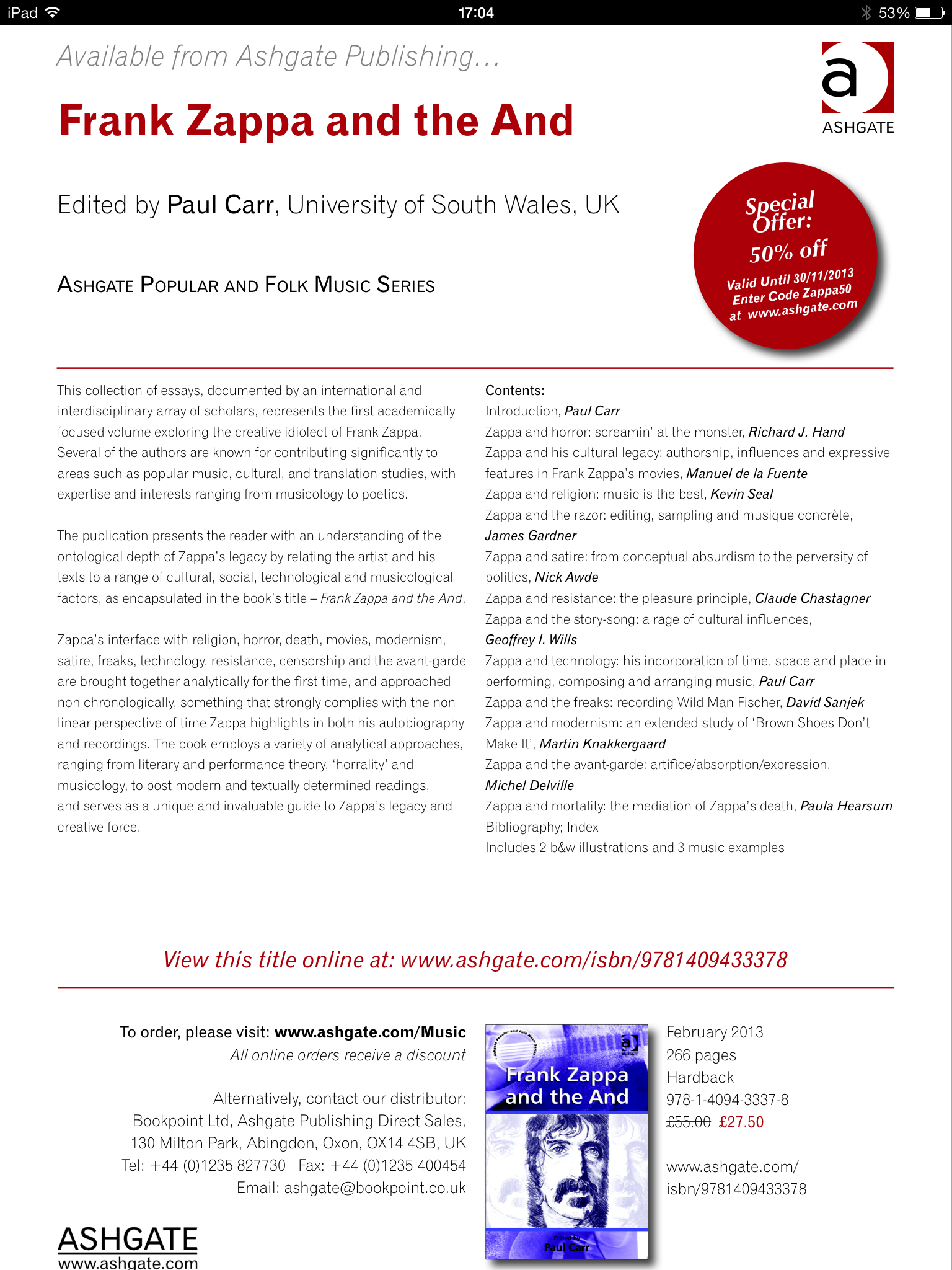
2) Provided a code which enables you to purchase the book for half price up until the end of November directly from Ashgate

photo

Posted in Frank Zappa | Tagged , , , , , | Leave a comment

Song – Arrangement – Track: Where is the ontological presence of a song?

This week in my Musicology session we have been discussing the various ontological aspects of a record. Alban Zac describes the following three factors:-

1)      The song: Made up of factors such as melody, chords and basic form

2)      Arrangement: Specific ways that a song has been arranged. This can range from aspects of style, texture, timbre, production techniques etc.

3)      Track: This is a combination of the above.

The big idea is that points 1 and 2 have  ontological independence – so we can analyze them differently.

I am interested in any observations anyone may have about this (not just my students) – so a couple of questions to get you started

a)      Examples of how the compositional process has changed over the years when working with these factors. For example at one time the songwriter and artist were independent – as was the arranger and composer. How have these factors become merged –  in particular with more affordable technology?

b)      Where does The Song exist? Is is via the definitive recorded version of the Song (we all know what they are) – or does it exist virtually – making it the sum of its collective recordings and performances?

Interested in any comments.

Posted in Musicology | Tagged , , , , , | 3 Comments

Back to Blogging: More Zappa I am Afraid!

For a variety of reasons, over the last few months I have found it really difficult to find the time to blog – life has just been getting in the way. So – here is an attempt to get back into it by providing an update of my activities. I will then aim to post far more regularly from here on in. Although in my last post I stated that I had  ‘completed’ my ‘Zappa related activities’ for a while – the great man is still providing me with loads of interesting opportunities to discuss his music – and I  can’t turn them down.

Firstly, last month I done an interview for the BBC related to Frank Zappa and the And book. As always, it is always a great pleasure to discuss the reasons why I have become so obsessed with this man’s music over the last seven or eight years. Check out the link below to listen to it.

In terms of activities coming up. I have a book launch for the Zappa book taking place at the ATRiuM in Cardiff October 18th. The good news coming off the back of this, is that Ashgate have kindly decided to offer the book at 50% discount for a limited period – until the end of November. Please see the poster below for more details, or look at the Facebook Event Site.


photo

I have also been putting the final touches for a new chapter on Zappa for Oxford University Press. This is going to be released next year in a book on Music and Virtuality – watch this space for more details.

In addition to this, The Zappanale Festival have kindly asked me to write a short piece (alongside many others) to celebrate the 25th anniversary of the Festival. I am hoping to get this done in the next few weeks – and it will be published at the festival next summer.

Nearly last but not least – I have been really honored to be asked to write the Programme Notes for the forthcoming UK Premier of 200 Motels at the Southbank in London. I am so looking forward to this gig – so feel greatly privileged to be involved in any capacity. It is going to be AMAZING.

Finally, Nottingham contemporary have organized an event on November 28th entitled ‘The Theory of Zappa’. It is to coincide with an amazing sculpture by Geoffrey Falmer entitled ‘Let’s make the Water Turn Black’. Check it out below

For those of you who are thinking that I need to focus on something else – you will be relieved to know I have been!! I am currently working on a proposition for a book on Sting – specifically focusing on his relationship to his northern roots. This is something that resonates really strongly with me – so watch this space for future developments.


Posted in Musicology | Tagged , , , , , , , , | Leave a comment

Frank Zappa and Musical Virtuality: The Final Word on Zappa (for a while)

Frank Zappa Front Cover - Zappa Drawing

Well, after the best part of eight years of trying to understand what makes his music tick – I completed what will be my final piece of work on Zappa for a while. Close on the heels of Frank Zappa and the And – I have recently completed a chapter for a forthcoming book on music and virtuality. It uses Zappa’s philosophies and compositional techniques as the basis for trying to understand the ways in which music can be considered ‘virtual’. Drawing on the thoughts of the likes of Kant, Hagal, Schopenhauer, Nietzsche  and Bernard Russell, the chapter tries to present ways in which we, as listeners interface with the system of signs and sonic vibrations we call ‘music’.

In the couple of months since its release, the reception to Frank Zappa and the And is building nicely – having good recent reviews in both Record Collector and Pop Matters. It has also had some local press – and a forthcoming interview on the BBC in a couple of weeks. Having said this, considering we are approaching the 20th anniversary of his death – I am surprised that there is not more media exposure of his music this year. Why is his music still on the ‘outside’ still? I would welcome the opportunity to discuss this in any forums etc that anyone is aware of.

I am sorry for the delay between this post and the last one – but I now intend to once again begin blogging more regularly. For the moment – I have copied the abstract of the new chapter below. A Facebook site for Frank Zappa and the And can be found here and a Vine presentation here

This essay will discuss the creation and reception of the music of Frank Zappa, who overtly positioned his creative output in a virtual, often teleological dimension. Through the analysis of Zappa’s music and personal philosophies such as Xenochrony, Project/Object and Big Note, the essay will draw on the work of a range of scholars from Hanslick, Hagel, Nietzsche and Schopenhauer, to Bernard Russell, Jennifer Robertson and Leo Treitler, ultimately examining the broader question regarding the extent to which music (often with the assistance of written language and lyrics) has the capacity to be representational and/or ‘virtual’. Due to Zappa’s obsession with recording his live concerts, the essay will also place his music in the context of philosophies such as Perdurantism, Organism and metaphysics, asking the important question where the ontological presence of his songs exist.

20130204-221755.jpg


Posted in Frank Zappa, Musicology, philosophy | Tagged , , , , | Leave a comment

Truth and Method: How Can We Be More Objective When Analysing Music

I read a review of Frank Zappa and the And this week – and despite its negativity,  it got me thinking about the ways in which our world views impact the ways in which we interpret meaning in music. Being simplistic about it – if one looks at the world through a Marxist lens, the chances are you will be suspicious of (what you perceive to be) authority (such as universities or academics), not to mention the ‘truth’ that institutionalised narratives impose. Likewise, if you regard music to be ‘absolute’ (when its beauty is itself), semiological (where it has the potential to refer to meanings outside of the music itself) or spiritual (where it has some relation to the divine) – your world view will play a big part in helping you decide what the music ‘MEANS’.

For me, as outlined in Gadamer’s ‘Truth and Method’ – real objectivity is impossible. We can’t help but ‘know’! However – we have to try!!

So – my question is: Where do the meanings of music lie – and how do we overcome the prejudices of our ‘methods’ to produce ‘truth’? I don’t have any definite answers to this – but am interested in ideas/responses.

Posted in Frank Zappa, Musicology, philosophy | Tagged , , , , , , , | 9 Comments

Frank Zappa Musicological Analysis

Here is a lecture on Frank Zappa I gave to students as part of a musicology class this week.

Comments Welcome!

<div style=”margin-bottom:5px”> <strong> <a href=”http://www.slideshare.net/carrp/session-7-zappa-final-presentation&#8221; title=”Session 7 zappa final presentation” target=”_blank”>Session 7 zappa final presentation</a> </strong> from <strong><a href=”http://www.slideshare.net/carrp&#8221; target=”_blank”>Paul Carr</a></strong> </div>

Posted in Uncategorized | Tagged , , , , | 2 Comments

Performance Analysis

I delivered a session on an introduction to Performance Analysis this week – asking the students the following questions

Place examples of

Episodic Markers (see presentation below)

and one of the following
Sonic/Tactile/Kinetic Anaphones
Genre Synecdoche
Experiments with Time & Place
Although this blog is aimed mainly at students – I am very happy to receive ideas from anyone


<div style=”margin-bottom:5px”> <strong> <a href=”http://www.slideshare.net/carrp/session-5-performance-analysis-1&#8243; title=”Session 5 performance analysis 1″ target=”_blank”>Session 5 performance analysis 1</a> </strong> from <strong><a href=”http://www.slideshare.net/carrp&#8221; target=”_blank”>Paul Carr</a></strong> </div>

Posted in Musicology | Tagged , , , , , , , | 7 Comments

Les Paul and Mary Ford: is it still possible to be successful and truly experimental?

A year or so ago, I wrote a blog about how the singer Rumer sounded like Karen Carpenter  – and how the music industry could be seen to be using  a proven formula (i.e The Carpenters) to sell the public music. This is not the topic of this blog – but more related to taking this theory back a few years – this time to the relationship between The Carpenters and the Les Paul/Mary Ford duo. I have been a big fan of Les Paul for most of my adult life – but have always listened to his records with a ‘guitar head’ – ie his amazing solos and use of technology for overdubbing. However, when one listens to Mary Ford’s vocals – they have, to my ears at least, a clear relationship to Karen Carpenter. For example –

‘I’m a Fool to Care’ (1954)
For me, this has not only similarities in vocal timbre, but also in the use of technology to create those amazing vocal harmonies, made famous in songs such as Goodbye to Love
Goodbye to Love (1972)
How high the moon
In both cases, these harmonies only exist in a virtual space – as they are multiple instances of the same singer/singers. I write this, as it is interesting to trace what I would call the ‘primary signification’ of influences such as this (where these is little difference between the sound and what it stands for – for me at least). Taking this thought process back a stage further – the same influence can also be heard between Les Paul’s guitar style (both rhythm and lead) and Django Reinhardt – see the examples below

The Sheik of Araby

For me, these sort of relationships can be viewed from two perspectives
1) the authentic influences of the artist, who have simply listened to the influence and therefore begin to sound like them (ie Les Paul and Django)
2) the music industry machine – where the artist is ‘told’ to sound like another artist or incorporate a specific style (examples to numerous to mention)
If an artist is fortunate enough to be able to be successful and portray their ‘natural’ influences – and these influences resonate with the industry,which in turn have the potential to resonate with the public, all well and good. My question is – are opportunities like this becoming rarer and rarer? Is it only possible to obtain success by positioning your music into a ‘category’ (be it sound, dress, style, etc)? I realise this is always been the case to a greater or lessor extent – so am interested in examples of music that break this pattern. What music is out there that is truly experimental and ground breaking?
Posted in Musicology | Tagged , , , , , , , | 2 Comments