Zappa And the And – the Final Blog!

20130204-221755.jpg

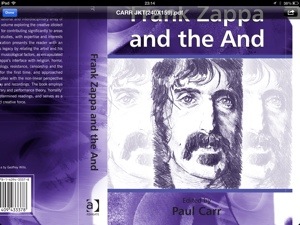
Well – I finally got my copies of my Zappa book last week – so this will probably be the last time I blog about it (hip – hip……). I would really appreciate anyone helping with the social network side of things by liking/sharing/etc etc. You can read a sample chapter from the link below – and if you are interested in a copy – I think direct from Ashgate is the best bet at the moment.

Thanks to those of you that have given the book support over its development

http://www.ashgate.com/isbn/9781409433378

Posted in Frank Zappa, Musicology, philosophy | Tagged , , , , , , | 6 Comments

The Relationship of the Elements of Music to Form

This weeks musicology session focused on the relationship of  the Elements of Music to Musical Form. I have asked students to consider the following questions –

  • Examples of pieces of music with unusual bar numbers between sections
  • Examples of how rhythm delineates form between sections
  • Examples of  pieces of music which has the same chords for both verse and chorus
  • Examples of artist specific sounds
  • Examples of texture/instrumentation delineating form
  • Examples of how metre delineates form between sections
  • Examples of how sounds allude toward change of style for an artist
  • Examples of how sounds indicate a specefic place or time.
  • Examples of how musical textures outline the lyrics or a title of a song

Any thoughts welcome!

<div style=”margin-bottom:5px”> <strong> <a href=”http://www.slideshare.net/carrp/session-3the-elements-of-music-16223884&#8243; title=”Session 3‘the elements of music’” target=”_blank”>Session 3‘the elements of music’</a> </strong> from <strong><a href=”http://www.slideshare.net/carrp&#8221; target=”_blank”>Paul Carr</a></strong> </div>

Posted in Uncategorized | Tagged , , , | 11 Comments

Zappa and the And Published in two weeks

Well – over two years since it was initially announced – Zappa and the And is to published in a couple of weeks. Ashgate  have officially posted my introduction online – you can see it at here There are also links to the Contents Page and the Index. Ashgates’ Home Page about the book is also live – as is the Amazon Link. I get my copies next week – so looking forward to seeing them. Although it was not by design – the fact that the book is being published 20 years after Zappa’s death has a nice resonance about it.


Posted in Frank Zappa | Tagged , , , , , | Leave a comment

Production and Text Analysis – and the Elements of Music

I have attached below a 2nd presentation of my musicology class – which focuses on how we can analyze how music is produced in addition to the text (using the elements of music). It starts with a few questions which are inspired by Hanslick’s thinking – which can be over viewed as follows

  • ¨Interesting to compare view to that of Plato and the late antiquity scholars. Greek Modes for example were deemed to contain emotion.
  • ¨Viewed the ‘beauty’ of music as being its formal structure – contained no emotional content within its notes or referred by them
  • ¨Influenced by Kant’s concept of being ‘disinterested’
  • ¨Leads to some interesting questions:
  • ¨Is there a difference between what a piece of music is – and what is known about it?
  • ¨What  impact does our memory and imagination have on our interpretation of music?
  • ¨Is the meaning we hear in the music – or referred by it?
  • ¨Do our opinions and words reflect reality  – or construct our own version of it?
  • ¨What is the impact of the author (composer) on how we interpret music.
  • ¨What is the impact of lyrics?
  • Can music represent ‘real’ meaning

As with last week – have a look through the presentation below – and post any comments below.

<div style=”margin-bottom:5px”> <strong> <a href=”http://www.slideshare.net/carrp/session-2-song-arrangement-and-track&#8221; title=”Session 2 song arrangement and track” target=”_blank”>Session 2 song arrangement and track</a> </strong> from <strong><a href=”http://www.slideshare.net/carrp&#8221; target=”_blank”>Paul Carr</a></strong> </div>


Posted in Musicology | Tagged , , , , , , | 8 Comments

Musicology – Session 1

As last year, here is a powerpoint of some introductory notes to a musicology session I teach. Anyone interested in commenting – please do so!

<div style=”margin-bottom:5px”> <strong> <a href=”http://www.slideshare.net/carrp/introduction-to-musicology-lecture&#8221; title=”Introduction to Musicology Lecture” target=”_blank”>Introduction to Musicology Lecture</a> </strong> from <strong><a href=”http://www.slideshare.net/carrp&#8221; target=”_blank”>Paul Carr</a></strong> </div>

Posted in Education, Musicology | Tagged , | 19 Comments

Chapter 12: Zappa and Death

Here is the final chapter from Zappa and the And – by Paula Hearsum – Zappa and Death. This is in fact the only chapter that is any sort of chronological order – but I felt it was difficult to avoid putting this one at the end. So that’s it – the book will be published at the end of this month – so watch this space for news of its publication. I may even be offering some free copies in a competition 🙂

The need for rituals throughout dying and death transcends cultures, religions and time. It is an innately human response to aid making sense of this part of the life cycle to turn to both words and music – funerals, for instance, use both. As Zappa was a verbally articulate and outspoken musical performer, the mediation of his dying and death offers a potent possibility to examine the perception of his musical legacy through his obituaries and coverage of his death. They yield more than data and statistics, offering a dual reflection: both how Zappa is held within the musical arena as well as a societal snapshot of views on death. This chapter explores the extent to which journalistic coverage, through the examination of Zappa’s dying and death, reflects and shapes the reality of a life-lived and sheds light on social views of death culturally and historically. The chapter will also examine the social functions of journalism’s coverage of Zappa’s death through news and obituaries, sample broadsheet and music press articles, in addition to considering the utilisation of news values and ideologies that create our collective memory of Zappa’s legacy.
Zappa’s famous quotation to Rolling Stone, about the music press, was indicative of his position on the role of the media in general and music journalists specifically.

‘Most rock journalism is people who can’t write, interviewing people who can’t talk, for people who
can’t read’.

Whilst his opinion of journalism was often less than favourable, it is questionable whether he would find the irony that his death and continuing legacy has been documented for posterity within the press. Popular music’s more generic relationship with the subject of death has been extensively intertwined – not only in terms of its content but also within the statistical spike that forms the basis of the live fast die young cliché to which journalists use as a metaphoric device. The desire and increasing curiosity for a critical insight into the mediation of this final rite of passage is however, a relatively recent phenomenon in terms of academic engagement. Through an analysis of the news articles of Zappa’s last years living with prostate cancer and his obituaries, the chapter will seek to demonstrate how a life is renegotiated in the re-presentation of a particular type of death and how that in turn, is a reflection of society.

20130102-185641.jpg

Posted in Frank Zappa | Tagged , , , | 1 Comment

Zappa and the Avant-Garde: Artifice/Absorption/Expression

Well – I finally did the proof of the index for Zappa And The And this week – it will be published the end of January – so I thought I had better post the final couple of extract chapters before the year runs out. So – this chapter is by my friend Michel Delville – not only a fine academic – but also guitar player. After this – one more chapter to go before the real thing.

In an oft-quoted passage of his poem-essay ‘The Artifice of Absorption’, former Language poet Charles Bernstein, one of the most influential representatives of the post-war American avant-garde, writes that ‘a poetic reading can be given to any piece of writing; a “poem” may be understood as writing specifically designed to absorb, or inflate with, proactive- rather than reactive-styles of reading’. ‘Artifice’, he adds, ‘is a measure of a poem’s intractability to being read as the sum of its devices and subject matters’. Bernstein’s target here is the so-called ‘voice’ poem, which he considers as ‘based on simplistic notions of absorption through unity, such/as those sometimes put forward by Ginsberg (who as his work shows/knows better, but who has made an ideological commitment to such simplicity)’. Bernstein’s attacks against the voice-based poem can be usefully extended to the study of popular music, which perhaps more than any other musical genre relies on the immediacy and transparency of voice as both the origin and the spontaneous vehicle of feeling and self-expression. More specifically, in the context of this essay, Bernstein’s definition of artifice also urges us to reconsider Zappa’s experimental poetics within the history of contemporary radical art, raising the issue of the relationship between alternative, underground pop culture and the avant-garde while simultaneously questioning the boundaries that allegedly separate experimental music from mainstream music. Zappa’s music and lyrics, far from committing themselves to simple notions of unmediated self-expression, rely on complex strategies of manipulation and disfigurement which include the use of various forms of collage, close-miking, bruitism, sped-up cartoon-like voices, found spoken material, rehearsal and backstage conversations, etc. Such techniques of disfigurement are bound to make Zappa’s songs sound foreign and, to extend Bernstein’s metaphor, ‘impermeable’ not only to mainstream audiences but also to his most devoted fans. The latter’s eagerness to follow the meanders of Zappa’s cultural and intertextual labyrinths is often defeated by the sheer complexity and elusiveness of the composer’s dense allusiveness and his private system of references. As Christophe Den Tandt recently argued, another, even more fundamental difficulty encountered in the consumption and study of popular lyrics is that they are ‘expected to function in a way that can withstand, literally or figuratively, high levels of background noise: they are poems performed in material contexts characterised by sonic mayhem, audience distraction, mind-altering substances, uncontrolled commercial reappropriation-conditions that seem indeed highly constraining for lyrical poetry’. From this perspective, it would be tempting to conclude that rock lyrics can be consumed primarily as gesture, based on the assumption that most rock audiences do not understand (or misunderstand) many of the words that are being sung on record or during a performance. As Den Tandt rightly suggests, however, this does not mean that rock lyrics should not be considered outside their performative dimension: ‘approaching rock lyrics as poetry is not a gesture exclusively tied to the necessities of academia: song-books of Dylan’s texts – in some cases, pirated, custom-made transcriptions – have been published on a regular basis from the 1960s’. This is clearly the case with Zappa’s lyrics, which have been amply transcribed and disseminated on paper and on the web and have become the subject of endless speculation on the part of thousands of fans who are not remotely associated with academia and whose blogs reflect a genuine fascination with the diverse meanings that can be attributed to the songs in the context of Zappa’s now famous concept of Conceptual Continuity.

20121215-190749.jpg

Posted in Frank Zappa, Musicology | Tagged , , , , | 1 Comment

Zappa and the And: Chapter 10

Zappa and Modernism: An Extended Study of ‘Brown Shoes Don’t Make It’
Martin Knakkergaard

With only a couple of months to go before the Release of Zappa and the And – I need to get a move on to ensure I cover all chapters via my blog. So – here is the into to Chapter 10 – by Martin Knakkergaard. Martin has actually published on Zappa before, and this chapter is one of the few musicological chapters in the book – a detailed essay on Brown Shoes Don’t Make It.

Frank Zappa is an outstanding figure in Western musical, cultural and even political life of the twentieth century, with a musical legacy of extraordinary stylistic breadth and complexity. His musical universe comprises an abundance of styles and genres across historical, artistic and musical boundaries, yet still constitutes an intellectual whole, a cohesive musical oeuvre that can rightfully be acknowledged as Modern. Modern not just in its everyday sense, but also ideologically, it contests tradition, resists norms, neutralises the morally good and functionally useful, and insists on staging the dialectic continuum between secrecy and scandal.
Taking the collage-composition ‘Brown Shoes Don’t Make It’ as an exemplar, this article weaves a mosaic of analyses, ranging from strictly structural, to purely discursive and hypertextual, constructing the case that Zappa’s work, rather than being a wild profusion of styles, is instead a highly coherent and stringently complex work of meaning. It is an oeuvre in which subtle correspondences between music styles, titles, lyrics, texts and more, critically reflect central aspects of modern culture and human life in a psychological, sociological as well as philosophical exposition. In addition to a close reading of the primary text and citations of other artists’ work, the article includes references to much of Zappa’s discography and aims to point out how the musical coding in Zappa’s work take on a decisive modernistic role in an almost Adornian sense, expressing the historical necessity of complexity and opposition.

To read on – buy the book 🙂

Posted in Frank Zappa, Musicology | Tagged , , , | Leave a comment

Update

I presented at a music and semiology conference last week – this was essentially a reading of the introduction to the forthcoming Zappa And the And book. Excellent conference, nice city – although I was pleased to get home. Although the proceedings are not uploaded as of yet – details of the conference can be found here

We also have live music based conference taking place in Cardiff at the weekend. Building on a couple of reports I have written on live music over the last couple of years – it is organised by The Live Music Exchange in conjunction with Glamorgan University’s Centre for Small Nations. Details can be found here.

My new job has made finding time to research problematic, but at the moment I am working on a book chapter on music and virtuality. I will however be looking for projects in the new year once the dust settles.

The Zappa book is released in January 🙂

Posted in Education, Frank Zappa, Music Industry | Tagged , , , , | Leave a comment

The James Taylor Quartet live in Milan

In a previous life, I was not an academic, but a professional musician. After leaving Uni, like many of my Geordie peers, I moved to London in the  hope to make a living as a musician. After working freelance for a number of years in countless bands and situations (some of which were not particularly glamorous) – I landed the gig in the James Taylor Quartet. At the time ‘Acid Jazz’ was just starting out – and I found it amazing that this ‘young peoples’  music resonated so strongly with much of the music my Dad actually listened to – Jimmy Smith and Jack McDuff in particular.  At that time the band was in transition, moving to a more ‘polished’ sound – if that’s the right word. I had (and still do) so much respect for Jamie (James Taylor) as a musician. At the time, he was in his early 20s – but boy could he play. The band also featured Steve White on drums – who again was (and is) such a good player. During the later part of the 80s – this band done a lot of touring, and it was always a bit of a disappointment to me that we were not recorded live. The studio recordings capture the band to a certain extent – but not completely. Well – out of the blue – someone forwarded me a bootleg concert that we recorded in Milan in 1989 – the last date of a European Tour (the first of several that year) – that ended with a week in Milan.  Although the quality of this recording is very poor – it does capture something that the professional quality recordings don’t – ENERGY. Oddly enough, I am actually writing a book chapter on the creative processes this band employed when composing in particular (something I started a few years back) – so this recording is actually really good data. Enjoy the first 9 tracks!


Posted in Academic | Tagged , , , , , , | Leave a comment