Martyn Bennett: Underrated and a great example of Genre Synecdoche.

A week or so ago, I posted about a few different ways that music can convey meaning – using the terminology Sonic Anaphone, Kinetic Anaphone, Tactile Anaphone and Genre Synecdoche (From Phil Tagg). Well, over the last few days, I have been listening to an album by the late Martyn Bennett –Bothy Culture. Firstly, considering when the album was made (1997), I am amazed how far ahead of its time it is. Secondly, it is a great example of horizontally mixing musical styles in what is a really original mix of styles Tracks such as ‘Tongues of Kali’ mix drum and bass, Celtic Scottish Music, Musique concrète. Check out the track ‘Aye’ below

For me, this is not only an interesting way of mixing musical styles, but also a great example of a Scotsman making great music, without compromising their identity. A great musician and composer. It has led to a number of other composers mixing Celtic music with other influences. See below


Posted in Musicology | Tagged , , , , , , | Leave a comment

Destuctive Editing: Can ‘Pain’ be Indoctrinated in Music and Meaning transfered to a listener?

Here is a beautiful and graphic account of how painful circumstances resulted in a particular creative practice in music production. I would love to hear this piece by Adrian Benavides. As a musicologist, one of the things I challenge my students with is the ontological gap between the ‘intended meaning’ of a piece of music and the way it can be received. This gap is described by the likes of Umberto Eco and Roland Barthes as the ‘Open Work’ and the ‘Death of the Author’ respectively. This account leaves no doubt of the ‘pain’ that resulted in the ‘destructive’ editing described so eloquently below. What interests me – in particular with instrumental music – is how this intention is transferred to listeners. Indeed – can it be? In fact is it possible to embed ‘pain’ inside a piece of instrumental music? The start of the blog is copied below, followed by a link. It is worth reading.

This is what my therapist told me a month after I lost my daughter, Valentina, in a full-term stillbirth.  If you’re not sure what that means, then here’s a short explanation.  She was a fully formed baby who would have been born totally healthy and normally if her heart hadn’t suddenly and unexpectedly stopped beating.  For no reason.  She was delivered in exactly the same fashion as many other children.  I was in the operating room wearing scrubs like a father typically does during a c-section procedure.  My beautiful little girl was handed to me swaddled up with a little hat on just how she would have been delivered otherwise.  The devastating reality is that she was just gone.

To see the full blog click here.

Posted in Academic, Musicology | Tagged , , , , , | 6 Comments

The Relationships Between Higher Education and the Live Music Industry in Wales: A Critical Analysis (working title)

As indicated in reports such as Building New Business Strategies for the Music Industry in Wales (ap Siôn, 2009), An Assessment of the Feasibility of Establishing an Independent Music Licensing and Royalty Collection Agency for Wales (Ap Rhisiart and Owen, 2011) and Investigating the Live Music Industry in Wales: A Critical Analysis (Carr, 2011),  the value of live music to the Welsh economy is significant, with the most recent calculations from the PRS indicating the value of UK Live music in 2010 to be £1,430 million ­­- down 6.8% on the previous year’s £1,589 million (Carey and Page, 2011).

To see the rest of the blog – click here.

Posted in Live Music | Tagged , , , | Leave a comment

Live Music and Higher Education: How can we work together?

I am starting a new research project in a couple of weeks related to live music. It builds on a number of projects I have done before – but this time is specifically related to how Higher Education can work more productively with the live music sector. Although focused on Wales, the research should be of interest to all. I have set up a specific blog for the project here, and I would very much appreciate any feedback that would assist the research. If you work in live music in the UK, I would also appreciate you doing the online questionnaire – which can be found here. I will be posting updates of this research to the new blog, but will occasionally update progress here – more to follow.

Posted in Live Music, Music Industry | Tagged , , , , , | Leave a comment

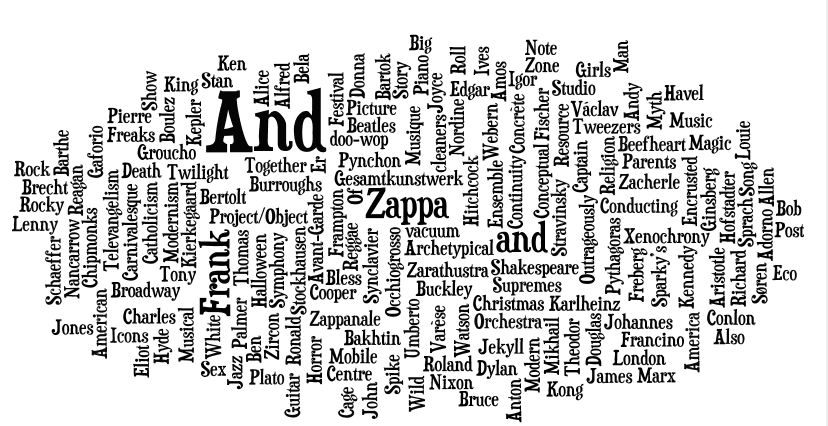
Zappa And The And: Ideas for cover of book

I am eventually in the closing stages of finishing the Zappa book. 
Playing around with some ideas for the cover - See below. 


Posted in Frank Zappa | Tagged , , , | 2 Comments

More Musicological Thoughts

I gave a musicology lecture the other days which focused on a number of techniques introduced by musicologist Phil Tagg. They are

Sonic Anaphone: Where the music extract resembles what it represents.For example motorbike sounds. For me this is similar to Charles Pierce’s ‘Icon’.

Kinetic Anaphone: Where the sound represents movement. For example here is an example of a piece that sounds like a moving train.

Tactile Anaphone: Where the sounds represents touch. For example soft string sounds or a gravelly voice.

Genre Synecdoche: Where a small aspect of the mix alludes to a larger genre. For example the following track by Shakti is not just a mix of european and Indian music – but alludes to the whole culture of latter also.

Episodic Marker: Where a musical sound or texture informs the listener that a new section in a piece of music is about to occur. This could be a drum fill, a guitar slide etc.

In the lecture we also examined Intentional or Extensional aspects of performance: essentially is the meaning of a piece of music related to a score (extensional) – or is musician interaction more important. Here is a great example of Pink Floyd involved in the latter.

Finally, we examined the ways in which time and place can impact a performance or recording. For example places such as Headley Grange (Led Zep) and Joe Meek’s recordings at 304 Holloway Rd – how did they impact the creative process and the sound of the recording.

Anyway – I would love to hear any indicative examples of these techniques.


Posted in Musicology | Tagged , | 17 Comments

One Direction Tickets – Secondary Ticketing

Here is another great post about secondary ticketing. I know first hand how much people are prepared to pay – it is scary!! Click here to read an in depth report via a Watchdog programme on Secondary Ticketing.

Posted in Live Music | Tagged , , | Leave a comment

Live Music Exchange: Mastering Tickets

There is an excellent post by Martin Cloonan on live music ticketing on the live music exchange. It reads as follows


On Thursday 23 February Channel 4’s Dispatches programme was entitled The Great Ticket Scandal. In it Channel 4 reporters went under cover to investigate what happens at two leading “fan exchange” sites, Viagogo and Seatwave. They found that contrary to the sites’ claims that they are simply a mechanism for fans to mutually exchange tickets, in reality they are clearing houses for a combination of semi professional and professional touts and promoters who sold direct to these “secondary” ticket agents. It was alleged that the biggest concert promoter in the world, Live Nation, is amongst those selling directly to the secondary market and thus benefitting from sales of ticket at prices which are well above the face value. The fallout from this seems set to continue.

What was at stake in the programme was two things. The first is fairness. Here fans who were at box offices and online at exactly the time that tickets went on sale were allegedly denied them because promoters had already sold chunks of primary tickets direct to the secondary market. This was portrayed as a well-established, routine, practice. Secondly, came deception. Both the sites claimed to be fan to fan, but evidence suggested that genuine fan exchange accounts were a maximum of a third of the sites’ business. In addition in cases where Viagogo was not being allocated tickets by the promoter, it used illicit means (such as multiple credit card buying) to buy tickets on the primary market which it then sold through its own website. In both cases the seller was not another fan, but the site itself. Considerable sums of money could be made here, the sites and promoters were alleged to be complicit in the deception, although no acts were named as benefitting from it.

To read the rest of the post – click the link below.  My big question is this – how does this relate to Wales?


Mastering Tickets.

Posted in Live Music | Tagged , , | Leave a comment

Update of Current Activities

Just a quick update of what I am up to at the moment. Firstly – the edited collection on Frank Zappa is about one month from being sent to the publishers! The plan is to get it on the shelves by the end of this year – so fingers crossed. When it comes out – I will post more details of chapters etc.

My chapter on Welsh Identity in music was realeased last month in Popular Music History. This has been a long time coming – it can be found here

I am also in the process of finishing off a chapter with my colleague Prof. Richard Hand on British Rock ‘n’ Roll in Cinema. It will be published in Spain in L’Atalante. Revista de estudios cinematográficos – more details soon.

Finally I have just started some research for The Higher Education Academy into how live music can interface with higher education. As part of the project I will be speaking at a couple of conferences in May – and will post more details about this when I have them

Posted in Academic, Frank Zappa, Live Music, Wales | Tagged , , , , , , | Leave a comment

The Relationship between The Elements of Music and Musical Form


My most recent musicology lecture focused on the relationship between musical form and the elements of music. I am looking for examples of the following – feel free to suggest –

Examples of pieces with unusual bar numbers between sections (verse – chorus etc)

Examples of how changes in rhythm delineate form

Examples of verse and chorus with same chords

Examples of artist specific sounds – ie Hendrix, Metheny etc.

Examples of texture/instrumentation delineating form

Examples of how metre delineates form – ie 3 / 4 to 4 / 4.

Examples of how sounds allude toward change of style

Examples of how sounds indicate a place or a time.

Examples of textures that outline the lyrics and or title of a song

With all of these questions you need to also ask ‘how’?

Posted in Uncategorized | Tagged , , , , , | 19 Comments