In 2009, I wrote about how the Zappa Family Trust were using Grand Rights as a way of stopping tribute bands playing the music of Frank Zappa. I eventually ended up doing a major research project on this, interviewing loads of bands, visiting the Zappanale Festival and eventually publishing a detailed article in Contemporary Theatre Review in 2011. After that, I moved onto other territory – eventually publishing my book Frank Zappa and the And. I was absolutely fascinated, and I must say a tad dismayed to see the latest development – with an article in The New York Times stating that Dweezil Zappa himself is now involved in this – actually being prevented from using the word ‘Zappa’ for his long standing band ‘Zappa Plays Zappa’. I don’t know, and to be honest don’t want to know why this has happened, but I think it is such a shame that this sort of thing is going on after the death of Gail Zappa. To be prevented from using your own surname in your band is crazy! It detracts from the great mans legacy I am afraid! The pic below is taken in the old East Germany – which has named a street after Frank Zappa. As far as I am concerned – this is a tribute!
I had a really interesting time presenting at Newcastle University last week. We had an interesting debate at the end of my lecture, which give me some ideas to consider the final chapter of my book. I am also considering some of the useful editorial comments I have received, in particular concerning why Sting disguising his Newcastle background in the first few years of The Police was given so much press.
Although Sting has been accused of and has accepted that he ‘disguised’ his Newcastle background during the early stages of his career in the late 1970s (when rock musicians were expected to be ‘authentic’), it could be argued that rock music has always been about self-invention. Rock vocalists such as Cliff Richard, Mick Jagger, Robert Plant and countless other sang/sing in American accents, but were never accused of neglecting their hometown backgrounds. Indeed artists such as Black Sabbath have been celebrated for portraying the authentic sound of the Birmingham steel industry, despite Ozzy Osborne’s American vocal inflections (see http://www.birminghampost.co.uk/whats-on/music/birmingham-birthplace-of-heavy-metal-4031445). Even the most ‘authentic’ of rock musicians’ are/were, in the words of Hugh Barker & Yuval Taylor, ‘Faking It’. Most people are aware that fake names abound in popular music, but it is usually less apparent that artist personas are also heavily disguised. Arguably the most famous example of this is Bob Dylan, often cited as an exemplar of authenticity, but who in reality is a buddle of disguises, most notably the playing down of his middle class background and the obvious visual and musical influences of Woody Guthrie. So the question is, why was Sting singled out as someone wanting to escape from his Geordie past? Is it that in the late 1970s, musicians from the provinces in the UK were not supposed to transcend their backgrounds? When he moved to London in 1977 was he expected to speak in a regional accent, in the same way that his Liverpudlian predecessors The Beatles had?
I am interested in any ideas anyone may have as to why such a big thing was made of Sting disguising his background. As typified by Dylan in the US and Joe Strummer in the UK (whose background was solidly middle class), is it deemed acceptable for middle class musicians to portray working class traits, but not the other way around? I am interested in any examples of other musicians who have experienced similar issues. Also – any examples of ‘middle class punks’ would be great. Facebook me or leave messages here. Thanks
Really looking forward to doing a talk at Newcastle University this Wednesday on my forthcoming book on Sting. The lecture is actually taking place in the very place where Sting started his career playing with Last Exit all those years ago – so it is a place of real significance. I have copied the abstract below – feel free to come along if you are in the area. It is in the Armstrong Building – room 2.09. Starts at 4.00.
Born in Wallsend, a mainly working class area of North Tyneside in the early 1950s, Gordon Sumner, aka Sting’s creativity and drive for success were established in the region of his birth, with vestiges of the spaces and places of his upbringing, social conditions and ‘Northern Englishness’ continuing to re emerge in his music long after he left the area. When broadly considering his relationship with Newcastle, it is possible to regard the years 1977 – 1985 in terms of ‘outward momentum, while close to the last 30 years have witnessed an increasing gravitation pull – during which his interface with the city has become more regular and profound. The process of exploring and sometimes exorcising his background through songs such as ‘All This Time’ (The Soul Cages, 1991) and ‘We Work the Black Seam’ (Dream of the Blue Turtles, 1985) has cumulated in his most recent album The Last Ship (2013), an album replete with local dialect and real and imagined characters based from his past: resulting in a vivid visual portrait of the time, places and spaces of his upbringing – through the lens of his imagination and memory. This paper will provide a very brief snapshot of my forthcoming monograph on Sting, published later this year. I will touch upon some of the themes highlighted in the book, by outlining Sting’s often problematic love/hate relationship with his hometown since forming The Police in 1977, with a particular focus on an analysis of the song ‘Dead Man’s Boots’, from The Last Ship (2013). I will also use the opportunity to show some of the images I have collected during the research. The book is due to be published later this year.
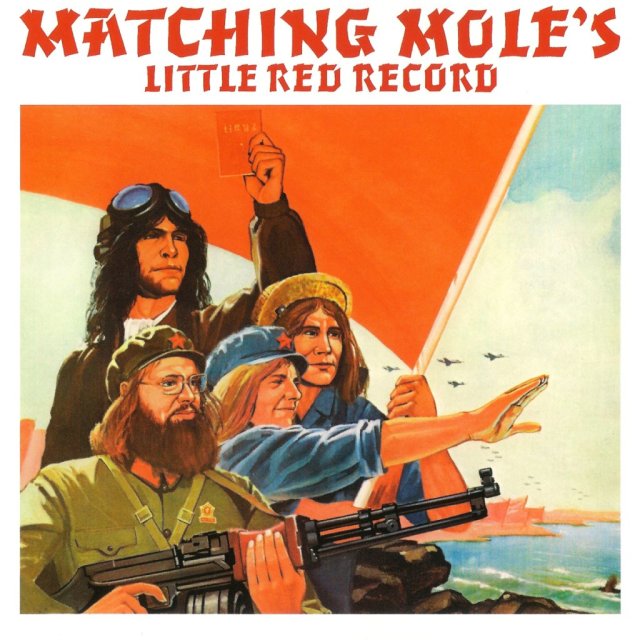
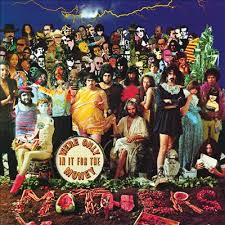
I have just sent off an essay to a potential publisher on Matching Mole – the relationship of the band to politics and genre boundaries. As can be seen below, their 2nd album is a direct take on a Chinese propaganda poster from the early 70s. I am interested in if anyone knows of any other albums that have based their albums so overtly on other images. The only other album I can think of off the top of my head is We’re Only in it for the Money by Zappa.
To me, both of these examples are highly political. In the case of Matching Mole, the title of the Matching Mole’s Little Red Record directly references Mao Zedong’s ‘Little Red Book’, once again incorporating the use of a pun, a device so common in Wyatt’s album and song titles. However, as stated the album artwork is also overtly based on Chinese propaganda images of the time, baring a clear resemblance to a poster produced around 1971 by the Red Eagle Corps of the Air Force, Nanjing. Considering Mao Zedong’s reputation as a war criminal, this was a controversial image for an album cover that in retrospect could be regarded as an ill thought out gesture by Wyatt and the record company. In addition to Mao Zedong’s Little Red Book, it is possible that Wyatt’s thinking was influenced by the socialist collection of songs entitled The Little Red Songbook, first published in 1909. The book contains the song ‘Red Flag’, that Wyatt recorded on his Nothing Can Stop Us (1982) album. More recent appropriations of the Little Red Book range from The Little Red Book of Obamunism to a House of Commons episode in November 2015, when the Shadow Chancellor John MacDonnell was heavily criticised for jokingly quoting Mao Zedong when attempting to make a point about the Chancellor of the Exchequer George Osborne’s selling off state assets to the Chinese.
So – examples of other album covers that have done something similar??
There is also a great list of ‘albums spoofing other album covers’ to be be found here.
The relationship of popular music to memory, identity and nostalgia is now well established in popular music studies, with academics such as Schulkind, Hennis and Rubin (1999) outlining how music, in particular from ones youth, can have strong nostalgic impact – evoking both general and specific memories of life events. Most importantly, the research of Schulkind et al. found a correlation between more general emotions and memory: suggesting the more emotion a song produced, the greater the likelihood it has to trigger associated memories. As I have documented in other published materials (for example Carr 2010, 2013, 2016), the relationship between music and emotion has been long contested from the time of Eduard Hanslick (1825-1904), with the polysemic nature of music meaning that a song with great emotional significance for one individual, will have little attachment for another, even if both individuals are from the same generation. More recent research from the likes of Janata, Tomic and Rakowksi (2007) and Barret, Grimm, Robins, Janata et al. (2010) have attempted to understand the means through which music can evoke memories and the conditions through which nostalgic responses occur. This paper proposes to build upon this research, although from a distinct methodological angle. As opposed to incorporating an ethnographic approach, where the researcher uses an often-anonymous community as the focus of their research, this project will overtly position the participants as `prosumers’ (consumers and producers) of a heritage based digital archive, which aims to establish an online collaboration and co-authoring space with the local community to accommodate and nourish collective musical memories in the town of Merthyr Tydfil, between the years 1955 to the present day. This multifaceted project, currently in its early stages of development, aims to investigate how memories of engagement with local, national and international popular music activity in the town, facilitates audiences and artists to negotiate their individual and shared identities and emotional responses, while also attempting to understand issues associated with articulating it. As the digital archive project develops, the community will learn how to engage with their musical history and prepare their own digital stories and materials (such as music files, newspaper cuttings, visual footage and photos). This emphasis on the interrelationship of emotion (including nostalgia) and memory, mediated through technology and musical activities such as performing, attending concerts and listening to music, is the focus of the project and the paper.
Bibliography
Barrett, F.S., Grimm, K.J., Robins, R.W., Wildschut, T., Sedikides, C. and Janata, P. (2010) ‘Music-evoked nostalgia: Affect, memory, and personality’, Emotion, 10(3), pp. 390–403. doi: 10.1037/a0019006.
BOYM S. (2001), The Future of Nostalgia, New York: Basic Books.
Carr, P (2010). ‘National Identity Versus Commerce: An Analysis of Opportunities and Limitations with the Welsh Music Scene for Composers and Performing Musicians’, Popular Music History (5/3), pp. 265–285.
Carr, P (2013). ‘The Big Note, Xenochrony and All Things Contextual: Frank Zappa and the And’. Book chapter in Paul Carr (ed.), Frank Zappa and the And: Key Essays on the Contextualisation of his Legacy. Ashgate, 2013.
Carr, P (2016). ‘The Impact of Virtuality in the Creation and Reception of the Music of Frank Zappa, in Sheila Whitely and Shara Ramarran (eds), The Oxford Handbook of Music and Virtuality, pp. 81 – 94.
Carr, P (2016). Final Thoughts on Musical Virtuality’, in Sheila Whitely and Shara Ramarran (eds), The Oxford Handbook of Music and Virtuality, pp. 613 – 625.
Carr, P. Magnetic North (2016): Sting, Place and Identity, Reverb. Forthcoming
DAVIS F. (1979), Yearning for Yesterday: a Sociology of Nostalgia, New York: Free Press.
Janata, P. (2009) ‘The neural architecture of music-evoked autobiographical memories’, Cerebral Cortex, 19(11), pp. 2579–2594. doi: 10.1093/cercor/bhp008.
Schulkind, M.D., Hennis, L.K. and Rubin, D.C. (1999) ‘Music, emotion, and autobiographical memory: They’re playing your song’, Memory & Cognition, 27(6), pp. 948–955. doi: 10.3758/bf03201225.
Van Dijck J. (2006), “Record and Hold. Popu- lar Music between Personal and Collective Memory”, Critical Studies in Media Communication, vol. 23, n° 5, pp. 357-74.
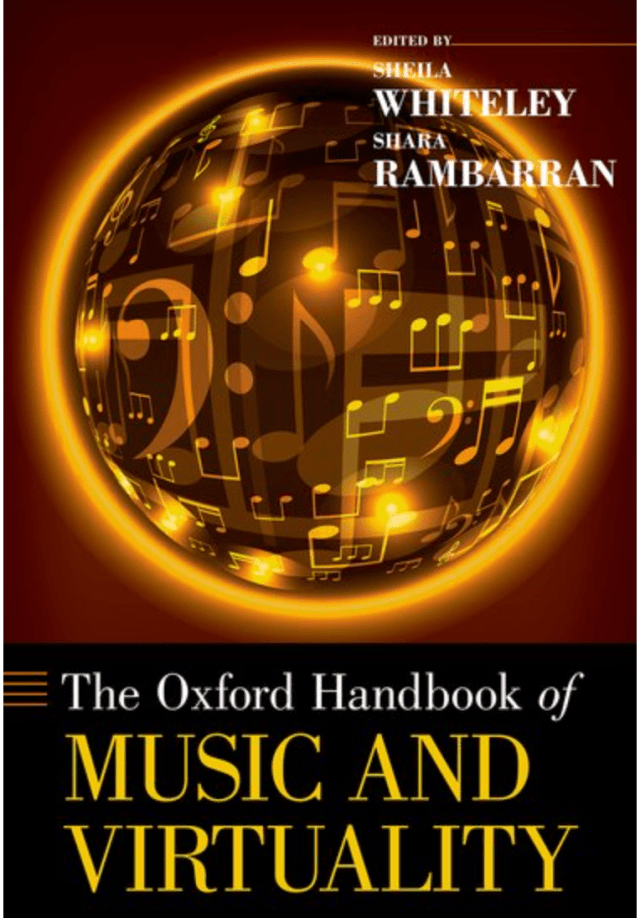
I have not blogged for over a month, so I thought I would write a quick post as a catch up of what I have been up to. The year kicked off with the publication of The Handbook of Music and Virtuality. I wrote a chapter for the book and edited another one, that featured several academics debating their perceptions around this fascinating subject. The book is edited by Shara Rambarran and the late Shelia Whiteley.
As we moved in January, David Bowie’s demise hit the headlines. I was surprised how it impacted me – reminding me of my pre teenage years in particular. Alongside a whole load of other writers, I was asked to write a short tribute for Wales Arts Review – you can find this here.
Throughout all of this, I have been working on a couple of other projects. The first is preparing for a Progressive Rock conference at Edinburgh University in May. My paper is on Matching Mole, I have copied the short abstract below
This paper proposes to analyse the two albums released by Robert Wyatt’s post Soft Machine band, Matching Mole. A band on the periphery of progressive rock history, the paper will provide both a historical context and musicological appraisal, with a particular focus on how these factors comply with genre labelling and protest narratives. Regarding the former, Kevin Holm-Hudson, noted the tendency of progressive rock to be “notably apolitical” (Holm-Hudson, p. 11), a narrative that is not typical of Matching Mole’s catalogue – in particular the 2nd album, Matching Mole’s Little Red Record (1972). This ‘apolitical’ stance is directly related to the music industries later categorisation of progressive rock, as it ‘narrowed its borders’, becoming based on factors such as classical influences, virtuosity, intellectualism, and of course the need for record sales.
Regarding genre classification, the eponymously named first album by Matching Mole (1972), ranges stylistically from ‘O’ Caroline’, a sentimental first person ode to Wyatt’s ex girlfriend Caroline Coon, to the wordless angular vocals of ‘Instant Pussy’, to ‘Signed Curtain’, a song which presents a perspective of the predictability of popular song format – resonating strongly with Adorno’s concept of ‘standardisation’. ‘Part of the Dance’ is the first track on the album to contain ‘authentic’ ‘progressive’ credentials – although as with much of Matching Mole’s music, it leans more toward jazz-rock than progressive rock, indicating that the album is a snapshot of a genre still defining its boundaries. In 1997, John Covach asserted that ‘Close to the Edge’ by Yes “challenges the listeners sense of stylistic boundary” (Covach, 23), and it proposed the two albums by Matching Mole do the same – with the added complexity that most of the boundaries on these albums were not embraced in any meaningful way by the music industries classification of the style.
As outlined by Simon Frith – the interplay of “musicians, listeners and mediating ideologies […] is much more confused than the marketing process that follows” (Frith, 88). This paper intends to investigate this tension by considering how this small but significant snapshot of the history of progressive rock informs us about the greater whole.
I have really enjoyed working on the paper, and have been lucky enough to interview Caravan’s David Sinclair and Dave MacRea, with Bill McCormick to come next week!
The final project I have been working on is tracking the history of music making in Merthyr Tydfil from 1955 to the present day. There is too much to say about this at the end of a blog post, but I will be delivering a paper on this in Prague in November. Will post more details soon, but for now – here is an abstract of what I will be talking about.
The relationship of popular music to memory, identity and nostalgia is now well established in popular music studies, with academics such as Schulkind, Hennis and Rubin (1999) outlining how music, in particular from ones youth, can have strong nostalgic impact – evoking both general and specific memories of life events. Most importantly, the research of Schulkind et al. found a correlation between more general emotions and memory: suggesting the more emotion a song produced, the greater the likelihood it has to trigger associated memories. As I have documented in other published materials (for example Carr 2010, 2013, 2016), the relationship between music and emotion has been long contested from the time of Eduard Hanslick (1825-1904), with the polysemic nature of music meaning that a song with great emotional significance for one individual, will have little attachment for another, even if both individuals are from the same generation. More recent research from the likes of Janata, Tomic and Rakowksi (2007) and Barret, Grimm, Robins, Janata et al. (2010) have attempted to understand the means through which music can evoke memories and the conditions through which nostalgic responses occur. This paper proposes to build upon this research, although from a distinct methodological angle. As opposed to incorporating an ethnographic approach, where the researcher uses an often-anonymous community as the focus of their research, this project will overtly position the participants as `prosumers’ (consumers and producers) of a heritage based digital archive, which aims to establish an online collaboration and co-authoring space with the local community to accommodate and nourish collective musical memories in the town of Merthyr Tydfil, between the years 1955 to the present day. This multifaceted project, currently in its early stages of development, aims to investigate how memories of engagement with local, national and international popular music activity in the town, facilitates audiences and artists to negotiate their individual and shared identities and emotional responses, while also attempting to understand issues associated with articulating it. As the digital archive project develops, the community will learn how to engage with their musical history and prepare their own digital stories and materials (such as music files, newspaper cuttings, visual footage and photos). This emphasis on the interrelationship of emotion (including nostalgia) and memory, mediated through technology and musical activities such as performing, attending concerts and listening to music, is the focus of the project and the paper.
Bibliography
Barrett, F.S., Grimm, K.J., Robins, R.W., Wildschut, T., Sedikides, C. and Janata, P. (2010) ‘Music-evoked nostalgia: Affect, memory, and personality’, Emotion, 10(3), pp. 390–403. doi: 10.1037/a0019006.
BOYM S. (2001), The Future of Nostalgia, New York: Basic Books.
Carr, P (2010). ‘National Identity Versus Commerce: An Analysis of Opportunities and Limitations with the Welsh Music Scene for Composers and Performing Musicians’, Popular Music History (5/3), pp. 265–285.
Carr, P (2013). ‘The Big Note, Xenochrony and All Things Contextual: Frank Zappa and the And’. Book chapter in Paul Carr (ed.), Frank Zappa and the And: Key Essays on the Contextualisation of his Legacy. Ashgate, 2013.
Carr, P (2016). ‘The Impact of Virtuality in the Creation and Reception of the Music of Frank Zappa, in Sheila Whitely and Shara Ramarran (eds), The Oxford Handbook of Music and Virtuality, pp. 81 – 94.
Carr, P (2016). Final Thoughts on Musical Virtuality’, in Sheila Whitely and Shara Ramarran (eds), The Oxford Handbook of Music and Virtuality, pp. 613 – 625.
Carr, P. Magnetic North (2016): Sting, Place and Identity, Reverb. Forthcoming
DAVIS F. (1979), Yearning for Yesterday: a Sociology of Nostalgia, New York: Free Press.
Janata, P. (2009) ‘The neural architecture of music-evoked autobiographical memories’, Cerebral Cortex, 19(11), pp. 2579–2594. doi: 10.1093/cercor/bhp008.
Schulkind, M.D., Hennis, L.K. and Rubin, D.C. (1999) ‘Music, emotion, and autobiographical memory: They’re playing your song’, Memory & Cognition, 27(6), pp. 948–955. doi: 10.3758/bf03201225.
Van Dijck J. (2006), “Record and Hold. Popu- lar Music between Personal and Collective Memory”, Critical Studies in Media Communication, vol. 23, n° 5, pp. 357-74.
Hi was asked to write a short piece on David Bowie this week for Wales Arts review. I have copied the first half of the short essay below, but to read the rest, and many other tributes, click here.
David Bowie’s birth date of January 8th has always had resonance for me. He shares this with both his hero Elvis Presley and my late father in law, so through my adult years it was a date I always remembered. January 8th 2016 however was to be different – this marked the release Bowie’s new album Blackstar – this was special – distinct – anticipated. Although work commitments resulted in me not being able to listen to the album during the first couple of days after its release, the Bowie headlines that dominated both mainstream press and social media took a while to resonate on the morning of January 11th.
After initially being convinced my Facebook feed was simply congratulating the great man on his latest artistic achievement – the reality slowly began to hit home. David Bowie was dead! Throughout the day, I listened to Blackstar several times, trying to make sense of Bowie’s death as I went about my daily duties. Being one of the pre-teen generation who witnessed first-hand Bowie’s iconic Top of the Pops performance of ‘Starman’ on July 6th 1972 , my first response was one of emotion. This was a guy who had always been around. He was a signifier of my youth and I felt like I had lost part of it. More significantly, I remembered Bowie the artist. Ziggy Stardust remains the only album I have purchased three times – on both vinyl and CD. I was also reminded of the fact that Bowie was beginning to populate academia and the establishment. The Kingston University professor attempting to understand Bowie’s creative impulses by dressing like him for a year and The Victoria and Albert Museum Bowie archive came to mind. Closer to home, Bowie’s biographer, Paul Trynka was in the process of enrolling to do a PhD under my supervision – investigating Bowie’s complex personae. Having recently read Paul’s fabulous book, Starman (2012), Bowie was close to my heart on January 11th.
A recent article in The Independent outlined some recent research on why we like certain types of music-stating our likes are clearly linked to our personalities. It stated:
Why does some music bring us to tears while other pieces make us dance? Why is it that the music that we like can make others agitated? And why do some people seem to have a natural ability to play music while others have difficulty carrying a tune? Science is beginning to show that these individual differences are not just random but are, in part, due to people’s personalities.
Drawing on their PhD research, the authors assert that it is possible to classify our engagement with music into three categories
Empathisers (Type E) have a strong interest in people’s thoughts and emotions. Systemisers (Type S) have a strong interest in patterns, systems and the rules that govern the world. And those who score relatively equally on empathy and systemising are classified as Type B for “balanced”.
The data displayed empathisers to prefer mellow music that had low energy, sad emotions, and emotional depth, while systemisers preferred more ‘intense’ music, in addition to music with ‘intellectual depth and complexity’.
Interestingly, the research also appears to make links between personality and musical ability and most importantly, between musical taste and and the way we think, making it potentially Important research for music therapy.
This offers an interesting addition to the the impact of music on us. I seem to be what the research classifies as ‘Type B’ – somewhere between the two extremes, although I need to think further on how this impacts my musical tastes and ability. I would be interested what classification other musicians fall in to – my hunch is that it will be ‘Type B’?
I have spent today playing around with some ideas for a new book I am in the early stages of working on. There are a lot of sweeping statements in there at the moment – but this is where I am so far – 2500 words in one day! I am interested in any examples of any of the ideas I am discussing – or let me know if you don’t agree. This will also act as some basic lecture notes for my students.
The first thing we need to consider when considering the difference between song arrangement and track, is to consider the ontological differences between them. As discussed in a previous post, the song consists of the basic melody, the chords, and outline of the form. The important thing to remember is that the song has no specific sound, the arrangement is a specific setting of the song and the track can be considered the specific recorded strands that make up a record (for example a drum strand or guitar strand)
In his book, The Poetics of Rock: Cutting Tracks Making Records, Albin Zac is clear that the Song Arrangement and Track are ontologically independent – so we can discuss them independently and collectively. When we look at the attached mind map, we can see the Song, Arrangement and Track being part of the record – but how can we use this to talk about music?
Regarding the song, it is interesting to consider how the copyright of a Song is divided up into two components: lyrics and melody – so the copyright is divided, usually into 50% lyrics, 50% ‘music’, or variations thereof. Probably the most famous exemplar of this agreement is the work of Lennon and McCartney, who were known for their symbiotic lyric/music working relationship. This ‘even split’ however becomes much more complicated when a band composes a song through the rehearsal process – where they may simply develop ideas via jamming. The copyright issue then potentially becomes far more complicated, as we have to ask the question – who owns what? On the one hand, bands like U2, who regardless what they produce, tend to divide the royalties between the band members equally. Where as bands The Beatles or the Rolling Stones for example, attribute(d) copyright far more specifically. This however has its complications, as musicians such as Bill Wyman (the original bass player in the Rolling Stones) for example recounted in an issue The Australian, he felt he was simply not getting the songwriting credit he felt he deserved.
So – regardless what song we are analysing, it is useful to consider, how it was put together? How is copyright divided and why? What impact can copyright strangleholds have on the creative process and band dynamics? At the turn of the last century, through to the Tin Pan Alley era, it is interesting to consider how songs were often considered as independent entities, often represented via sheet music – which at one point would be played on home pianos and, after the emergence of the record industry, were usually recorded by more than one artist. An indicative example of this would be the countless versions of songs released as part of the American Songbook – for example ‘Autumn Leaves’, ‘Stella By Starlight’, ‘All The Things You Are’, etc. However, over the years, we have gradually begun to relate songs to specific arrangements and recordings. For example, when we listen to classic songs like The Beatles’ ‘Yesterday’ or Louie Armstrong’s ‘What A Wonderful World’ – it is difficult to disassociate them from an ‘original’ – despite the countless cover versions that have taken place over the years. Suddenly the concept of a song is no longer an abstract entity – it somehow becomes ‘real’. As we will see later, in some instances, these perceptions can be ‘age dependent’ – depending on the version we heard first and how that particular recording resonates with our past.
During the Tin Pan Alley era of course, songs were written in spaces that looked like small basic rehearsal rooms – basically a small room and a piano. A typical process would be a songwriter or songwriting team given the task to write the song, which was then given to an arranger, which was subsequently taken to the recording studio to be made into a record. So the Song – Arrangement – Track took place not simultaneously but in a linear fashion. It was also common during Tin Pan Alley period that the person/people who wrote the songs, where not those who performed it. This is interesting, as since the era of the ‘singer-songwriter’ in the 1960s, we take this union for granted – a relationship that for this writer at least results potentially in a greater perception of authenticity. This of course begs the question – where does the song we are analysing fit in on this continuum? It is important to point out the separation of singer and songwriter is by no means a phenomenon of the past, nor indeed a clear separation – with Paul McCartney writing of ‘Step Inside Love’ for Cilla Black, or more recently Ed Shearing’s un-named song for Justin Bieber being indicative examples where the demarcation lines can get blurred.
Both McCartney and Shearing are indicative examples of the tendency of songwriters to be the individuals who are celebrated in the history of popular music. Even if this is disputed – one this is for sure – songwriters usually get most of the money! It is interesting to consider how the role of the arranger performer has changed over the years. How do the mainly anonymous arrangers who worked on the Tin Pan Alley era catalogue, through to celebrated arranger/producers such as George Martin, through to sampling and the modern day DJ relate to each other? How are they similar and distinct? How has the role of performers, who are not songwriters, developed since the emergence of Elvis Presley for example?
It is also interesting to consider how the awareness of songwriters has (possibly) become subsumed because of the way we consume music. If we listen to music via social networks and streaming, no longer having access to album/cd covers, has the arrangement and track become more noticeable than some songwriters (the person who instigated the song in the first case)– as we no longer see their names? It is also intriguing to consider if there is a generation emerging that simply don’t care who wrote the songs. An indicative example of this would be represented in TV programmes such as XFactor – where the performer takes a very firm precedence over the songwriter – using the song a vehicle to instigate their stardom. This show of course is a series that (usually – not always) celebrates the disunion of the songwriter and performer – possibly one of the reasons why it is not associated with high notions of authenticity?
Not being a songwriter in the traditional sense, my own experience with the songwriting process has usually been in the rehearsal room, where fragments of ideas are brought into this space, then fleshed out by band members. With this process, the rehearsal can be seen to be responsible for formulating what the song is – it is essentially used as a compositional tool, while the ‘arrangement’ of the song take place simultaneously! This of course can lead to copyright issues – unless you adopt the democratic approach to songwriting attributed to U2 above. With copyright being such an important part of the music industry, it is important early on to consider intellectual property ownership – it therefore makes sense to discuss ‘percentages’ at the end of rehearsals – not once a record is released!
Depending on the sort of music you are participating in, it is also important to consider the role of computer technology in the songwriting process. This can range from simply using the technology to arrange a song, cutting and pasting sections, correcting mistakes, experimenting with sounds, to the technology actually being responsible for the basis of a song. For example a songwriter could sit down at a workstation with little inspiration, but the use of a drum groove, a sample, or an inspirational sound could instigate the song itself. With this type of creativity, the song – arrangement – track are no longer a linear process, but simultaneous – they all depend on each other. Unlike the song, which as mentioned earlier was originally represented via sheet music or a lead sheet, arrangements of songs are represented either via performances, or recordings, unlike ‘classical’ music, which are represented via a score. The difference between these of course is that scores don’t display any instances of ‘real events’ (sounds) – they are a guide to performance rather than the performance itself. Albin Zac, influenced by the work of Walter Benjamin would say that these recordings/arrangements are autographic – they display traits of specific events, which are recorded permanently via the track. This leads to questions regarding the publications which transcribe the instrumentation of specific popular music songs – what do they actually achieve? We need to be clear about this, they are useful to consider a particular dimension of the instrumentation and texture of a song, which may lead to us being able to understand notes and rhythm relationships, but if we want to replicate the recording exactly – we need to listen to it. This is also the case when attempting to understand why particular instrumentations are put together in popular music – the sounds and production values, alongside the actual notes need to be considered. This of course leads to the concept of the track – the specific recordings of the above-mentioned instrumentations.
It is important to point out, that just as lyrics and music have a separate copyright, so does copyright in the recording. It is important to remember that when a record is played on the radio for example, both the songwriter(s) and owners of the copyright in the recording get paid. The owners of this copyright are usually the record company – unless you do what artists such as Frank Zappa achieved – and buy the copyright from them. Illegal use of copyright in the recording is of course one factor that can lead to copyright infringement cases. It is possible to steal the intellectual property of a song, by illegally using a melody, riff or chord sequence for example from a well-known tune. What is more common however, since technology easily facilitated it, is infringement of the record or track – better known as sampling. When I was a child, I distinctly remember a series of albums entitled ‘Top of The Pops’, cover bands performed where chart hits of the day. I used to always wonder why it was not possible to simply release a record with the original artists performing the hits of my childhood. It was only later I found out that this was related to prohibition of copyright in the recording – where as the artists give permission for the cover version on these records, the record companies did not. It was not until the releases by labels such as KTel that compilation albums featuring original artists became more pervasive. These legal issues will not be covered here, but it is interesting to consider the various other relationships between song, arrangement and track when analysing music. When we listen to specific recordings – how can we differentiate then from live performances – in other words how is the track distinct from the arrangement? As already noted, is it possible to ascertain from interviews or indicators in the recording what the process of putting the song together was? Was it simultaneous or linear? With the above information in mind – we can begin to think about these processes.
If we consider the song ‘Puppy Love’ as a very brief indicative example. The original song was written in 1960 by Paul Anka when he was 17, reporting on the break up of a teenage romance. This was followed by a version of Donny Osmond in 1971, then S Club Juniors in 2002. It is interesting to consider how three different versions of one song interrelate. Working backwards, when listening to the version by S Club Juniors, it is fascinating to compare it to the earlier Donny Osmond version. Firstly, it is easy to hear that the S Club version has deliberately incorporated the Osmond arrangement – having a similar instrumentation, use of backing vocals, and similar emotive leave vocal. Most importantly, it is exactly the same length! It is clear that an attempt has been made to copy the Osmond arrangement and market it to a different audience – so it appears new (to the younger audience). As mentioned earlier, I suggested that many songs such as ‘Yesterday’ by The Beatles have a clear ‘universal’ original – but this appears to break down with songs such as ‘Puppy Love’. My own reference is firmly positioned with the Donny Osmond version, which I remember hearing as a child. However, many of the students I teach today recall the S Club version as linking into their childhood. Additionally, the original version by Paul Anka would have been heard by my own parents generation as an original, with my mother being a teenager when it came out. What makes songs such as this so interesting is a listener’s generation has a clear part to play in what they consider to be the ‘original’ version of a song – which is not necessarily the literal original.
So, we can discuss how and why songs have been developed via arrangements and tracks, in addition to how and why they resonate with us – depending on our age. When we listen to the original mono recording by Paul Anka, the influence of the arrangement is immediately obvious on the later versions, it being easy to hear instrumentations such as strings, and most importantly – the emotive voice – as part of the arrangement and track respectively. When we consider the emotive vocals, it is also interesting to consider if it is ‘real’ or ‘fabricated’. In the case of all of these instances – I would suggest the latter. In a similar way to Michael Jackson’s famous emotional outbreak in the recorded version of ‘She’s Out of My Life’ – which was often replicated live, the emotion in all versions of ‘Puppy Love’ appear to be ‘producer led’. Although I have no evidence to prove this – they all sound like they have been told, by the person leading the session to sing the song with a particular vocal quality – which of course would resonate with the record companies audience demographic. More work of course needs to be done in discussing how this emotionalism is delivered and received – but that is another discussion (although the evoking of nostalgia appears to be the object of all three records). It is also important to consider the differences between recordings – for example they are all in different keys – so why? The first version is sung by a 17 year old boy, the 2nd a 12 year old boy and the third a group of teenagers. Does this have something to do with the choice of key? As a final unifying point, when Paul Anka wrote the original song, it is suggested he used the Tin Pan Alley linear framework – despite the fact that he sung the song. After writing the song, he would have had the song arranged, prior to it being recorded – although at the point of writing, I don’t know if he recorded the vocals live with the ensemble (I suggest not). Interestingly, I would imagine that the Osmond and certainly the S Club versions would have simply added vocals to a backing track, but strong supporting traits of the producer led emotionalism outlined earlier.
That’s it for now – I will add to these as I move toward publishing the book – more later.










 Professor Paul Carr Music Consultancy