The History of Acid Jazz: Part 2

thumb_IMG_1047_1024

I was involved in an interesting discussion last week for Loose Goose Radio on the history of Acid Jazz. I got the opportunity to reflect on my time in the James Taylor Quartet and how without even realising it – I was inadvertently involved in a style of music that became Acid Jazz. To listen to the show – either click here – or listen below.


Posted in Musicology | Tagged , , , | Leave a comment

Why Do Artists such as Sting Receive Criticism When Engaging in Fundraising and Protest?

Embed from Getty Images

When doing some of the last bits of research for my Sting book – I have been pondering on why he received so much criticism off the press for his stance on human rights protest. Before I get around to Sting – here is a comment directed at Peter Gabriel after he had just completed the ‘Conspiracy of Hope Tour’ – with Sting, in 1986.

To suggest that anyone is here to further their own careers would be the worst form of cynicism. But by the time this tour is over, Gabriel should be a major star – these performances will expose him to the masses he has yet failed to reach, and his musical loquaciousness and fiery performance will gain him scores of new fans. While many people will leave these shows with the urge to send $25 to Amnesty, suspicions are that far more will first choose to spend their money on Gabriel’s phenomenal new album

In 1993, another article in the UK national press, reflected on how the national press had slated Sting over the years up to that point.

Sting’s announcement that he was setting up a foundation to raise public awareness of the devastation of Brazil’s rain forests, in particular the Xingu Park, an area of native land the size of Switzerland, gave them [the press] the impetus to wound. He was a do-gooder, a dilettante; worst of all, a bore… “What a career move,” cynics hissed, as he introduced heads of state and chat-show hosts to Chief Raoni, leader of the Kayapo tribe, whom they would remember more for the plate that distended his bottom lip than for the dignity of his pleas for the protection of his people and their environment (The Times, 1993)

This narrative was continued seven years later in the Sunday Times

The trouble is, though, since Sting decided to promote his new CD by sewing it into the bottom lip of an Amazonian tribesman, singing about trees has been seen as a bit uncool (Sunday Times, 2000)

What is interesting, is that this criticism can be seen to cross over to the music itself – not only fund raising concerts and charitable organisations. It is well documented that Sting’s close friend Paul Simon received criticism when he released Graceland in 1986.The Album’s sophisticated musicianship, post-modern combination of styles, use of jazz musicians, and inter-cultural cooperation introduced many listeners to the sounds of South Africa for the first time, with Simon even including “revenues from the album’s promotional tour to support charitable projects in Africa and in African-American communities. Despite these honourable intensions, Simon, and by default the album received criticism for complying with hegemonic western power relations. Concisely speaking, Simon and his representatives were deemed still to have the controlling power in terms of who had access to factors such as marketing, finance, technology and intellectual property.

This begs the question, do Sting’s songs such as ‘They Dance Alone (Cueca Solo)’ and ‘Desert Rose’ de contextualise the music and traditions of oppressed countries, or do they do as Sting intended – raise awareness of oppressed people and the case of ‘Desert Rose’ – music that has limited commercial outlet to be given a global presence? Protest song in both live and recorded format can also be considered a symbolic act of solidarity with the countries or localities represented, which in the case of Sting, is usually backed up with fund raising initiatives and personal appearances – making his protest gesture not just theoretical, but practical.

I am interested in any thoughts anyone has about this – why do artists such as Sting receive criticism from the press for fund raising and engaging in protest?

Posted in Musicology | Tagged , , , , , , , | 4 Comments

The History of Acid Jazz Podcast

I am having a chat tomorrow with the guys down at the Loose Goose Podcast on the early years of the Acid Jazz movement. In order to do a bit of prep I raided my old vinyl collection and found a few ‘records’ I was involved in. Did not even realise that I had some of these – brings back memories of times – when I used to simply describe myself as a ‘guitarist’!

thumb_IMG_1047_1024

One of the things I will probably talk about are the influences of the movement when I was involved, and how these influences for me anyway were related to music I had listened to for a long time – in particular artists such as Grant Green and Jimmy Smith. It was also surprising to me how popular this music was to young people my own age (then!). To finish, here is a bootleg recording of JTQ live in Milan during a 5 day residency – featuring me on guitar, Steve White on Drums, James Taylor on Hammond, John Wallace and John Willmot on tenor sax. Excuse the mistake at the start – the music kicks at around 1:17. It displays perfectly the post modern phenomena of how old sounds were beginning to mean things to a new generation. More of this on the podcast.

Posted in Academic | Tagged , , , , , , | Leave a comment

Kingsley Ward Rockfield Fellowship.

thumb_2015-07-09 10.00.40_1024
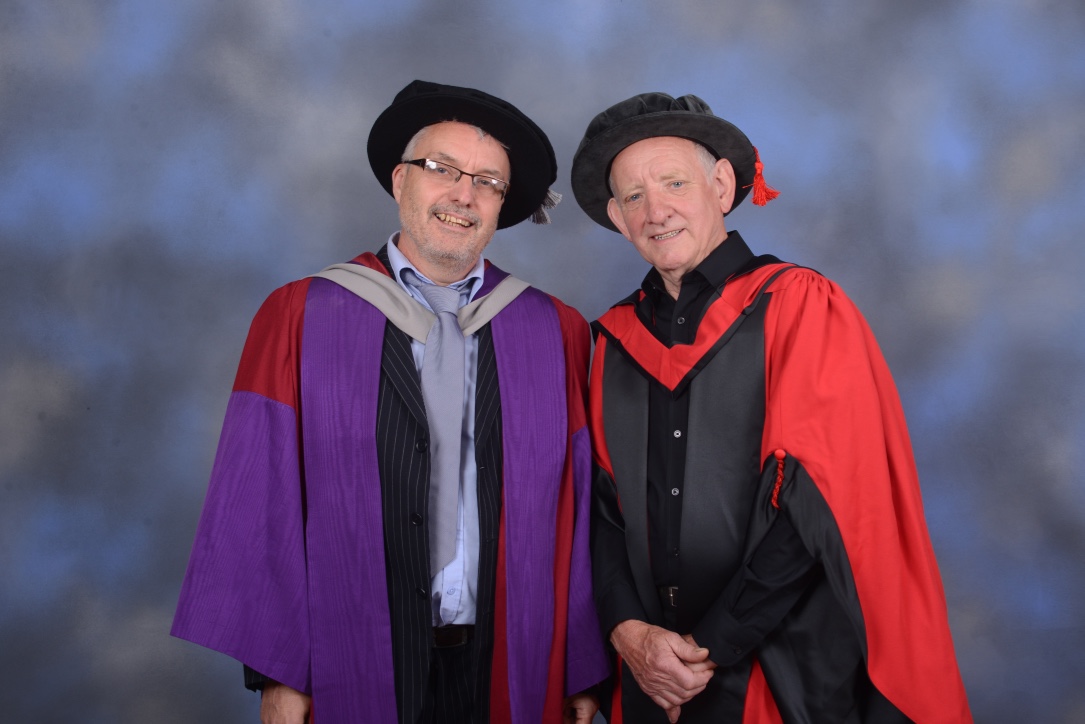
I had the honour last week of presenting a talk prior to Rockfield Studio owner Kingsley Ward receiving a Fellowship from my university. I have copied a transcript of the talk below for those that are interested.

Pro-Chancellor
I present to congregation, Kingsley Ward, for the award of Fellow of the University. Kingsley is the driving force behind Rockfield Studios, a recording studio just outside the village of Rockfield, near Monmouth. This recording studio is one of the most important recording studios in the history of British popular music – a place where some of its most prestigious recordings have taken place over the last 40 plus years.
The origin of Rockfield Studios goes all the way back to 1961. Kingsley’s, first studio effectively began with a simple mono recorder, which was used to record his brother Charles’ acoustic guitar based songs. The duo – the Charles Kingsley Combo, were then working the pubs and clubs of South Wales, and like many young songwriters, had little idea what to do with their creative output. Having met George Martin, who later of course was to find fame producing The Beatles, they soon found themselves with a recording contract, and were soon travelling to London to work with another iconic record producer – Joe Meek. Influenced by Meek’s ‘do it yourself’ mentality, Kingley and Charles decided to set up their own studio back home in Wales. It was this studio, which started in their parents’ attic, which was later to become known as ‘Rockfield’. Starting off as a ‘demo’ studio, in the early 1960s, by 1965 the studio had moved into the granary of their parents’ farmhouse, becoming one of the first recording studios to offer ‘residential’ opportunities for musicians.

In 1969 a second studio was built, The Coach House Studio. This studio incorporated an important piece of technology – an eight-track recorder, a rarity outside of central London at that time. One of the first groups Kingsley recorded in the new space was none other than Black Sabbath, who after forty plus years are still recording at Rockfield. This new space also provided Rockfield with its first number 1 record in the early 1970s: Dave Edmunds’ – ‘I Hear You Knocking’, recorded in the Coach House Studio with Kinsley as engineer and producer.
A third studio was constructed in 1973 in the large stable block of the farmhouse – The Quadrangle Studio. One of the first groups to record in this new studio were Queen: who recorded Sheer Heart Attack and A Night at The Opera. The latter included large parts of the song ‘Bohemian Rhapsody’ – one of the most iconic songs in the history of popular music.
Today, Rockfield is one of the very few independent recording studios surviving from the 1960s. It still proves to be an amazing environment and location in which to record music and is undoubtedly one of the most prestigious and historically important recording studios in the world. In addition to those already mentioned, artists that have recorded there are too numerous to mention, but include, in no particular order, Simple Minds, Robert Plant, Paul Weller, The Stone Roses, The Charlatans, New Order, Budgie, Bullet for My Valentine, Judas Priest, Moterhead, Rush, Oasis and Coldplay. The list goes on.
Kingsley’s drive and ambition to build a company out of nothing, the ability to seize an opportunity and to develop his ideas over time and not be afraid to change those ideas if needs be are legendary in the industry. To take risks in investing money and not being afraid to follow his own instinct, for example when buying Neve consoles at a time when no other studios were doing so, or to then sell those consoles and replace them with vintage equipment at a time of technological advancement, represent characteristics in a person that is a leader in their field.

Today, Rockfield is still a family run business, with Kingsley at the helm. It now not only offers top recording facilities, but also Recording Masterclasses to assist young student engineers and producers. Indeed over the last several years, under the guidance of course leader Andrew Gwilliam, who nominated Kingsley for the award, and who helped me greatly in the detail of this presentation, some of our own students at the University of South Wales have benefited from visiting Rockfield and from Kingsley’s expertise.

Kingsley is passionate about what he does at Rockfield and all that it stands for, not only within and for Wales but also globally. When it started back in the 60s he was told by the mainly London based record industry that it would never last, being so far away from the epicentre of the industry. This perception has certainly been proved wrong!

Kingsely has made a significant contribution to the musical and cultural life of Wales and the recording industry. Pro-Chancellor, it is for these reasons that I present to congregation Kingley Ward, for the award of Fellow of the University.

Posted in Music Industry | Tagged , , , , , | Leave a comment

Noel Gallagher dominates vinyl sales in the UK in 2015

There is an interesting post in the Guardian stating that no other than Noel Gallagher is dominating both the single and album vinyl charts. If this is not surprising news – I am also alarmed at the number of male artists who seem to be popular for these sorts of purchases. Are we also saying that it is mainly males who purchase vinyl – and if so WHY??? I have not purchased an album for 20 years – but I have a 19 year old son who does. Needless to say – it is not on my daughters radar!! What is the reason for this? Sorry – I don’t know the answer.

via Noel Gallagher dominates vinyl sales in the UK in 2015 | Music | The Guardian.

Posted in Musicology | Tagged , , , , , | Leave a comment

Why Apple Music Doesn't Stand a Chance Against Spotify…

This is a bit of a bizarre post by Digital Music News (see below) – stating that Apple Music does not stand a chance against Spotify – then giving no reason!! I started my 3 month free trail yesterday – but intend to keep my Spotify subscription going. For me the jury is still out – although I think I prefer the Spotify interface. There is also a strange dilemma that Spotify subscribers like me face – losing your playlists – that you have build up for years!! I very much like the way Apple Music interfaces with iTunes – but I still need more time to work out if it is easier to use. Would be interested in any thoughts.

via Why Apple Music Doesn't Stand a Chance Against Spotify… – Digital Music NewsDigital Music News.

Posted in Music Industry | Tagged , , , , , | 2 Comments

Recording Sales Would be 17 Times Higher Without Piracy, UMG Study Finds

Where are you on the continuum of ‘free’ or ‘subscription’? I have personally being paying to Spotify for around 4 years now – as I think it is the only way the music industry has a future.The ‘free’ model for me is akin to asking me to play a gig for free – not only is it not sustainable, but it also sends the wrong message – Music Should Not Be a Free Commodity!

via Recording Sales Would be 17 Times Higher Without Piracy, UMG Study Finds… – Digital Music NewsDigital Music News.

Posted in Music Industry | Tagged , , , | Leave a comment

Apple Music to pay royalties during free trial

Common sense has prevailed. Well done Apple Music for having the guts to make a U Turn!

via Apple Music to pay royalties during free trial: 'We hear you Taylor Swift' | Technology | The Guardian.

Posted in Musicology | Leave a comment

Some Sensible Words from Taylor Swift on Apple Music

I have to say – sensible words from Taylor Swift (See below). Apple’s mentality is very similar to some other parts of the industry: support bands being asked to play for free, young bands being asked to play for experience, restaurant and hotel owners who refuse to pay a fair price for live music, etc, etc. Apple are basically expressing a long standing perception by some that it is ok for musicians to offer their services for free. Imagine the outrage if we were to expect a free iphone, or to visit a restaurant and expect them to knock up a pizza ‘for the experience’, or to go to a hotel and expect them to give you free accommodation! It is akin to me asking Apple to give me free telephone calls on my mobile so I can build my business up. The concept is simply absurd and morally reprehensible. I am totally behind the idea of a paid subscription (I have subscribed to Spotify for years) service and even a three month trial. But if there is a three month trail – APPLE SHOULD PAY FOR IT – not the musicians!

Taylor Swift criticises 'shocking, disappointing' Apple Music | Technology | The Guardian.

Posted in Music Industry | Tagged , , , , | Leave a comment

Sonos keen to support Apple Music alongside Spotify and other rivals |

If ever there was a case of ‘technological determinism’ driving the music industry – this is it. See the recent article in The Guardian below

Sonos keen to support Apple Music alongside Spotify and other rivals | Technology | The Guardian.

Posted in Music Industry | Tagged , , , , , | Leave a comment