The Use of Loops in Popular Music

I am presenting a paper with a colleague on the creative use of ‘loops’ at a conference at Liege University in early March. To get some creative ideas flowing, I thought it would be useful to blog the development of my thoughts. The conference abstract is as follows –

The Impossible Made Real: An exploration of the immediacy and hypermediacy of signal processed loops on in the work of electric guitarist composers.

All popular music has a degree of repetition at a micro and/or macro level, a paradigm that has also been shown to be true in both the European classical tradition and music of most other cultures. The occurrences of these events can range from the smallest motific melodic fragment, to ‘phrase’ (question/answer) and ‘section’ (verse chorus) repetitions, to riff based harmonic/melodic patterns.[1] These repetitions usually occur on an intra compositional basis, but as evidenced by the pervasiveness of sampled loops in contemporary dance music and rap, can also work on inter compositional levels, resulting in potential conceptual allusions of musical (and non musical) factors between texts. This paper intends to examine the creative incorporation of a specific type of repetition in popular music, that of loop-based composition and improvisation within the work of electric guitarist composers. After presenting a brief overview of the history of tape and digital based looping as pertinent to popular music and the electric guitar in particular, the paper will examine the means through which looping enables guitarists to interface with listeners on a more profound level than more widely debated performance paradigms, with analysis not only able to consider factors such as technical capacity, timbre generation, versatility etc,  but also the intricacies of the disembodied voice that looping precipitates.[2]As noted by academics such as McClary,[3] Auslander[4] and Zac[5] electronic modes of production often aim to precipitate ‘immediacy’ in the listener, becoming noticeable only when closely scrutinizing the text. However, loop based guitarists such Robert Fripp, David Torn and Bill Frisell often straddle the divide between the immediacy of more conventional electric guitar performance paradigms and the practice of hypermediacy, where the music acknowledges multiple acts of representation and makes them apparent to the listener.[6] Susan McClary’s observation that ‘the closer we get to the source, the more distant becomes the imagined ideal of unmediated presence and authenticity’[7] is noteworthy, and this paper intends to implement this methodology by exploring the means and impacts through which the listener and performer can interface with both ‘real’ and ‘virtual’ environments, including the man vs. machine dynamic.

Although the subject matter of this abstract focuses on guitar players, and is very likely to change slightly, we intend to build a typography of the use of loops in popular music, before figuring out how selected guitarists use them.  Over the next few weeks I will be presenting some initial thoughts on the ways that loop’s can be considered both on the impact of the original source, and also the ways in which they have been creatively employed in the new work.

More later – but any thoughts off anyone in the meantime very welcome.


[1] Richard Middleton refers to short and long repetitive cells as musematic and discursive respectively.

[2] Alongside its associated lack of authenticity.

[3] Andy Bennett, Barry Shank, and Jason Toynbee, The popular music studies reader (Routledge, 2006), p23.

[4] Philip Auslander, Liveness (Routledge, 2008), p76.

[5] Albin Zak, The poetics of rock (University of California Press, 2001), p47.

[6] Jay David Bolter and Richard Grusin, Remediation (MIT Press, 2003), p.33.

[7] Sheila Whiteley, Andy Bennett, and Stan Hawkins, Music, space and place (Ashgate Publishing, Ltd., 2005), p167.

Posted in Academic | Tagged , , , , , , | 2 Comments

No one had ever heard a guitar played like that before: The redefinition of the jazz aesthetic in the work of post 1970’s electric guitarist composers

I wrote a book chapter a while ago as part of an edited collection entitled ‘De Canonizing Music History’. The chaper looks at the position of the electric guitarist as a jazz composer. Anyway, I have noticed that the book does not appear to be turning up in any searches on the electric guitar – so this is an attempt to put this right. I have copied the abstract below to give any interested parties a feel for what it is about. If you want the book however – be warned – it is nearly £40!

This article addresses the often underrated role jazz guitarist composers have
played in redefining the jazz aesthetic, specifically through fusing jazz with other music forms. Most publications and broadcasts on jazz history have a tendency to overlook this issue, Ken Burns’ most recent TV series being an indicative example, omitting arguably four of the most influential and experimental jazz musicians of the last 40 years – Pat Metheny, Bill Frisell, Larry Coryell and John McLaughlin. Additionally, although there have been numerous ‘non academic’ texts written about the technical
proficiencies of many electric jazz guitarists, there is no academic material examining their compositional impact on the jazz canon. During the late 1960s – early 1970’s, it will be suggested that the guitarists’ assimilation of jazz with the emerging rock genre was more an expression of cultural and social paradigms than an overt attempt to fuse the two styles. In direct contrast to the pervasively quoted pioneer of fusion, Miles Davis, who incorporated the rock aesthetic into his music to ‘reach the people’, or
‘Third Steam’ musicians such as George Russell and John Lewis who fused classical and jazz musics for intellectual reasons, the post 1970’s guitarist/composers were often natural embodiments of both styles, simply being products of their generation. A good example of this paradigm can be seen in the work of Jazz-Rock pioneers John McLaughlin and Larry Coryell, who could both be considered authentic practitioners of both Jazz and Rock traditions during their work prior to the fusion movement. Echard (2005) describes two aspects of tradition that can have a profound impact on the
perceived originality of an artist He describes clichés as “strongly and exclusively correlated to their tradition in the sense that, even if the feature appears elsewhere, surrounded by elements coded as belonging to other traditions, it will still function as a reference to it’s own tradition” (p.46)1. Typical Features on the other hand “are an integral part of a tradition but are not unique to that tradition” (p.46)2. He goes on to elaborate the effect of these paradigms on the originality of an artist, commenting that “clichés make it more difficult to elaborate a singular and unique persona since they
come with so many specific prior associations” (p.46). This argument is important when outlining the contribution and originality of artists such as Coryell and McLaughlin. When closely examining the inaugural Mahavishnu Orchestra album, The Inner Mountain Flame (1971), or many of Larry Coryell’s early recordings such as Coryell (1969), it is noticeable how few clichés or typical features one would readily associate with Jazz at the time. It is also apparent how the stylistic paradigms of both albums became more pervasive in jazz in the years that followed. Gestures on the recordings such as distorted guitar, rock based grooves, modern production techniques,
in addition to visual factors such as specific dress codes and stage behaviours could indeed have been regarded as clichés of Rock, but today can be conceptualised as typical features of the jazz canon. It is recognised that musicological factors alone are not enough to classify the qualities of any musical work, and when discussing the stylistic ambiguity of Frank Zappa’s portfolio, Gracyk comments

For more info – speak to me or buy the book!

Posted in Academic | Tagged , , , , , , , , , , , , , , , , , , , | Leave a comment

James Taylor Quartet Analysis

Here are the details of a paper on Phenomonology I presented at Cardiff University in September. It is a paper in development – so be gentle with me!! I have also attached the associated powerpoint slide – to make it easier to understand.


Posted in Academic | Tagged , , , , , , , , | Leave a comment

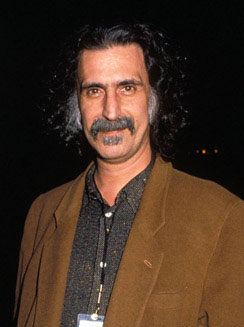
Frank Zappa: December 21, 1940 – December 4, 1993

On the anniversary of Frank Zappa’s death, I thought it appropriate for me to write my own tribute to him.  As a young person growing up in the 1970’s, I was introduced to Zappa’s music at around the age of 14. The album was Apostr0phe, and the first thing I remember latching on to was his humour – this guy was so intelligent and funny! As I had only just started playing the guitar at that point it took a couple of months to get his guitar playing. As he moved outside of the predictable blues riffs of many of his contemporaries, the angular rhythmic approach of his playing initially took some getting used to – but once I did – Amazing.

In the years that followed Zappa was a constant but peripheral part of my musical landscape, as I continued to be impressed by his irreverent approach to the establishment, something that seemed to appeal to my generation, as it had to the generations before. Although I heard fragments of albums such as the London Symphony orchestra recordings, I have to admit I initially thought his experiments with ‘classical music’ were a gimmick. However, I WAS WRONG! When revisiting his music over the last several years with more mature ears, and listening intently to all of his orchestral material (in addition to all those albums recorded before my time), I realise that not only was he a quick witted satirist, a brilliant guitarist, and a talented songwriter, but also an outstanding composer. What other ‘rock’ musician had his music accepted and recorded by Pierre Boulez?

Of late my work has given me the opportunity to follow in the footsteps of Ben Watson and a select group of others, and examine Zappa from an academic perspective. In fact I am currently awaiting on a decision from Ashgate publishers to give the green light to set in motion an edited collection of essays on him – something that I hope will contribute to the understanding of one of the greatest composers of this age.

After finishing this post, I am going to raise a glass to Frank Vincent Zappa and thank him for the jaw dropping joy he has given me over the last 30 years. I will be listening to his music with a particular sadness this week, as like legends such as Hendrix, I can’t help but wonder where his musical genius would have taken him if he were around today. However, he did pack an incredible amount into the years he was with us, so there is only one thing to say – THANK YOU

Posted in Frank Zappa | Tagged , , , , , | 5 Comments

‘Fair Use, Grand Rights and the Zappa Family Trust: A legal and ethical examination of the enforcement of restrictive rights by a copyright holder’

Well, I am off to Helsinki next week to wait for it – talk about Frank Zappa. I seems a while since I have done this, but as I get ready to hopefully work on the book ‘Zappa and the ‘And” – I thought it made sense to start sharing my views with others again. Anyway – a few details about the conference. It is positioned between Espoo and Helsinki in the cultural centre, and organised by the International Association for the Study of Popular Music Norden. The presentations can be found here. My paper is entitled ‘Fair Use, Grand Rights and the Zappa Family Trust: A legal and ethical examination of the enforcement of restrictive rights by a copyright holder’, and the abstract is copied below.

Since the death of Frank Zappa in 1993, there has been an ongoing legal battle between the Zappa Family Trust and the plethora of tribute bands that have emerged, recording and performing his music. It could be argued that these ensembles not only pay direct homage to Zappa’s legacy by interpreting his music in numerous ways, but also keep his memory alive by interfacing with both his long standing audience, and a younger generation who may not be aware of his music. Despite this, the ZFT position focuses upon copyright protection, as opposed to exploiting an opportunity to publicize Zappa’s legacy. Their recent claim that a ‘tribute performance’ falls into the category of a ‘musical dramatic work’, and therefore ‘Grand’ as opposed to ‘Statutory Right’ remuneration is controversial, and raises a number of important issues regarding the ‘dramatic nature’ of Zappa’s music, and  to what extent his portfolio is being appropriated for specific use. These factors represent a unique example of a copyright holder effectively litigating its fan base, and acts as a fascinating case study of the ethical and legal factors of what constitutes a reduction in a performers’ collective bargaining. This paper intends to explore these issues, before contextualizing them through speaking to the tribute musicians themselves.

It is based on a chapter that is hopefully being published in Contemporary Theatre Review in 2011.


Like This!

Posted in Uncategorized | 4 Comments

How Relevant Are Foundation Degree’s To The Music Industry (Part 2)

Continuing on from my last post regarding the  relevance of Foundation Degrees, I would like to briefly discuss how important they are to the music industry. The research I have been doing into live music over the last few months has enabled me to speak to a lot of people in the music industry, and it seems to me that many practitioners within the industry believe that a qualification to upgrade their skills would be useful, BUT – they don’t seem to know what Foundation Degrees or Creative Apprentiships are.

Regarding my own experience, I left school with very few qualifications, but managed to get into music college at the age of 19 to study for my first degree. The reason I was there was to learn about music – I was not interested in the qualification. This led to the first big mistake in my life – I left 4 months before the end of the qualification to play the guitar in Middle East with my first professional band.  In retrospect, this move enabled me to move to London the following year and begin my career as a professional musician, BUT –  it did not take me long to realise – the qualification I kicked into touch would have opened up many doors that were firmly locked. This led me to go to Middlesex Uni to complete my degree, which I followed up with a PhD a few years later (with composer Gavin Bryars as my mentor). These qualifications enabled me to make the transition from a professional musician to an ‘academic’ (what ever that means). I think this background has made me more aware than many of how relevant training/qualifications can not only give you the skills to make a living, but they can also provide you with a piece of paper that may open up doors in the future.

That is the reason I have been developing a foundation degree for practitioners already in the music industry. I feel it will enable practitioners to get credit for their experience, and learn how to exploit their creative abilities. All of this begs the question – how do this generation of people working within the music industry consider qualifications? As stated above, my impression is many people are interested in training/qualifications, but don’t really understand what they are or what they offer. This communication between universities and colleges is something that needs to be addressed in future if we are to encourage professionals from the industry to take up qualifications such as foundation degrees. If anyone is interested in doing a Foundation Degree at some point in the future let me know.

Posted in Academic, Music Industry | Tagged , , | Leave a comment

How Relevant Are Foundation Degree’s To The Music Industry (Part 1)

The research I have been doing recently for the Welsh Music Foundation into live music over the last few months has made me think – how relevant and important are Foundation Degree’s to the music industry? This is part of a two-part post, where I will address ‘relevance’ first.

I have written a number of Foundation Degree’s over the last 10 years (For both Bournemouth University and Glamorgan University), and I think the original idea behind these qualifications was theoretically sound. The concept of a qualification reflecting the skill requirements of the music industry is useful, and although Foundation Degree’s have worked well in other sectors, there have always been  factors that prevent this qualification from being relevant for music.

For example, an important ingredient of all FD’s is the work placement. As the qualification is vocational, it makes sense to facilitate practitioners to obtain part of their credit via the work place.The vast majority of institutions teaching FD’s find this difficult with music, something which results in many devising ‘work related assignments’, where students are accessed via ‘real life’ scenarios. Although this is the next best thing, like myself,  many lecturers find it difficult to keep up with current industry practice (How can you do both?). Although it may be easy to organise a work placement to a local builders firm or Tescos (who now have their own FD), it is far more difficult to enable students to work as part of a successful touring act, or a major publisher.

It seems to me that this has resulted in the music industry (whatever that means) generally not relating to the qualification. Having being part of this process over the last 10 years, I recently decided to develop a Foundation Degree that is not aimed at school/college students, but at people already in the industry. This leads me to the 2nd part of my post – how important are qualifications to the music industry.

More on this later ……………………..

Posted in Academic, Music Industry | Tagged , , , , | 1 Comment

Live Music Research

Here is the powerpoint that has been used in the Forum Meetings for the live music industry research. The presentation has been used as a basis to encourage discussion, which will in turn influence the final report which will be published by WMF. If you have any comments that you think would assist the research, please get in touch.


Posted in Music Industry | Tagged , , , | Leave a comment

Listening Habits Over The Last Week

I have been listening to so much amazing music over the last few weeks- I thought I would spend a few mins letting everyone know about it. As I type  I am listening to Hunn Hurr Tu from Russia.  The main feature of this music is Tuvan Throat Singing – a technique where two or even three notes can be sung simultaneously by wait for it – one singer!! I once witnessed a vocal workshop where the leader demonstrated something similar – really is something else. As I listen to most of my music on spotify these days – it is possible to link it Last FM to see what you have been listening to recently – see what I mean by clicking  here. I think its a good way of reminding yourself what your listening habits are. Aside from Hunn Hurr Tu, I have also listened to Jamiroqai’s latest album over the last few days, and one of my favourate artists at the moment – John Holenbeck. If you have Spotify, listen to this. I also spent a bit of time listening to James Taylor (not the Quartet), Megson (From Newcastle), Mumford and Sons, and the amazingly atmospheric Trygve Seim.

I don’t know what other people think, but I think Spotify has changed my listening habits. As opposed to listening to recordings until they wear out, I tend to be more speculative, often listening to much more music for less time. I don’t know what the long-term impacts of this sort of listening will have – but it has certainly helped me regain my love for music – something that can be knocked out of you when you are an academic!!

Anyway, to finish off, I can only recommend listening to Lionel Loueke. This guy is not only a fantastic guitarist and singer, but he has a musical ear like no one I have come across. Depress yourself by listening to this.

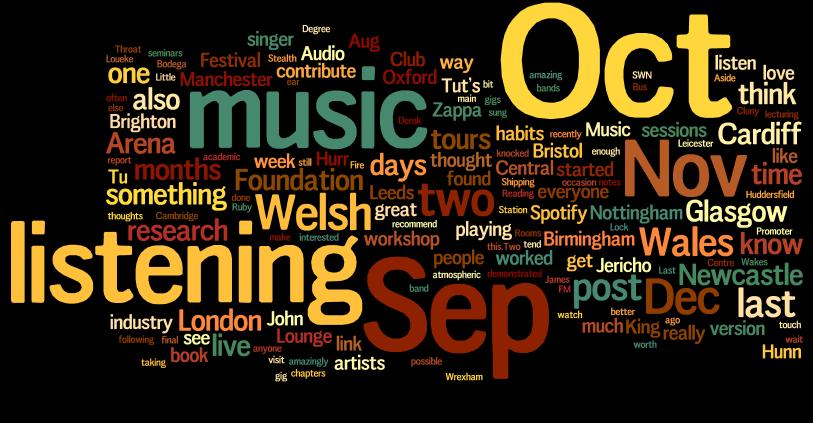
By the way, the image at the top of this post is done in Wordie – a great way to see which  words you use the most!!

Posted in Music | Tagged , , , , , , | Leave a comment

Live Music Industry Research Update

Two months without a single post – then 2 in two days – how is that for predictability?? For those who are interested in live music, I am chairing the final two seminars for the Welsh Music Foundation next week in Aberystwyth and Swansea – the details can be found here. SWN Promoter John Rostron will also be doing a workshop at both events – so the sessions are well worth a visit. If you can’t make the sessions to contribute to the research, there is still time to fill in the online questionnaires. The English version can be be found here, and the Welsh version here. If anyone has any thoughts about the live music industry in Wales or would like to contribute to the research in any way – just get in touch with me.

Posted in Live Music, Music Industry | Tagged , , , , | Leave a comment