An Emic and Etic Analysis Of The Impact Of Creative Listening When Recording And Performing With The James Taylor Quartet

It is a long long time since I posted my last blog, so will try and make up for this in the next few days. I am off to Ireland in two weeks to present a paper on ecological listening, using my time as a member of The James Taylor Quartet as a case study.

An Emic and Etic Analysis Of The Impact Of Creative Listening When Recording And Performing With The James Taylor Quartet

Dr Paul Carr

University of Glamorgan

This paper proposes to explore the creative listening roles employed by myself when working with the ‘Acid Jazz’ ensemble The James Taylor Quartet (JTQ) during the years 1989 – 1990. During this time the band recorded their 2nd album Get Organized (Polydor Records 1989) in addition to undertaking several European tours, releasing two mini albums, a promotional video and a single. It is proposed that my dual role today as both an ex band member and academic enables a unique opportunity to analyse factors such as the impact of creative listening on the progressive development of songs, arrangements, productions and performance paradigms. Gioia’s (1988) comment that ‘jazz musicians cannot look ahead at what [they are] going to play, but can look behind at what [they] have just done’[1] is pertinent, and this paper will apply this philosophy by including my own and others reflections on the creative listening process. As noted by Keith Sawyer (2007), ‘all innovations result from a collaborate web’, and the epistemological paradigms through which listening is an essential aspect in the group creative process will be discussed, drawing on personal reflection, interviews with James Taylor himself and academic insights from the likes of Aaron Copeland,[2] William Cahn,[3] Keith Sawyer [4] and Eric Clarke.[5] After contextualising my role in JTQ, the paper will be constructed to progressively examine research questions that have particular relevance for performing musicians and composers as follows:

  • What are the means through which musicians employ listening to recreate ‘pastiche’ sounds of the past?
  • How and why do musicians incorporate listening skills to integrate authenticity into their work by ensuring specific sounds, styles, production techniques and performance conventions comply with the canon?
  • How does creative listening impact group composition, live performance, rehearsals and improvisation?
  • How do environmental factors impact creative listening?

As JTQ have a wide range of commercial recordings from this period, both live and studio based, the paper will also include textual and phenomenological analysis of selected compositions and arrangements.

The James Taylor Quartet (JTQ) are a British based ensemble formed by Hammond Organ player James Taylor (b.1964) in 1986.  Their debut single several months later was a cover of Herbie Hancock’s ‘Blow Up’, and was released independently through Re Elect The President, a forerunner of the successful Acid Jazz label. This was followed by the band’s debut album Mission Impossible (1987) the following year, a recording that continued what was to be a long association with film music covers themes, with pieces such as ‘Goldfinger’, ‘Mrs Robinson’ and ‘Alfie’ being amongst the works included. My personal involvement with the group started around October 1988, soon after the band had secured a record deal with their first major label – Polydor Records. Having just recorded a third studio album Wait A Minute (1987), it was apparent that the band at this point was in a stage of transition, attempting to forge a more original, highly produced funk based style that involved more original composition and less pastiche than earlier efforts

James Taylor verified the transitory nature of the album when stating

The various pressures on me at that time were enormous, record company deadlines and personnel, money, musical output, performance, also I had just split with my old band, including my brother, so it was a painful time for me, therefore very rich artistically! There were also some big egos present, including mine. So it was an interesting time with a kind of ferrel nature dominating the atmosphere.[6]

After a short rehearsal period learning existing material and auditioning new members, JTQ spent the end of 1988 doing a number of one-off performances in the UK and Europe. These live performances facilitated a testing ground to refine what was to be the new version of the group, which undertook a number of further changes during this period. This included using four bass players, in addition to reducing a three piece brass section to a single saxophone. As JTQ’s Wait A Minute album contained numerous arrangements for full brass section, the ideal solution was to tour with a similar line up. However, financial and logistical constraints compromised this decision, and the impact this reduced and ever changing band personnel had on band members’ creative listening will be discussed later.  Once the line up was reasonably established, a period of intense rehearsal, touring and recording commenced, which in the initial stages occurred simultaneously, before touring commitments began to dominate. The dialogic pairing of touring and recording is a tried and tested methodology in popular music performance, in the case of JTQ being used as a means of ensuring that the permanent recorded versions of specific songs were not only performed well,[7] but in an agreed and acceptable stage of compositional development. As indicated by Sawyer, creativity occurs over time, with each member of an organisation contributing small but important ideas toward the ‘big picture’.[8] Sawyer continues to discuss how these collaborations remain invisible without scientific analysis, and how successful innovation occurs when ‘organisations combine just the right ideas in just the right structure’.[9] By the time I had joined the band there were no founding members left aside from James Taylor himself, so it appeared to be an ideal opportunity to develop material with new colleagues. Retrospectively, much of the early rehearsal activity involved either recreating sounds from the previous album – Wait A Minute, preparing for touring commitments, or developing new material for the next album, which was to eventually be entitled Get Organized (1989). This dual role of appreciating and understanding past musical events while simultaneously creating new musical relationships and compositions was probably the most significant task that the new ensemble had to achieve, and it is noticeably similar to what Sawyer[10] describes as ‘deep listening’.[11] The author considers this as being the ability to focus not only on one’s own performative actions, but also that of others, and this is possibly one of the main listening skills that inexperienced or egocentric musicians do not consider. As outlined by academics, historians and musicians such as Lucy Green,[12] Paul Berliner[13] and John Stephens,[14]music is a social discourse, and it is proposed that the ways in which listening was precipitated in JTQ was greatly impacted by the social space the band were working in.

The Intentional/Extensional Listening Process

As I had been earning my living up to this point as a freelance guitarist I felt comfortable with reproducing musical parts, although I was more experienced in simply playing what was on the notated page. As originally outlined by Chester, this ‘intentional[15] /extensional’[16] dialogic is important regarding the expected autonomy a musician has when performing, and has a profound impact on the ways that musicians listen to music. Whist the latter is usually associated with notated classical music that often has little room for creative interpretation, the complexity of intentional music is seen to be achieved by ‘modulation of the basic notes, and by inflection of the basic beat’.[17] Allan Moore [18]continues this debate when discussing the potential creative attributes of parameters such as tempo, dynamic level and rhythm and pitch, regarding them as being ‘precisely the devices a performer of intentional music will utilise’.[19] However, it is proposed that when copying these parameters from a recording for a pastiche performance, they become extensional in nature (to the musician) – the equivalent of replicating the notes and dynamic markings from a musical score. During JTQ rehearsals it was originally considered important to not only learn the notes and recreate the sound of  Wait A Minute, but also for each musician to musically interrelate with new colleagues to formulate a fresh unified voice for the new album, the latter being an intentional process. Both of course require very different listening competencies from the musician. As no members of the original band were available, precisely replicating previous sounds and style parameters from the earlier album proved a difficult task, and although the current line up comprised of numerous seasoned session players, it was problematic to exactly recreate the raw style of the earlier band. It is hypothesised that this is the reason why an unwritten code naturally developed that enabled new band members to indoctrinate their own performance idiolects (and listening competencies) into the music. In retrospect, this was an important decision regarding the progressive movement of JTQ from a mod sounding ensemble to what is now considered a sophisticated funk band. The All Music Guide seems to confirm this point, describing Get Organized as ‘the unexpected missing link between the James Taylor Quartet’s early mod-cum spy theme sound and the later polished acid jazz feel without sounding like either of them’.[20] Regarding my own creative listening role when learning these pieces, my first impression was it sounded like music I had been aware of for a number of years, despite its new Acid Jazz labelling.[21] For example, many of the pieces featured on ‘Wait A Minute’ employed a James Brown funk style guitar,[22] which was often played through a wah wah pedal.[23] Additionally other tracks featured Bossa Nova rhythms,[24] blues based progressions,[25] and funk based grooves not unlike those performed by Jimmy Smith, Jack McDuff[26] and Maceo Parker. Although mine and my colleagues’ performance styles were not the same as our predecessors, the pieces provided a stylistic framework that we were comfortable with, enabling us to straddle the divide between intentional innovation and extensional replication. As stated by Sawyer, ‘innovation emerges from the bottom up, [often] unpredictably and improvisationally, and it’s often only after the innovation has occurred that everyone realises what has happened’.[27] In JTQ, it is proposed that innovation occurred because the correct balance of extensional prescription and intentional freedom was facilitated within our social space, which was largely precipitated by James Taylor himself. Upon reflection, it is apparent that when re arranging the earlier album’s material the adaptation of musical events is often small, with the extensional elements dominating. Examination of freshly arranged songs such as ‘Wait A Minute’ and ‘Starsky and Hutch’ taken from an ITV broadcast reveal the basic grooves to be identical to the recordings, however there is enough autonomy for band members to input into factors such as form, tempo and instrumental timbre. In the case of the guitar theme of ‘Wait A Minute’ for example, small variations in melody and rhythm enable the melody to comply with the busier groove of the new version. Many of these changes were of course not conducted purely because of band personnel reasons, but were logistical due to the smaller ensemble line up. However, all of the changes enabled the ensemble to engage with the intentional – extensional divide, with both requiring specific listening skills and competencies. It is important to emphasise that all of the members of the new ensemble were employed as session musicians, so were effectively being paid to perform to the requirements of James Taylor and the record company. Regarding the latter, James Taylor confirmed that the Polydor threatened to drop JTQ unless he ‘split the old band and put together a new one’, in addition to allowing specific record company personnel to be involved in the record’s production.[28] As discussed later, these factors precipitate a specific social space with associated listening styles and habits. However, core members such as myself were also in a position to assist with the song writing process. Having grown up listening to many of JTQ’s principal influences in addition to a range of other musical styles, this proved to be a relatively natural process, and in my case resulted in a co written piece with James Taylor entitled ‘Touchdown’, which I will now discuss to illustrate how intentional and extensional listening combines with social factors to foster creativity.

The Potential Impacts Of Social Parameters on Music Making

‘Touchdown’ entered the rehearsal studio as a series of fragmented ideas that were based on a harmonic pattern similar to Van Morrison’s ‘Moondance’. When listening to the up tempo swing sequence, it is apparent that this groove would not be possible if all participants were either not familiar, or able to be quickly taught the stylistic conventions of the Hard Bop tradition. After jamming through the sequence several times, James Taylor was quickly inspired to document the melody of the verse, a modal theme taught by rote, and originally played on Hammond organ in unison with myself on guitar. After further experimentation, it became apparent that part of the theme could be played as a fugue, a factor that would not have been apparent without the creativity that Jamming precipitates.[29] After playing the theme and soloing over the harmonic progression a few times, Taylor struggled to find a complementary section for the chorus, so I suggested a 7/8 melodic theme which was originally intended to be part of another piece. Although this is not stylistically similar, it was decided collectively that the section provided important contrast and worked musically. These decision making processes were rapid, and to quote Simon Frith, were facilitated ‘not only through knowledge and interpretation of musical forms, but also the social conventions in which they occur’.[30] Frith’s notion that the meaning of music for listeners can change as it enters new social situations is also true for the performing musician, who listen according to the environmental factors they find themselves encountering. In the case above, social factors such as record company pressures, the informal rehearsal environment, current life experiences and the personality/egos of the musicians, in addition to the fact that I was working principally as a session musician, combine with the intentional and extensional listening abilities of improvisation, awareness of style, pastiche development and musical memory. Eric Clarke discusses the importance of what he describes as an ‘ecological’ approach to determining musical meaning. Like Frith, his philosophy is suited to establishing the means through which musicians’ interact with their evolving musical environments by reorientating  and ‘tuning’ themselves to new situations, and how the ‘goodness of fit between and organism and its environment is not a matter of chance, [but a] product of mutual adaptation brought about by an evolutionary process.[31] This Darwinian approach is pertinent to the situation all members of JTQ found themselves in when undertaking rehearsals, performing past material, composing new music and negotiating changing band members. Although it may have been possible to reproduce earlier sounds and textures more precisely, this adaptive approach is more ‘naturally selective’, enabling members to build upon their skills and experience in order to develop something new, albeit based on the JTQ tradition. It is proposed that the means through which this is achieved is principally through creative listening, where the experienced performing musician develops non only sensitivity to various conventions of musical style and the playing idiosyncrasies of other performers, but also an awareness of

where and when to use these factors, depending on their social setting. As Clarke states – ‘perception and action are inextricably bound together‘(23) and this is often passive, with the results often only being apparent retrospectively.

In conclusion, it is proposed that the ‘intentional mode’ of participation requires the musician to quite simply listen more creatively, while the extensional in its more contemporary perspective requires the ability to ‘recreate’ not only notes on a page, but also textures, timbres, style indicators, etc. It is apparent that all songs on Get Organised were either composed by James Taylor, or James Taylor and another band member, although this was usually after extensive development of the composition in the rehearsal studio where everyone was involved in the act of creative listening. This process required the ensemble to rapidly reference specific grooves[32], learn harmonic and melodic components quickly by ear and be sensitive to sounds that referenced the JTQ tradition, in addition to being aware of the social environment in which all of this was occurring. Although many of these factors are intentional in nature when analyzing the recordings, they are extensional to the musician at the time, as they have to be reproduced exactly. Regarding James Taylors own perceptions of the listening experience, he commented

I think for any artist in this sort of situation it is important to have some kind of understanding as to what one’s value system is, ie, what is [the] music and why am I playing it? For me, music has always been a means to an end. That end being a kind of merger and extreme level of emotional engagement and connection with the listener/audience.[33]

This external ‘connection’ with the listener is of course only possible if the participating musicians are communicating internally, and Cahn’s observation that ‘in a cultural environment where physically active “doing” is valued highly, it is sometimes necessary to draw attention to mentally active doing’[34] is important. This paper has hopefully provided an insight into this process.


[1] Ken N. Kamoche, Miguel Pina e Cunha, and João Vieira da Cunha, Organizational improvisation (Routledge, 2002), p.55.

[2] Aaron Copland, Music and imagination (Harvard University Press, 1980).

[3] William L. Cahn, Creative music making (Routledge, 2005).

[4] Robert Keith Sawyer, Group genius: the creative power of collaboration (Westview Press, 2007).

[5] Eric F. Clarke, Ways of listening (Oxford University Press US, 2005).

[6] Interview with the author. January 25th, 2010.

[7] This was particularly important, as JTQ have a respected reputation as a ‘live act’.

[8] Robert Keith Sawyer, Group genius (Westview Press, 2007), p14.

[9] Ibid.

[10] At a later stage it is important to discuss how numerous other writers have used this phrase – although it does not always mean the same thing.

[11] Sawyer, Group genius.

[12] Lucy Green, Music, informal learning and the school (Ashgate Publishing, Ltd., 2008).

[13] Paul Berliner, Thinking in jazz (University of Chicago Press, 1994).

[14] John Stevens et al., Search and reflect (Community Music, 1985).

[15] Where meaning is considered to be ‘inside’ the music. For example a recording.

[16] Where meaning is considered to be outside the music. For example in a musical score.

[17] Simon Frith and Andrew Goodwin, On record (Routledge, 1990), p315.

[18] Allan F. Moore, Rock, the primary text (Open University Press, 1993), p23.

[19] Although he does cite the flat 5 substitutions of Howling Wolf’s ‘Little Red Rooster’ as an example of an intentional piece with ‘some extensional development’

[20] http://www.allmusic.com/cg/amg.dll?p=amg&sql=10:3cfqxqu5ldfe

[21] A term which James Taylor regards as ‘meaning different things to different people’/

[22] For example ‘Wait A Minute’, ‘The Natural Thing’ and ’Kooks Corner’.

[23] Indeed as a gesture of authenticity the album featured Pee Wee Ellis and Fred Wesley, both of whom were members of James Brown’s band during the 1960’s 1970’s.

[24] ‘Indian Summer’.

[25] For example ‘Jungle Strut’ and ‘Fat Boy Stomp’.

[26] For example note the rhythmic similarities of ‘McDuff’s Wade In The Water’ to ‘Jungle Strut’.

[27] Sawyer, Group genius, p25.

[28] Interview with the author. January 25th, 2010.

[29] John Kao has written extensively on how business ideas benifit from ‘jamming’. Refer to John Kao, Jamming: The Art and Discipline of Business Creativity (Harper Paperbacks, 1997).

[30] Simon Frith, Performing rites (Harvard University Press, 1998), p.250.

[31] Eric F. Clarke, Ways of listening (Oxford University Press US, 2005), p.20.

[32] Some pieces used existing music as a starting point.

[33] Interview with the author. January 25th, 2010.

[34] William L. Cahn, Creative music making (Routledge, 2005), p.49.

Posted in Academic | Tagged , , , , , , | Leave a comment

DEVELOPMENT OF A FOUNDATION DEGREE IN MUSIC RETAIL MANAGEMENT: A CASE STUDY PARTNERSHIP BETWEEN A UNIVERSITY AND ROLAND UK

I have just had an article published on the research I have conducted regarding developing work based music Foundation Degrees. The Details can be found here.

Posted in Academic, Music | Tagged | Leave a comment

More on Eivind Aarset

Here are some more Eivind Aarset live recordings that emphasise the dislocation of his body from what we hear. His solo towards the end of this piece has so many layers it is difficult to ascertain what he is actually ‘playing’. It is a true mixture of ‘man and machine’. This is extended by the band (and himself) improvising around his loops – very interesting.

This is extended in the following video, which not only includes repeated guitar loops, but drums also. This is in addition to sounds not normally associated with the guitar.

This final one is included again as it is from his ‘Sonic Codex’ album, which I am beginning to appreciate very much. As stated in my earlier Blog, he is taking what Terge Rypdal achieved and moving it forward in a more ambient modern direction.

I am interested in finding out any info regarding how these pieces are constructed. There is obviously a lot of freedom – almost similar to the way Miles D compiled his more recent works toward the end of his life. I know there is a PhD  written in Norwegian on Eivind – would love a translated copy if it becomes available.

Posted in Loop Music | Tagged , , , , | Leave a comment

Jon Eberson – Another Norwegian Gem

After listening to Eivind Aarset, I thought I would dig around and see if I could find any other Norwegian guitarists that are relevant to my research. I have been a fan of Terje Rypdal for many years, but now realise there a loads of players I am not aware of. Jon Eberson is one such player. What I find interesting about this guy is that he sounds lso different guitarist on many of his albums. I can hear a Holdsworth influence on ‘Stash’, and Metheny on later titles such as ‘Standards’ and ‘Jazz For Men’.  ‘Music For Men and Machines’ sounds way ahead of its time – a must listen in my opinion. Check out the links below on Spotify if you can. Although not a ‘loop’ based album, two of the tracks are constructed in this way (‘I Dreamt and ‘Dance’) – would love to see them played live.  He even moves into more free Jazz on 1999’s ‘Mind The Gap’ – influenced by Terge Rypdal in my opinion.

Jon Eberson – Stash

Audun Kleive – Music For Men Og Machines

Morten Halle – The Eagle

Bjørnar Andresen – Mind The Gap

Jon Eberson – Standards

Jon Eberson – Jazz For Men

Posted in guitar, Music | Tagged , , , , , | 1 Comment

Eivind Aarset Trio – 21 Century Guitarist

Just discovered this amazing guitarist – Eivind Aarset – what an xmas present. He seems to encapsulate  what a guitarist of the 21st Century can be – using available technology to create a soundscape that is very difficult to comprehend in terms of the sound in relation to  his ‘performing body’ . I am fascinated by the way this music is constructed, in particular how he uses loops in creativity. If anyone knows of any other ‘obscure’ players who compose like this – I would be very interested.

Posted in Loop Music | Tagged , , , , | Leave a comment

YouTube – Robert Fripp String Quintet Kan Non Power

I am in the very early stages of writing a paper on guitarists who use loops as a creative tool. I came across this, and it reminded me what a great guitarists and composer Bob Fripp is.  Have a great holiday season.

Posted in Loop Music | Tagged , , , | 1 Comment

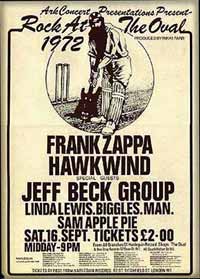
Rock At The Oval 9-16-72

Here is an interesting review of Zappa’s Grand Wazzo gig in London in Sept 72.

“After a long delay for setting up, and tuning, Zappa’s Grand Wazoo took the stage, and if no-one else had played I’d have been happy to wait around all day just for that. The 20-piece band play Zappa’s music with unbelievable taughtness and lyricism. Firing straight ahead on things like “Big Swifty” and “Dog-meat” (a kind of medley of “Dog Breath Variations” and the “Uncle Meat” theme), or creating strange rhythms and textures on “The Adventures Of Gregory Peckory” – don’t worry, said Zappa, this’ll be over soon and then we’ll do a shuffle.”

Read on for more details at –

via Rock At The Oval 9-16-72.

Posted in Frank Zappa | Tagged , , , | 2 Comments

The Big Note – The Ultimate Gesture: The incorporation of time, space and place in performing, composing, arranging and producing Frank Zappa’s music

As promised – here is the full 3000 words of a paper I presented in Cardiff a month ago. This is unedited – so probably has a few typos etc. I will be aiming to develop this early next year into a 8000 word document for publication. As always – feedback always welcome. Apologies in advance to those of you who are ‘Zappa experts’, but this paper was delivered to a group of people who know very little (or nothing) about his work. This still surprises me, but although it does reiterate many seemingly obvious areas of his idiolect, the paper hopefully is useful in some way for everyone.

Often regarded as one of the most prolific and versatile composers of the rock idiom, Frank Zappa’s ability to amalgamate numerous popular music styles alongside musique concrète, electronic, and serial techniques make him a fascinating case study on the interdisciplinary roles of performer, composer, arranger and producer. One of the earliest musicians to successfully and consistently experiment with fusing these skill bases, Zappa’s oeuvre is now gradually beginning to be recognized as one of the most prolific and original in the history of popular music. Using these factors as creative mediums, Zappa can be considered the only rock musician to consciously and consistently engage with time, space and place throughout his entire career, having a compulsive fascination with ensuring his entire life’s work was considered part of his Big Note philosophy, with many of his performances, compositions, arrangements and productions being part of an overarching organisational structure he sub texted conceptual continuity. He also developed the terminology project/object to describe the difference between the completed work of art and the process of redefining it, and made countless rearrangements of many of his compositions, clearly considering individual works of art as being in a constant state of development. To achieve these aims, he utilised available studio technology to create highly original ‘virtual studio’ and ‘virtual live performances’, which comprise of clues alluding to both his own music and popular culture at large.  Examples range from the experimental employment of Xenochonic and cut and paste techniques,[1] to alluding to figures such as Frank Sinatra, Richard Strauss and The Beatles. This paper examines how Zappa pushed the boundaries of available studio technology to develop compositions, (re)arrangements and performances/virtual performances of his work, while creatively engaging with time, space and place through blurring the distinction between studio and live environments. After presenting an overview of his interface with technology throughout the 1960’s, the discussion will progress to analyze albums such as the You Can’t Do That On Stage Anymore (1988 – 1992) series, cumulating with his work on the synclavier during the late 1980’s – early 1990’s with albums such as Jazz From Hell (1986) and Civilization Phaze III (1993).

When Frank Zappa entered the international music scene in 1966 with the inaugural Mothers of Invention (MOI) album Freak Out (1966), he was already an experienced musician. Although having earned a living as a performer,[2]songwriter, and film composer, it seems that the purchase of his colleague Paul Buff’s studio in 1964 [3] was a pivotal factor regarding his transition from a practitioner who engaged with these paradigms separately, to one which adopted a more interdisciplinary approach to music making,

When considering Zappa’s work with Buff from this period, it appears to be reminiscent of Kealy’s ‘entrepreneurial mode’ of collaboration. This is depicted as a ‘fluid and open’ partnership, allowing, ‘an interchange of skills and ideas among musicians, technicians and music market entrepreneurs’,[4] and is seen to be the precursor of what the author describes as ‘The Art Mode’ of collaboration, where the artists develops a ‘natural interest in the craft of sound mixing as a means of artistic expression’.[5] A feature of this mode also excludes so called ‘middlemen’ who represent the commercial interest of record companies,[6] leaving the musicians and composers to make the creative decisions, a factor that results in ‘work previously considered merely technical [becoming] artistic’.

A recent interview I conducted with Paul Buff confirmed the ‘entrepreneurial’ nature of his collaboration with Zappa. When asked about their working practices he stated

The cross influence was about equal. Zappa knew very little about recording or electronics, but obviously was a budding genius. I knew little about music and my “genius” such as it is was in electronics.

According to Buff, Zappa ended up in the studio by himself doing the same sort of experimentation in the control room and studio, and consequently presented an early example of  Kealy’s ‘Art Mode’, described as the ‘integration of the sound of studio technology with the musical aesthetic of popular music’.[7]

After his studio closed, Zappa was to increasingly use tape editing as a compositional tool in addition to developing the business side of his career, forming Bizarre Productions with Manager Herb Cohen. In addition to producing and releasing music by non conformist artists such as Lenny Bruce and Captain Beefheart, Zappa’s MOI and solo ventures continued in earnest throughout this period, with recordings such as Freak Out, Absolutely Free and We’re Only In It For The Money all incorporating technology to formulate compositions in addition to creating virtual performances and arrangements.

Ex Zappa sideman Don Preston informed me in a recent interview of the process Zappa employed during this time period, he commented

During Absolutely Free for example, some songs would consist of between 30 – 40 independent takes, and each one would have to be attempted several times, as not all of the band members read music

This process is particularly apparent in pieces such as ‘Plastic People’ and ‘Brown Shoes Don’t Make It’, both of which are obviously constructed through multiple takes to produce a unified piece. It is apparent that Zappa has used the technical and human resources at his disposal, and incorporated them to formulate his creative requirements, which at the time were possibly proving problematic to realise during the rehearsal process. As Preston states, the majority of the early MOI did not read music, so multiple attempts at short sections of these pieces was the only way to document Zappa’s advanced musical ideas. Later in his career, Zappa would employ the extraordinary skills of selected musicians with studio technology to continue this principle, and this is particularly noticeable during pieces such as ‘The Dangerous Kitchen’, which combines at least two live locations spliced together with a studio recorded Steve Vai guitar transcription of Zappa’s vocal line. On the same album, Vai was given the task of transcribing a difficult spreechstimme vocal on ‘Jazz Discharge Party Hat’s,’ which Zappa dutifully placed onto a live backing track recorded at Southern Illonios University, and this is typical of the way Zappa used his ‘stunt guitarist’ during the early to mid 1980’s. Although Zappa never intended to perform these versions live, the recordings create an illusion of what appears to be an ‘impossible’ display of musicianship, and in doing so engages the listener in the practice of hypermediacy. In the same way that we are invited to watch the action of a film through the eyes of a protagonist such as Norman Bates in Psycho, Zappa invites us into the inner processes of his creativity when openly declaring on his album sleeve notes the means through which the impossible is made real. As Bolter and Grusin outline, hypermediacy ‘acknowledges multiple acts of representation and makes them visible’,[8] and this is an apparent joy for Zappa considering the transparent way he reveals the multiplicity of his creative processes. However, the authors also describe hypermediacy as ‘mutually linked’ to immediacy,[9] depicted by Anne Cranny-Francis as ‘the demand for the erasure of the medium of the viewing experience’.[10]Zappa’s involvement with the early quadraphonic format is an indicator of his intention of using technology to remediate as ‘realistic’ a listening experience as possible,[11] and this is also manifested in the fastidious way he edited the ‘imperfections’ in his early catalogue.

In addition to using technology to create ‘virtual studio performances’ that sound as if they could be played live, Zappa’s more pervasive practice included the juxterpositioning of otherwise incongruent live versions of the same piece into ‘virtual live performances’ that were intended to sound like they were performed live. Although this process came to a head with the six part ‘You Can’t Do That On Stage Anymore’ series (1988 – 1992), ‘Little House I Used To Live In, ‘Holiday In Berlin, Full Blown’,[12] and ‘Toads Of The Short Forrest’[13] are all interesting early examples of Zappa combining numerous ensembles and environments to form what appeared to be a utopian live performance. Although the edits on these performances were crude compared to his latter standards, they do provide a methodological foundation regarding fusing time, space and place in addition to combining live instrumentation with sounds only available through studio technology.[14] Regarding the You Can’t Do That On Stage Anymore series, Zappa was explicit that these performances were ‘not chronological’ and proceeded to confirm that ‘any band from any year can be (and often is) edited to the performance of any other band from any other year – sometimes in the middle of a song’.[15] Although the majority of the series has to quote Zappa  ‘No Overdubs’, and focuses on his perception of a ‘perfect gig’, it is interesting how a number of specific ‘performances’ in the series actually include juxterpositioned bands who played with Zappa many years apart.  Examples include ‘Lonesome Cowboy Nando’,[16] which combines a performance recorded in the summer of 1988 in Genoa, Italy, with one recorded 17 years earlier in UCLA Los Angeles, and ‘King Kong’ which combines the ‘Flo and Eddy’ band of 1971 with musicians circa 1982.

It is important to note that Zappa’s use of technology was not used for purely musical reasons, but also conceptual. Right from the early part of his career Zappa stated that all of his music was unified by a philosophy he entitled ‘The Big Note’. In a 1968 edition of Life Magazine, Zappa stated

Everything in the universe is composed basically of vibrations – light is a vibration, sound is a vibration, atoms are composed of vibrations – and all these vibrations just might be harmonics of some incomprehensible fundamental cosmic tone [17]

Although not directly influenced, there is a close parallel between Zappa’s philosophy and the teachings of Sufi Master Hazrat Inayat Khan, who considered music to be ‘behind the workings of the whole universe [18] and that ‘the reason we are drawn to music is that our whole being is music’.[19] There also appears to be a close parallel with the discoveries of Robert Wilson and Arno Penzias, who accidentally discovered in 1965 that a residual sound related to the Big Bang was still apparent in the universe, and that this sound was judged to be vibrating at approximately 4080 mega hertz, slightly flatter than B in equal temperament tuning.[20] Regardless of whether Zappa was aware of these revelations or not, it is apparent that his music is littered with a web of fractal logic, where consistent patterns are apparent in single tracks, albums and his entire portfolio.  In Pop Music: technology and creativity, Timothy Warner discussed how pop music has a greater tendency than rock to use technology to develop what he calls ‘the modified repetition of musical ideas between pieces’.[21] Although the author is specifically focusing on sampling, he also comments on  how pop uses ‘sounds from existing multi track recordings which are then rearranged and modified to create new and often radically different versions of the same piece’.[22] Zappa, a so called rock musician is probably the greatest exponent and unappreciated antecedent of this practice, employed two principle techniques to create the unified macrostructure to his life’s work – Xenochrony and Project/Object. The former’s etymology derives from the Greek, meaning ‘Alien Time’, and as opposed to the diachronic editing of incongruent performances of the same piece, was employed to synchronically fuse specific instruments from unrelated compositions, usually from disparate times, spaces and places. Although mainly used to import guitar solos from live performances into studio projects, he also used the technique with other instruments such as on ‘Rubber Shirt’ (Sheik Yerbouti 1979), which incorporates an 11/4 bass part extracted from a performance in Gothenburg in 1974, with a 4/4 drum part recorded in 1976 in studio conditions.

Zappa perceived his Object/Project philosophy as being the difference between the work of art, and the ongoing process of redefining it, a description that is similar to the ‘works/texts’ continuum described by Richard Grigely in Textualterity: Art, Theory, and Textual Criticism. Grigely argues that a text is ‘constantly undergoing continuous and discontinuous as it ages’ [23] and how artworks have ‘multiple texts’, consisting of discursive spaces and inherent meanings that are a direct product of the textual spaces we [and the artist] enter and engage in.[24] This process is certainly the case for Zappa, who recorded numerous versions of much of his portfolio. Zappa did not only constantly develop his own texts into evolving works, but also more subliminally cross referenced both his own pieces and those of others throughout his career, providing a range of semiological reference points for individual listeners. For example Absolutely Free alone has cross references to ‘Louie Louie’, The Rite Of Spring, ‘Duke Of Earl’, ‘Baby Love’, The Planets Suite, ‘God Bless America’, Petrushka, ‘White Christmas’ and The Soldiers Tale.[25] Zappa entitled the allusion to these pieces as Archetypical American Musical Icons, and many of them were repeated on other recordings as the years progressed, with ‘Louie Louie’ being a particularly pervasive example. Subliminal references to his own work are numerous, and include samples of ‘Who Are The Brain Police’ in ‘Help I’m A Rock’, ‘The Worlds Greatest Sinner’ in ‘Dog Breath, In The Year Of The Plague’ and ‘How Could I be Such A fool’ in ‘Lonely Little Girl’. [26] This conceptual continuity practice spanned his entire portfolio, as evidenced by his final album Civilization Phaze III, which merges material from the early 1990’s with samples from 1967’s Lumpy Gravy.

Towards the end of the 1980’s, problematic band personnel factors prompted Zappa to stop touring and focus more on the synclavier as a means of composition and production. Having had numerous issues with the poor performances of his classical repertoire in particular over many years due to what he described as the ‘human element’, this machine enabled him to compose music that was as complex as his imagination dictated, without the issues of large orchestral fees or negative artistic attitudes. The work he produced over the next several years in many ways resonates with his hero Edgard Varèse’s 1936 ‘liberation of sound’ lecture, which documented the composer’s desire for machines to compose music that went beyond the abilities of human performance.[27] In Zappa’s case, his work with the synclavier at least partially achieved that aim. The Perfect Stranger comprises of three live pieces conducted by Pierre Boulez and four computerised,[28] and this gesture is almost a signifier of the artistic equality Zappa considered this new artistic medium, as he introduced his new soundscape of live performance and computer based production. This practice continued on Meets The Mothers Of Prevention, which combines rock focused studio and live recordings with synclavier generated pieces. Although his sound palette is still limited, pieces such as ‘H.R.2911’ are beginning to combine complex melodies and rhythms with a greater variety of timbre, mixing orchestral textures with idiosyncratic traits such as the infamous Zappa snork. The album also features attempts at combining live performers with computer generated sounds, a technique he was to explore in greater depth on subsequent albums, and an important development in his fusing of performer, producer, composer and arranger roles.  Aside from the live band featured on ‘St Etienne’, Jazz From Hell is essentially a solo synclavier album, and as evidenced in its title track, begins to provide an insight into the possibilities of combining sampled and originally constructed sounds, with otherwise ‘impossible’ rhythms and melodic lines. Unlike the seemingly ‘impossible music’ Bennett outlines when discussing Les Paul’s experiments of the early 1950’s,[29] Zappa progressively blurs the distinction between human and automated performance. In 1988, Andrew Goodwin regarded this process as ‘the most significant result of the recent innovations in pop production’,[30] and considered it responsible for both a ‘crisis in authorship’ and a lack of authenticity in performance.[31] In Zappa’s case, it is ironic how his synclavier based Jazz From Hell won a Grammy for best instrumental performance,[32] and his computer albums in general were embraced by his fan’s, despite the lack of authenticity rock audiences normally associate with computer based works.

Had Zappa’s life not been cut short in 1993, it is interesting to consider how his computer generated music could have merged with live concert performance, and how this technology could have added a new dimension to his manipulation of time, space and place. His 1988 release Make A Jazz Noise Here is probably the best indication of this, with ‘When Yuppies Go To Hell’ combining live/sampled drums with synclavier harmonies and vocal effects. These mainly digital domains progresses into a ‘live’ brass theme, which is merged with synclavier vocal sounds, followed by a live trumpet solo with band backing. Sections where live musicians merge with the computer are particularly interesting, with Chad Wakerman’s analogue and electric drum kit providing particular ambivalence regarding the human – automated divide. This album was recorded during Zappa’s final tour in 1988, and in some ways acts as a statement of how computer technology would become his principle form of expression over the remaining years of his life. Although on first listening it appears that the opposing live/digital paradigms of ‘When Yuppies Go To Hell’ is achieved live, once again the details on the album sleeve reveal otherwise, it being compiled from various performances from the final tour between February and May 1988. In some respects, the process of manipulating time, space and place through celebrating and distorting what appears to be live performance is a continuation of what Zappa implemented at the start of his career, and it is proposed this process in part represents his distrust in the ‘human element’, which was apparent from Freak Out to Civilization Phaze III. This duality regarding the nature and notion of live performance was achieved by compiling utopian concerts that combined the marvels and frailties of the human condition, with innovative technological constructions, while simultaneously revealing how these constructs were made real. The countless rearrangements he made of many of his pieces were not filler tracks on albums, but part of a project – object philosophy in which he often used technology and live performance to re arrange his music, with both text and work closely aligned. Although always a ‘producer’, the synclavier enabled him to combine both human and machine in ways that traditional recording technology could not. Zappa’s ‘ultimate gesture’ is not only his music, but the uncompromising way his philosophy enabled him to realise it. It is hoped that this paper has gone some way into assisting our understanding of this.


[1] For Example “Friendly Little Finger” from Zoot Allures (1976)) brings together otherwise unrelated bass and drum parts.

[2] Zappa’s early cover bands included The Blackouts (James p.49) The Boogie Men (Slaven, 2003 p.33), and Joe Perrino and the Mellotones (ibid p.34) and The Muthers (ibid p.41).

[3] This date was confirmed in a recent interview with Buff himself.

[4] 213 frith

[5] Frith 214

[6] Frith 215

[7] Frith 214

[8] Jay David Bolter and Richard Grusin, Remediation (MIT Press, 2003), p.33.

[9] Freda Chapple and Chiel Kattenbelt, Intermediality in theatre and performance (Rodopi, 2006), p.56.

[10] Anne Cranny-Francis, MultiMedia (SAGE, 2005), p.2.

[11] When forming the Discreet label in the early 1970’s, Zappa’s original intention was to release albums in conventional stereo and quadraphonic. Although unfortunately only Overnight Sensation and Apostrophe were released, the Zappa family Trusts recent releases of Quaudiophiliac (what is the history of this) and Halloween (in 5.1) have continued this legacy of realism.

[12] Burnt Weeny Sandwich 1970.

[13] Weasels Ripped My Flesh 1970.

[14] In the case of ‘Holiday in Berlin Fully Blown’, note the double speed tuned percussion (2.20 – 2.56 ) leading into the live guitar solo (Recorded at the Ark in Boston in 1969).

[15] From the sleeve notes of YCDTOSA Vol.1.

[16] Vol 6

[17] life magazine p.84

[18] David Rothenberg and Marta Ulvaeus, The book of music and nature (Wesleyan University Press, 2001), p.13.

[19] Ibid., p.14.

[20] Frank Zappa, Captain Beefheart and the Secret History of Maximalism (Salt Publishing), p.2.

[21] Timothy Warner, Pop music (Ashgate Publishing, Ltd., 2003), p.10.

[22] Ibid., p.11.

[23] Joseph Grigely, Textualterity:Art, Theory, and Textual Criticism (University of Michigan Press, 1995), p.2.

[24] Ibid., p.4.

[25] See http://globalia.net/donlope/fz/quotes.html for details.

[26] http://globalia.net/donlope/fz/quotes.html

[27] Christoph Cox and Daniel Warner, Audio culture (Continuum International Publishing Group, 2004), pp.17-21.

[28] Which Zappa entitles The Barking Pumpkin Digital Gratification Consort.

[29] H. Stith Bennett, “Notation and Identity in Contemporary Popular Music,” Popular Music 3, no. -1 (1983): 215-234.

[30] Simon Frith and Andrew Goodwin, On record (Routledge, 1990), p.263.

[31] Ibid.

[32] For the title track, although Zappa was amused that those responsible for the award had not even listened to the music.

Posted in Frank Zappa, Uncategorized | Tagged , , , , , , | 5 Comments

Sir Paul McCartney Backs Rage Against Machine For Xmas Number One Against X Factor’s Joe McElderry | Showbiz News | Sky News

Sir Paul McCartney has thrown his weight behind the campaign to land Rage Against The Machine the Christmas number one.

via Sir Paul McCartney Backs Rage Against Machine For Xmas Number One Against X Factor’s Joe McElderry | Showbiz News | Sky News.

Posted in Music | Leave a comment

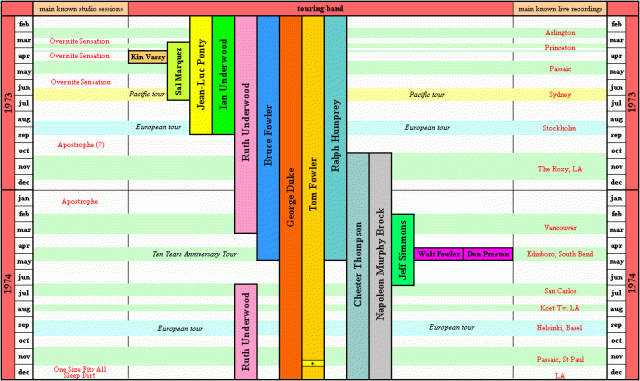
The Mothers of Invention – 1973-1974

Here is an interesting link which outlines the players in Zappa’s band during 1973 – 1974. Really useful when working out who is playing on bootlegs in particular.

The Mothers of Invention – 1973-1974.

Posted in Frank Zappa | Tagged | Leave a comment