Two Conferences in a Week: Time for Marking

Well, it is the time of year where everything is put on hold –  so I can wade through dozens of student essays and creative projects. However, last week, I took a break from marking madness and presented two at two conferences in a week – both related to my research project for the Higher Education Academy on the relationship of Higher Education and Live Music in Wales.

The first conference was at Kingston University, and entitled 21st Century Musician: Essential Skills for Making Music Today. It was hosted by Moke bass player Alex Evens – and featured a really interesting range of academic and music industry speakers. As you will see from the programme – my paper was followed by a talk by Sandy Swaw – a lovely lady – who provided an interesting insight into her career in the music industry.

After getting home for one night, I set off for Leeds for the two day Live Music Exchange conference. As you will see from the programme, this event was more directly related to live music, and for me the initiatve is really making a contribution to the ways in which the live music industry can work with academics such as myself. I will upload my  paper at a later date, but for the moment, the event confirmed that as a nation, Wales could learn much from what is taking place in Scotland – and this is something I intend to explore more after I have completed my live music research for the Higher Education Academy.

With this project I am currently documenting the critical report – so more info on this later.

Posted in Uncategorized | Tagged , , , , , , | Leave a comment

Frank Zappa and the And – Chapter 5: Zappa and Satire: From Conceptual Absurdism to the Perversity of Politics

Over the last week I have had the first official feedback from Ashgate on the Zappa book. It has been very positive – so with look the book is target for a 2012 release. Chapter 5 is by Nick Awde – and focuses on the relationship of Zappa and Comedy. So – five chapters down – Seven to go 🙂

Humour is a driving force throughout the oeuvre of Frank Zappa, a unifying element integral to his lyrical and instrumental music, films and corporate image. Indeed, while comedy is a genre that does not always travel beyond national or even the narrowest of social circles, Zappa’s humour proved no obstacle in helping his work transcend international boundaries,finding ready partners in the art, protest and civil rights movements that grew out of post-war society in North America and Europe. Humour, specifically satire, was the force that propelled Frank Zappa from conceptual comedian to social commentator to ‘perverse’ politician.

The vast majority of Zappa’s tracks stand up to scrutiny in this respect – even across a recorded repertoire of more than 60 official albums it is remarkably hard to identify ‘duds’ since context shifts with time and one must constantly revise appreciation of any given track.This chapter intends to provide an overview of Zappa’s humour and, identifying the principal satirical elements therein, to offer pointers towards placing him within the American comedy spectrum. It shall also note formative effects of his upbringing, the socio-historical context of comedy in post-war popular music, comic influences, and the changing effects of the times in which Zappa worked and his ability to adapt to them. Collectively, these will contribute towards a preliminary definition of his legacy.


Posted in Frank Zappa | Tagged , , , | 1 Comment

Chapter 3 of Frank Zappa and And: Zappa and Religion

When I put the call out for contributors to the Zappa book, one of the areas I wanted authors to explore was described as ‘Zappa and God’. Although most Zappa fans probably find this relationship problematic, I have always found Zappa’s Catholic upbringing and his opposition to Christian Fundamentalism interesting. Pandora’s Kevin Seal took up the challenge of exploring this fascinating area – and here is the beginning of his essay.

In the mythology Frank Zappa built throughout his work, he depicted religion as pure folly. Followers of religion appear as judgmental and gullible dupes, with religious leaders displayed as malevolent hypocrites. Yet throughout compositions such as ‘Watermelon in Easter Hay’ and ‘Sofa #2’, Zappa presents hints of the infinite. Is his take on a divine creator as cynical as his approach to zealots and patchouli-scented mystics? This essay intends to illuminate Zappa’s opinions of Catholicism, evangelical Christianity, and Eastern religions, and to demonstrate his view that music serves as a more valid means of spiritual communication than that which any organised religion can provide. After outlining Zappa’s position on religion, the essay will place particular emphasis on the texts of One Size Fits All, Joe’s Garage, You Are What You Is, and Broadway the Hard Way, and will examine the ways in which Conceptual Continuity and his Big Note theory resonate in the intersection of science and faith.

Posted in Uncategorized | Tagged , , , , , , , | Leave a comment

The Hologram of Tupac: Where does this leave the future of live music?

I have spent the the day thinking about the Snoop Dogg gig this week with the hologram of Tupac – who died in 1996. Where does this leave the future of live music? In a few years time, will we be going to see the Beatles at Yankee Stadium, or the Michael Jackson Dangerous tour? Will it be possible for holograms of bands to play 100 gigs in one night – a world tour in 2-3 hours? More important – how does the use of technology like this make you feel? Is it any different from going to see a tribute band or buying an album like Crash Landing by Hendrix – which features Hendrix ‘performing’ with musicians via studio technology? In short – is it morally correct? Watch this link asap – as You Tube seem to be  taking it down at breakneck speed.


Posted in Live Music, Music Industry | Tagged , , , , | 9 Comments

Chapter 2 of Frank Zappa and the And: Zappa and his Cultural Legacy: Authorship, Influences and Expressive Features in Frank Zappa’s Movies by Manuel de la Fuente

Chapter 2 of the forthcoming book on Zappa is written by my friend Manuel de la Fuente. Manual has already written a book on Zappa in Spanish – so it is great to get his thoughts on the great man in English for the first time. Please find below the first few hundred words of his chapter –

Throughout his career in music, Frank Zappa showed a constant interest towards audiovisual media as a tool for reflecting his expressive ideas. In his autobiography, Zappa writes how he managed to compose the score for his first movie (Run Home Slow) before releasing his first official LP Freak Out! in 1966. The order of these events proves that his relationship with movie-making is not a mere extension of his work as a music composer, but an independent entity. Zappa also discusses how the purchase of his first recording studio was not only for musical activities, but also for making cheap films. His interest in movie-making was so serious, that Zappa declared that if he had found a producer for his first projects in cinema, he would never have played rock music. In fact, Zappa produced eight full-length movies between the years 1971 to 1988, namely 200 Motels, Baby Snakes, The Dub Room Special!, Does Humor Belong in Music?, Video from Hell, Uncle Meat, The Amazing Mr. Bickford and The True Story of 200 Motels.

The chapter goes on to discuss Zappa’s relationship with movie making – an often under represented part of his legacy!


Posted in Frank Zappa | Tagged , , , , , , , , , , | Leave a comment

Plunderphonics: Mashups and Primary Meaning

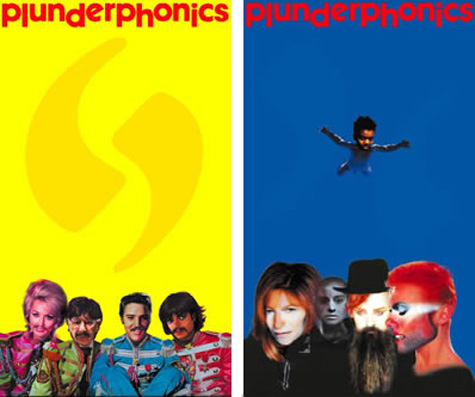
Due to DIY responsibilities at home, I have spent most of the day listening to some great music – something that has prompted this post. The main album I listened to today was the 60 track Plunderphonic compilation by John Oswald. After coining the term in the mid 1980s – what is interesting about the technique is the issue of using copyright material overtly – without getting sample clearance. Unlike some artists – who use sampling as a starting point for creativity – then ensure the original sample is disguised beyond recognition – Plunderphonics ensures that the samples are obvious – it is in effect a protest against the restrictions of copyright. Unlike later uses of sampling – from what I can gather – a Plunderphonic piece often just uses samples from one artist and in Oswald’s case – he uses a similar cut and paste philosophy on his albums covers –


Oswald seems to be a forerunner of Mashups – although I rarely see his name credited. When listening to the album – it seemed to be full of so much meaning for me – as I heard ghostly snippets of tracks I either recognised directly, or ‘sort of recognised’ from my childhood. In fact many of the tracks were full of Primary Meaning – rare in popular music.

Although I don’t understand how it got copyright clearance – the entire album can be heard on Spotify. I suggest you put a few hours to one side – and see what it means to you.

I recon that the Primary Signification is age related – with many of the tracks possibly become less obvious to listeners as the years go by. It may be that younger people may not get any direct Primary Meaning what so ever!

I have written about this sort of thing before – but it will be interesting to consider at some point how the copyright laws can be tweaked to ensure this sort of creativity can take place – it’s great music in my view. If it is passed on without being ‘sold’ – why can’t composers legally engage with this sort of process?

I suggest you listen to the album – check out the essay below – then see what you can recognise. After that – look at the album notes – which has details of what what the samples are.

Plunderphonics Essay from 1985 by John Oswald

Plunderphonic Album Notes


Posted in Musicology | Tagged , , , , , , , , | Leave a comment

Zappa and the And: Extract of Chapter 1

As promised, here is the first of what will be a series of short introductions of the forthcoming Zappa book. Chapter 1 is by my friend and colleague Prof. Richard Hand. Richard can actually be accredited for my recent obsession with Zappa. When having a casual conversation several years ago, we both realised, that although Richard has a background in Drama, and me in music, we had something in common – Zappa. This let to some initial research for Palatine into the Music Theatre of Zappa – An Experiment in Interdisciplinary Teaching. This also had an associated report – which examined some creative work we implemented with music and drama students. We had so much fun doing this, that we published two more papers, the first was an examination of Zappa and Musical Theatre, which was followed up with an essay on Zappa and the Musical Theatrical Gesture.

The following extract is from Richard’s chapter from the book – Chapter 1. He is an excellent writer and displays interesting insights into Zappa’s interface with Horror Movies.

Chapter 1

Zappa and Horror: Screamin’ at the Monster

Richard J. Hand

When looking at the link between horror and music in general what might spring to mind most immediately is the nineteenth-century Gothic tradition as epitomised by Modest Mussorgsky’s Night on Bald Mountain (1867) and Camille Saint-Saëns’ Danse macabre (1872) through to later works such as Béla Bartók’s opera Duke Bluebeard’s Castle (1918). Alternatively, we might think of horror movie soundtracks from Bernard Herrmann’s paradigmatic score for Alfred Hitchcock’s Psycho,John Carpenter’s own compositions for his early films or Goblin’s work for Dario Argento’s movies. When it comes to considering the links between horror and popular music we might think of Bobby ‘Boris’ Pickett’s novelty song ‘Monster Mash’, the high Gothic camp of Richard O’Brien’s The Rocky Horror Picture Show, the appropriated horror iconography prevalent in many examples of the heavy metal genre or the specific image customised by groups such as Kiss and individuals such as Marilyn Manson and Rob Zombie. One of the preeminent ‘horror music’ icons in popular culture is Alice Cooper, who developed a neo-gothic image not least through legendary stage performances which deployed macabre illusions as a complement to the rock songs. Alice Cooper was, in fact, ‘discovered’ by Frank Zappa, his first three albums being recorded on the Bizarre label. Discovering Alice Cooper notwithstanding, Zappa may seem a surprising figure to associate with horror, and yet it is a profound relationship. Throughout his career, Zappa reveals a recurrent interest in popular horror culture which is manifest in his achievements as a creative force of performance, composition and production.


Posted in Frank Zappa | Tagged , , , | 2 Comments

Frank Zappa and the And: Sent Off Today!!!

Well, after over year of hard work – Frank Zappa and the And: A  Contextual Analysis of his Legacy was sent off to the publisher today. There will still be work to do once it goes through the publishing process – but I am so relieved that it is finally packaged up and posted. The goal is that the book will be published by the end of this year, and there really are some fantastic chapters, discussing many areas of Zappa’s legacy that have not being touched upon before. Over the next few months I will occasionally post sort extracts of specific chapters to give interested parties a taster. So –  I thought a good place to start would be the Introduction.

‘Composer, guitarist, film maker, satirist and political activist, of all the prominent rock musicians to emerge during the mid 1960’s, Frank Zappa (1940–1993) is arguably the most complex and prolific. During his 27 years in the public eye (1966–1993), Zappa released over 60 official albums between the inaugural The Mothers of Invention recording Freak Out! and Civilization Phase III, a figure that does not include numerous bootleg recordings, or the ‘official’ posthumous releases made available by the Zappa Family Trust. This inexhaustible creativity is complemented by unusual eclecticism, with Zappa being one of the few rock musicians to interface with both high and low culture on a regular basis, a process in which he freely juxtapositioned otherwise disparate musical styles (such as doo-wop, reggae and musique concrète) within the same compositions and albums. Besides a tendency for implementing this artistic freedom via his much quoted maxim, ‘anything, anytime, for no reason at all’, Zappa also progressively cross-referenced his own, other composers’ music, and popular culture at large throughout his career, providing a range of what Roland Barthes described as obvious and obtuse meanings for his audience’…………………………………………..

The chapter then goes on to cross reference many references that relate to Zappa, including – Roland Barthe, Umberto Eco, Eduard Hanslick, Michel Imberty, Robert Walser, Paul Hindermith, Milton Babbitt, James Joyce, Thomas Pynhon, Ben Watson, Plato, Jamie James, Aristotle, Richard Norton, Julian Dodd, Søren Kierkegaard, Joseph Grigley, Richard Middleton, Michel Faucault, John Blacking, Douglas Hofstadter, Nick Cooke, Jean-Jacques Nattiez, and er………………… Frank Zappa.

More to follow next time.

Posted in Academic, Frank Zappa, Musicology | Tagged , , , , , , , , , , , , , , , , , , , , , , , , , , | Leave a comment

More Notes on Indoctrinating Music with Real Emotion: Adrian Benavides Part 2

A few weeks ago, I  posted about a very moving blog post by Adrian Benavides, when discussing his new album – Same Time Next Time. Not only was I taken by the honesty and open way Adrian discussed the death of his daughter, but also how these emotions were transferred into both the process and subsequent sounds of the album. I was particularly interested in how these emotions could be transferred to listeners. Having stated that ‘I would love to hear this album’, Adrian very kindly got in touch and sent me a copy. In the last couple of weeks, Adrian has uploaded another couple of posts – part 2 and part 3, where he talks candidly about the emotional process of recording the album. The posts also include streams on selected tracks, which makes it possible to make the connections I have discussed above. I have only just started listening to the album, and intend to post a more thorough review of the album later. But in the meantime, I can only recommend checking out his blog and listening to the music. It is one of the most honest albums I have heard in a long long time.

Posted in guitar, Loop Music, Musicology | Tagged , , , | Leave a comment

Online Content: Does it encourage students to miss lectures?

The musicology session I taught today was another step in the direction of using technology to assist with module delivery. Using Panopto, I have recorded one of my sessions for the first time. Although not edited in anyway – what students can see is essentially the lecture as it was delivered. However, does content such as this encourage students to miss lectures? This is something I would be interested in finding out about.

The session we discussed was the final partof a nine-part lecture series, and focused on amongst many other things about the difference between what William Echarddescribes as Cliches and Typical Features. I am not going to explain what they are at this point – watch the video if you are interst. I would be interested in examples of either of those in this blogTo view the fully featured one, click on this link or for the streaming MP4 version (mobile friendly) click here

Posted in Musicology, Uncategorized | Tagged , , | 17 Comments